Abstract
Practicum education is an ideal context for leadership development due to its pedagogical emphasis on supervision. Social work leadership has a critical role to play in today’s complex society, yet many would-be leaders struggle to see themselves as such because they are situated outside of dominant ideas of leadership. In an effort to increase diverse leadership, this paper introduces the Antiracist Leader Identity Construction (ARLIC) supervision model, which integrates antiracist supervision with leader identity construction theory. Through reflective, weekly supervision, the model fosters self-recognition, critical awareness, and antioppressive leadership practices that inspire future leadership experiences.
Keywords: leader identity construction, antiracist supervision, practicum education
This article explores the factors contributing to limited leadership development among Master of Social Work (MSW) students, and positions practicum education as a critical setting in which to cultivate leadership through applied, relational learning. The Antiracist Leader Identity Construction (ARLIC) supervision model is presented as an innovative framework to support students with intersectional identities in envisioning themselves as leaders and developing leadership skills within an antioppressive supervisory relationship. The article explores the theoretical underpinnings of the model, and a case example illustrates the model in practice. Finally, the article will conclude by exploring the model’s implications and limitations, particularly in light of the current sociopolitical climate in the United States.
Introduction and Literature Review
Social work leadership has a critical role to play in our complex society, and enhancing leadership development for social work students, particularly those from historically marginalized backgrounds, is an important way to prepare more social workers for the leadership roles they may assume in the future. Social work researchers have noted a leadership crisis in the field, citing lack of educational opportunities to train social work students coupled with student career preferences trending toward direct service over leadership development (Dunn & Orwenyo, 2025; Salsberg et al., 2019; Sullivan, 2016; Vito & Hanbidge, 2021). Complicating this further is that many would-be leaders may not see themselves reflected in common images of leadership (Conyers & Wright Fields, 2021; Longman et al., 2021; Rocco & Priest, 2023; Thrasher et al., 2025), which are often white, male, and hierarchical, or they may define leadership through more relational, community-oriented approaches that diverge from these norms (Chunoo & Torres, 2023; Fusilier & Beatty, 2023; McCarron et al., 2023). However, as sociaty becomes increasingly diverse, the social work profession must cultivate leaders who mirror these demographics, foster trust within communities, and contribute diverse perspectives to organizational decision-making.
Social work education can leverage current structures in practicum education, such as weekly individual supervision, to support leadership development, particularly in MSW programs where leadership and macro specialization are not offered (Council on Social Work Education [CSWE], 2021). Leader Identity Construction Theory (DeRue & Ashford, 2010) posits that leaders can emerge in any context and that leader and follower identities develop through social interaction. The Antiracist Leader Identity Construction (ARLIC) supervision model integrates antiracist supervision practices that center relationships, power analysis, reflection, and praxis. The model equips practicum instructors to support MSW students in exploring leader identities and developing skills for future antiracist leadership. It provides supervisors with a framework to conduct inclusive supervision that acknowledges intersectional identities and power differentials, while guiding students to enact antiracist practices in their future professional endeavors.
Lack of Emphasis on Leadership in MSW Curricula
The profession has been calling for more social work leaders for over 25 years (Dunn & Orwenyo, 2025; Rank & Hutchison, 2000; Vito & Hanbidge, 2021). While post-MSW training programs and partnerships between academia and community organizations exist (Dunn & Orwenyo, 2025), researchers have called for more emphasis on leader training and practice opportunities in social work programs (Mahesh & Miller, 2025; Peters, 2018; Vito & Hanbidge, 2021). While some schools of social work are creating coursework to address supervision and leadership, this is not feasible for all schools.
MSW curricula are structured around the Council on Social Work Education’s (CSWE) nine social work competencies and Educational Policy and Accreditation Standards (CSWE, 2022), with each school determining courses, practicum policies, and graduation requirements. Schools without a macro or administration focus often have limited space for specific leadership content. A 2020 CSWE survey (CSWE, 2021) found that only 29 of 223 programs (13%) offered specializations in organizations or community development that typically included administrative training (Hoefer, 2003). As a result, the literature suggests that students may not be systematically prepared for leadership roles, contributing to underrepresentation in organizational and academic leadership (Banks et al., 2018; Dunn & Orwenyo, 2025). In addition, with students’ preferences for direct service specializations (Salsberg et al., 2019; CSWE, 2023), students may not recognize leadership elements in their existing social work training. Practicum instructors, often educated in similar programs, may lack frameworks for integrating leadership identity into clinical supervision.
Social work students learn fundamental engagement, assessment, and intervention skills in their MSW curriculum (CSWE, 2022), though these are not always recognized as leadership competencies (Watson & Hoefer, 2014). In practice, leaders grounded in inclusive engagement, systemic evaluation, and antioppressive practice embody the NASW’s core values (National Association of Social Workers [NASW], 2021; Peters, 2018) and align with leadership frameworks common in human service organizations such as adaptive, servant, and transformational leadership (Fox & Kang, 2019; Hinton et al., 2020; Winston & Fields, 2015). Training practicum instructors in a framework that builds on this existing knowledge and fosters leader identity prepares more students for leadership and creates a pipeline within the profession.
Power, Identity, and Equity in Leadership Development
Preparing social work leaders means that leadership development must be viewed through a critical lens to challenge the systemic and internalized forms of oppression that continue to limit the leadership potential of diverse social workers. Research shows that racially diverse social workers are underrepresented in traditional leadership roles (Longman et al., 2021; Rocco & Priest, 2023). Although Black, Indigenous, and People of Color (BIPOC) representation in MSW programs grew from 14–30% in the early 2000s to 40% by 2017 (NASW Center for Workforce Studies, 2006; Salsberg et al., 2017; Shilling et al., 2008), this has not translated into proportional leadership representation. Social workers of color remain underrepresented in both general leadership positions (Mullin et al., 2021, as cited in Pizzo & Graham, 2025) and academic leadership roles (Banks et al., 2018).
Barriers include structural inequities, unconscious bias, stereotype threat, color-blind attitudes, and internalized oppression, which reinforce dominant notions of leadership (Chunoo & Torres, 2023; McCarron et al., 2023). Diverse leaders bring valuable perspectives, experiences, and representation that enhance service effectiveness (Chunoo & Torres, 2023). To be successful, leadership development must help learners understand power, privilege, and oppression, and locate themselves within these dynamics. Critical reflection, which aligns with antiracist pedagogy and leader identity construction (Chunoo & Torres, 2023; Kishimoto, 2018), is a tool to help learners analyze lived experience within a social and political context. Using critical reflection, students are able to open themselves to new ways of thinking and being, and gain awareness into assumptions and beliefs related to the social, political, and historical aspects of leadership learning (Burns et al., 2024).
Practicum Education and Leadership Development
Practicum placements offer rich learning experiences that foster tremendous growth in students’ skill development, confidence, and readiness for the field (Holcomb et al., 2025; Mehrotra & Gooding, 2023). Practicum education, a universal component of social work education, provides an opportunity to cultivate leadership skills without expanding course content (Dunn & Orwenyo, 2025; Mahesh & Miller, 2025). Augmenting student development with attention to leadership identity expands the prospects of what many students envision for their future careers. With CSWE and NASW emphasizing antiracist practice (CSWE, 2022; NASW, 2021), many schools are adopting pedagogy that challenges oppressive systems and equips students for ethical, competent practice in diverse contexts (Constance-Huggins, 2012). Engaging in a supervisory relationship that both supports and models antiracist practice deepens students’ learning and aligns with the profession’s goals.
While research on antiracist pedagogy in social work practicum education is limited, scholarship in antiracist supervision is growing (Legha, 2023; Vohra-Gupta et al., 2024; Wells & Isom, 2023; Williams et al., 2023). This is an approach that reinforces antioppressive learning in a developmental and supportive relational environment.
A New Approach
Current literature insufficiently addresses the intersection of practicum education, leadership development, and training for historically marginalized students. This gap presents an opportunity for a novel approach that integrates antiracist supervision with leader identity construction. The ARLIC supervision model, introduced here, leverages existing practicum structures to expand leadership preparation in all schools of social work. It works to reinforce core social work theories and practices while also addressing the structural and internal needs of students from intersectional, marginalized identities.
Theoretical Framework
Antiracist supervision, which is grounded in antiracist pedagogy, constitutes the process of the ARLIC supervision model, while Leader Identity Construction Theory (DeRue & Ashford, 2010) drives the content. Together, these theories offer supervisors a method to support the leader identity development of their practicum students while accounting for a supervisory relationship that centers intersectionality, power analysis, critical reflection, and praxis. This section will outline the theoretical underpinnings of the model.
Antiracist Supervision
Antiracist supervision establishes a collaborative relationship that recognizes systemic racism, fosters inclusion, and empowers students to address inequities within their practice contexts (Pizzo & Graham, 2025). Rooted in antiracist pedagogy, it draws on Paulo Freire’s (2000) principles of critical reflection, consciousness raising, and active dialogue. The call to decenter whiteness in the learning process is a central tenet of antiracist pedagogy, as this acknowledges the enduring nature of racism, white supremacy, and white privilege in society and social work education (Dempsey, 2022; Sulé, 2020; Todic & Christensen, 2022; Yearwood et al., 2021).
The concept of praxis and counternarratives are central to both antiracism and leadership learning (Berrett-Abebe et al., 2023; Dempsey, 2022; Kendi, 2019). Praxis, the process of combining reflection with action, enables students to link self-awareness with systemic change. Counternarratives, another concept often described in critical pedagogical and leadership literature, is defined as storytelling that elevates the lived experiences of marginalized individuals and communities (Berret-Abebe et al., 2023; Sulé, 2020). Pendakur and Furr (2016) discussed the use of counternarratives to support the leadership development of students of color by helping them center issues of power, race, and identity and recast their experiences with racism and oppression into stories that support their leadership capabilities. Berret-Abebe et al. (2023) also advocated for the use of counternarratives in social work education, noting that it offers an opportunity for students and faculty to reflect on dominant discourse and recognize multiple realities in our complex society.
Building an antiracist supervisory environment means the supervisor takes responsibility for broaching issues of race and identity (Wells & Isom, 2023). This practice builds a foundation of safety, recognition, and disruption of perpetuated harm. Researchers note how important it is for supervisors to be able to sit with their own discomfort around race to facilitate discussion while attending to the cognitive and affective needs of students (Campbell et al., 2024; Dempsey, 2022; Keyes et al., 2023; Wells & Isom, 2023).Effective supervisors also engage in continuous critical reflection of their identities and social location (Campbell et al., 2024; Elliott et al., 2021). Managing positional and personal power is necessary to minimize the negative expression of power related to one’s dominant identities as a supervisor (Elliott et al., 2021).
Using a critical events framework (Ladany et al., 2005, as cited in Wells & Isom, 2023) to address racial dynamics as they occur can assist with experiential learning. Addressing teachable moments as they arise with attention to feelings, supervisory alliance, and normalization of the experience demonstrates the supervisor’s relational focus and creates space for reflection and action. Wells and Isom (2023) argued that the more developed a supervisor is in their racial consciousness, the better able they will be in facilitating antiracist learning.
Finally, engaging in antiracist supervision goes beyond one-on-one interactions and also calls for institution-level practices (Bussey & Jemal, 2023; Kishimoto, 2018). The use of critical action project experiments (Jemal & Frasier, 2021) is a practice that offers opportunities to engage in incremental, antiracist action in a supportive environment. This could include advocating for more inclusive language on an intake form to starting an advocacy group with staff at the agency. These experiments also serve as opportunities for leadership in which students take initiative and claim responsibility.
Another tool, developed by Ford et al. (2022), aims to address antiracism in agencies. Entitled “Centering Blackness/Anti-Racist Agency Learning Plan,” this tool provides guidance and structure for collaboration between students and supervisors to identify and enact antiracist actions on the micro, mezzo, and macro levels in an organization. The tool offers the supervisory dyad a way to hold both parties accountable by documenting commitments, learning goals, and evaluation ratings.
Leader Identity Construction
Leader identity development is distinct from leadership development in that it focuses on the internalization of oneself as a leader versus the hard and soft skills acquired for leadership practice (Longman et al., 2021). The process of coming to understand oneself as a leader and solidifying that identity over time is a novel connection to social work leadership development, and has the potential to address disparities in leadership among those with marginalized identities (Longman et al., 2021).
Theory
DeRue and Ashford’s (2010) seminal article on Leader Identity Construction Theory works to explain why some individuals who hold formal positions of leadership are not seen as leaders, while others who do not have positional power are seen as such. Their theory posits that leaders can emerge at any level of an organization and that identities are internalized at the individual level, recognized at the interpersonal level, and endorsed at the collective level (DeRue & Ashford, 2010, p. 629). Leader identity construction posits that individuals take on identities of leader or follower through social interactions. These identities are co-constructed through a process of claims and grants where each identity is validated and reinforced by the other. Specifically, an identity claim is any action used to assert an identity, and a grant is an action that gives an identity to another. Both can be exchanged directly, indirectly, verbally, or nonverbally (Lanka et al, 2020; Thrasher et al., 2025).
As potential leaders make claims for leadership and followers either grant or reject leadership status, the leader identity process begins (DeRue & Ashford, 2010; Lanka et al., 2020; Longman et al., 2021; Thrasher et al., 2025). In practice, this process could begin by a student making a leadership claim by voicing an opinion, volunteering for a leadership role, or taking initiative on a project (Thrasher et al., 2025). A leadership grant is given when the student gets feedback or recognition from another, perhaps a supervisor or peer, which confirms the leader’s identity. This can also include being encouraged to take on leadership roles by someone else, such as a supervisor (Longman et al., 2021; Thrasher et al., 2025). When a follower grants leadership status, they are concurrently taking on follower status, thereby making relational recognition central to the theory (DeRue & Ashford, 2010). After an individual internalizes their status and another recognizes it, the process culminates when the leader identity is also collectively endorsed by the organization or social context (Humphreys et al., 2015). These three stages together constitute the leader identity construction process (DeRue & Ashford, 2010).
Enabling and Constraining Factors
Supervision, mentorship, and feedback are all elements that help develop leader identity (Lanka et al., 2020). Within the context of social work practicum education, this presents as a supervisor exploring a variety of opportunities for trainees to seek leadership claims and grants. For example, a student can shadow agency leaders, during which student skills and abilities are highlighted, encouraged, and discussed publicly with others (Longman et al., 2021). Creating identity-specific safe spaces to share ideas and reinforce the value of diverse perspectives in decision-making (Longman et al., 2021) also encourages leadership claims. Facilitating risk-taking by supporting a student in making themself visible and asserting themself in small and large ways (Longman et al., 2021) with the backing of a supervisor can all work to increase confidence and enhance one’s self-concept as a leader. Furthermore, collective endorsement from the larger organization might occur as upper management, or the community as a whole, recognizing an individual as being leader-like, even if their position or self-perception does not align (DeRue & Ashford, 2010; Humphreys et al., 2015).
It is important to recognize that barriers to effective leader identity construction also exist. These include organizational control, meaning strong hierarchy within an organization such that a trainee is given very little visibility or opportunity for leadership claims; identity rejection (denying leadership bids)from followers or those in positions of authority, which can hinder one’s motivation to seek further bids; and identity uncertainty, meaning an individual feels conflicted or uncertain about their identity as a leader, perhaps due to lack of desire to stand out (Lanka et al., 2020).
These constraining factors can reinforce internalized doubt, which may lead to reduced self-efficacy and disengagement from leadership aspirations. Supervisors can help by attending to the presence of implicit bias and overt structures like racism, homophobia, or ableism that prevent visibility or increase rejection of certain students in favor of others.
Leadership identity models are effective when they motivate students who would not otherwise consider themselves leaders or recognize their existing beliefs as aligned with necessary leadership skills and behaviors (Chunoo & Torres, 2023). Finding examples of leaders whose social identities and personal histories align with those of the learners, particularly those from groups historically omitted from traditional leadership, is a strategy to support new leaders (Ford et al., 2022). This practice supports the challenging of notions of who belongs as a leader and who does not, and it is the linchpin to increasing social work representation in leadership and self-identification of leaders in social work education.
Integrating antiracist supervision and leader identity construction offers a method to deepen the supervisory relationship and enhance social work skills. The exploration and execution of leadership claims and grants have the potential to increase confidence during the practicum placement and facilitate future leadership growth.
ARLIC Supervision Model
According to Archer-Kuhn et al. (2021), practicum educators play a significant role in the transformational educational experience of practicum students. These authors cited the critical nature of the relationship between supervisor and supervisee in facilitating transformational learning experiences, as well as the importance of self-reflection in moving through challenging dilemmas and analyzing the transformative outcomes. These supervisor qualities and behaviors also facilitate the Antiracist Leader Identity Construction (ARLIC) supervision model (see Figure 1), where supervisors are first asked to prepare themselves through self-assessment to build and facilitate learning, then begin to create the supervisory relationship, centering it throughout the process. The model is iterative in that self-reflection and process evaluation lead to deeper engagement with the three other steps of the process. These steps are (a) engage organizational opportunities, (b) scaffolding and support, and (c) collective endorsement.
Figure 1
ARLIC Supervision Model
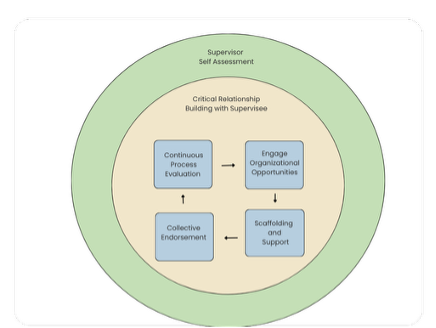
The supervisor is centered as the object of the model, as they are to take the lead in broaching topics central to antiracist supervision, even though minimizing hierarchy is also a goal. Table 1 outlines each stage of the model, highlighting its key tasks and theoretical connections.
Table 1
Theoretical Foundations of the ARLIC Supervision Model
| Steps in model | Antiracist supervision/ process | Leader identity construction/content |
| Supervisor self-assessment | Assess racial identity development (Wells & Isom, 2023) Reflexive consideration of one’s positionality (Wells & Isom, 2023) Consider how conflict will be managed, how trust is built, and use of communication styles (Elliott et al., 2021) | Consider the organizational and individual barriers the student might face, such as visibility, diffuse roles, blind spots and bias in organization, personality, interest (Bussey & Jemal, 2023; Lanka et al., 2020) |
| Engage in critical relationship-building | Note importance of broaching race, power, and structural oppression in social work practice (Asakura & Maurer, 2018; Wells & Isom, 2023) Focus on building trust, use of self-reflection, building rapport, and practicing with courage (Elliott et al., 2021; McGuire & Lay, 2020) Preview the use of critical events to enhance learning, explore experiences and perceptions of power and oppression in life and educational domains (Wells & Isom, 2023) | Explore meaning of leadership for the student, explore past experiences and perceptions, interest, and importance of leadership (Chunoo & Torres, 2023; Pendakur & Furr, 2016) Begin defining bids and grants (DeRue & Ashford, 2010) Co-construct leadership bid opportunities (Lanka et al., 2020) Share confidence in the student’s ability to learn and practice leadership. Begin making connections between MSW curriculum and practicum placement (McGuire & Lay, 2020) |
| Engage organizational strengths and seek opportunities | Discuss and evaluate opportunities for antiracist action on the direct service and organizational levels. Connect these to leadership behaviors (Bussey & Jemal, 2023; Ford et al., 2022) Identify and enact Critical Action Project Experiments (Jemal & Frasier, 2021) Engage supervisor sanctuaries to carve out small and large antiracist practices in organizations (Bussey & Jemal, 2023) | Assess areas where students can make bids for leadership, and ways supervisor or others can support this (Bussey & Jemal, 2023; DeRue & Ashford, 2010; Lanka et al., 2020; Thrasher et al., 2025) Ameliorate identified barriers the student might face: lack of visibility, limited activities for trainees, blind spots and bias related to social identities, personality, interest (Lanka et al., 2020) Use learning plan and goal-setting to identify targets (Ford et al., 2022). |
| Scaffolding and support | Build in developmentally complex activities that support antiracist practice and leadership (Ford et al., 2022) Continue reflective practices, consciousness raising, and hope-building (Elliott et al., 2021; McGuire & Lay, 2020) Uplift and center nonmajority leadership voices, which builds trust and deepens antiracist learning (Ford et al., 2022) | Consider adding affinity groups support, mentorship opportunities, additional training or reading. Use shadowing opportunities, discussion of critical events as educational tools (Lanka et al., 2020; Wells & Isom, 2023) Reinforce relational recognition of leadership bids and grants from followers (DeRue & Ashford, 2010). |
| Collective endorsement | Include counternarratives in culminating project to demonstrate inclusion, equity, and decentered dominant voices or practices (Pendakur & Furr, 2016) | Find avenues for others in the organization to acknowledge student leadership (Spence, 2019; Thrasher et al., 2025) Create a culminating project or activity to demonstrate leadership in the larger organization (Dunn & Orwenyo, 2025; McGuire & Lay, 2020) |
| Continuous evaluation | Discuss the placement experiences in terms of power, identity, practice, relationship, and learning (Chunoo & Torres, 2023; Ford et al., 2022) Critically reflect on strengths and areas of continued growth (McGuire & Lay, 2020) | How will the student’s leadership journey continue? Use feedback and reflection to assess praxis and continued growth (Lanka et al., 2020; McGuire & Lay, 2020). |
Practice Example
This section illustrates application of the six stages in the ARLIC supervision model. It describes a fictitious, idealized case example involving an advanced MSW student and their practicum supervisor.
Supervisor Self-Assessment
As the semester starts, a seasoned social work supervisor who identifies as a middle-aged, white, cisgender woman prepares for the upcoming year with a new advanced-year student. The supervisor will be working with a 22-year-old genderqueer MSW student of color who uses they/them pronouns and wants to be a mental health therapist. During the placement interview, the student expressed uncertainty about leadership but a strong interest in culturally responsive practice. As the supervisor prepares for the year, she engages in self-assessment by reflecting on what it means to be a white therapist working with the known identities of her trainee. As the supervisor assesses her identity consciousness, she situates herself somewhere between still learning but also being committed to antiracist action in her social work practice.
Through reflection on leader identity construction, the supervisor reexamines her understanding of leadership, expanding it beyond client-centered guidance to include her organizational contributions such as facilitating consultation and training meetings. The leader identity recognition, granted by colleagues, serves to confirm her identity as a leader. While she is uncertain about potential barriers that might emerge for her trainee, she notes her intention to use inquiry as a central supervision tool, to decenter herself and facilitate her supervisee’s critical thinking, confidence building, and sense of mastery.
Through the self-assessment stage, the supervisor carefully considers her positionality, analyzes interpersonal and organizational power dynamics, and considers how she might handle barriers and conflict. Her attention to her views on leadership lead to new insights about her own power and leadership in relation to others in the organization.
Critical Relationship-Building
During their first supervision meeting, the supervisor introduces herself and shares her social identities and positionality, inviting the student to share theirs at their own pace. The supervisor talks about the importance of exploring and challenging systems of power in therapy, in the organization, and in the supervisory relationship. The supervisor also normalizes mistakes and assures the student that they are helpful learning tools. The supervisor elaborates by explaining that she tends to use a critical events framework (Ancis & Ladany, 2011), so that when situations arise, they are explored together to provide opportunity for emotional expression, self-reflection, and support. This conversation is impactful for the student because it decreases pressure to please the supervisor and conform to unspoken norms dictated by whiteness, like perfectionism (Okun & Jones, 2000). The conversation also aligns with their previous knowledge about antiracism, power, and inclusion.
The first meeting also includes discussion about their shared and divergent views of leadership. The supervisor mentions that leadership is possible from any position in an organization, and they talk about Leader Identity Construction Theory. The supervisor states that she sees leadership potential in the student and hopes to support them in trying on some leadership experiences this year if the student is willing. While trust is beginning to develop, the student vows to proceed with caution waiting for more evidence in how the supervisor will handle racism and homophobia moving forward. The student is relieved that the supervisor broached race and positionality because they often feel burdened by having to do so in some of their classes.
The formation of the supervisory relationship is a critical element of antiracist supervision. Trust and rapport are built over time, and the supervisor’s ability to explain practices and seek approval for planned activities throughout the year, rather than dictating what is to occur, fosters a partnership stance in the process that decenters hierarchy. By addressing identity and power early in the relationship, the supervisor establishes trust, models antiracist supervision, and creates a foundation for collaborative learning (Wells & Isom, 2023).
Engage Organizational Opportunities
As trust develops, the supervisor and student identify leadership opportunities in which the student can make leadership bids within the organization. The student facilitates a group supervision session, introducing a culturally responsive case presentation tool. Positive feedback from peers reinforces their emerging leader identity and encourages them to present a case to the staff psychiatrist.
The supervisor is also careful to attend to barriers the student might face, and to process these with the student as they arise. When the student is misgendered by a staff member, the supervisor provides emotional support, addresses the incident at the organizational level, and integrates the student’s feedback into future training. Together, the two utilize the Centering Blackness/Antiracist Agency Learning Plan and Evaluation Tool (Ford et al., 2022) to set goals for accountability and equity. These collaborative actions reinforce leadership as an expression of antiracist, relational practice (DeRue & Ashford, 2010).
The supervisor leverages organizational infrastructure with regard to group supervision and in-house psychiatry services to support the student’s claims for leadership. Exposing the student to interdisciplinary practice by presenting to the psychiatrist and other mental health trainees elevates the student’s confidence in social work skills and knowledges and elevates their personal sense of mastery. They receive relational recognition from peers and staff for their leadership work (DeRue & Ashford, 2010). Furthermore, the supervisory relationship is developed further by processing the student’s experience of being misgendered, an emotional and professional barrier.
Scaffolding and Support
Looking for additional learning enrichment, the supervisor connects the student to a mentor of color outside of the agency. This additional support, which acknowledges aspects of the student’s intersectional identities, includes discussing leaders from identities similar to those of the supervisee and validates the presence and skill of queer Black leadership (Chunoo & Torres, 2023; Ford et al., 2022). This outside connection also provides an additional opportunity for relational recognition of the student’s leadership. The supervisor’s facilitation of this connection models shared responsibility for growth and the value of multiple knowledge sources in supervision.
Collective Endorsement
Toward the end of the academic year, the student completes their culminating project for the placement and presents it at an all-staff meeting. The student collaborated with another staff member on gathering input from queer clients of color on their experiences in the agency, taking the lead in facilitating the process. This final presentation is an opportunity for the larger organization to see the student’s work, recognize its value, and grant collective endorsement, the final stage in leader identity construction process. A final project also creates opportunity for self-reflection, consciousness raising, and self-evaluation as the student considers their growth throughout the year. The final placement evaluation will be delivered to the school of social work and provides additional opportunity to formally recognize the student’s work and share their leadership growth. This recognition provides both formal and informal validation, and is an important step in motivating the student for future leadership (DeRue & Ashford, 2010).
Continuous Evaluation
Self-evaluation continues throughout the supervision process. The supervisor regularly reflects on her positionality, power, and growth areas, often sharing these reflections with the student to model transparency and humility. Through mutual feedback and critical dialogue, both deepen their understanding of antiracist supervision and leadership.
The supervisor’s routine evaluation following supervision sessions and critical incidents strengthens reflective practice and informs future supervisory relationships. The iterative nature of self-assessment within the ARLIC model promotes continual learning and accountability for equity and inclusion in supervisory practice. In addition, as the supervisor and student reflect on CSWE competencies identified in the learning plan/evaluation tool required by the university, they engage in meaning-making around the document’s institutional language. These lofty ideas are translated into meaningful leadership behaviors for execution in future practice.
Conclusion
The ARLIC supervision model offers an innovative strategy to address the underemphasis of social work leadership development, particularly among those with intersectional and marginalized identities. At this moment in history, when social justice and racial equity are being challenged on multiple fronts in the United States, this model offers a different path. By centering power, privilege, and identity, it encourages continued preparation for inclusive, equitable leadership.
Implications
The model’s emphasis on critical reflection and antioppressive practices aligns closely with the pedagogical aims of social work education and supports the leadership development of diverse students. Embedding antiracist supervision into professional practice allows for the integration of intersectional identity, racial consciousness-raising, and praxis (Kishimoto, 2018; Wells & Isom, 2023) which develops knowledge and skills that aid strong leaders working in diverse settings (McLaughlin, 2020). These inclusive practices elevate nondominant perspectives and invite engagement through reflection, dialogue, and practical application (Dempsey, 2022; Kishimoto, 2018). Thus, students learn skills that enhance ethical decision-making, strengthen organizational culture, and align with the NASW core values of social justice and dignity and worth of the person (NASW, 2021).
Integrating Leader Identity Construction Theory into social work supervision practices enables students to internalize a leader identity, seek validation from peers and colleagues, and gain collective endorsement from the broader agency (DeRue & Ashford, 2010). These practices reframe leadership as a relational, inclusive, and developmental process accessible to all social workers. The process fosters greater confidence and openness to future leadership experiences (Longman et al., 2021).
Finally, by situating the model in practicum education, it has the potential to reach students from all identities, thereby building an equity-oriented leadership pipeline within the profession. As supervisors and educators adopt the model, they not only mentor emerging leaders but also embody antiracist leadership in their own practice. Modeling this kind of transformative leadership shapes the future of the profession and reflects the type of social work leadership needed in a complex, diverse society.
Limitations
This model reflects a theoretical framework designed to shape practice. Therefore, there will be variation in skill and critical consciousness in supervisors’ application and execution of the model. The case example represents an idealized application, and it is helpful to think of the supervision process, like other social work practice skills, as cultivated over time with training, experience, and consultation.
This article also assumes that schools of social work prioritize leadership development to the extent suggested in the literature. It does not acknowledge competing challenges in practicum education such as payment for placements or operating effectively with scarce resources (Eaton, 2025), each of which may influence institutional priorities. Furthermore, when viewed within the context of the current political climate, where diversity, equity, and inclusion efforts face federal scrutiny, investing in a model that explicitly challenges power structures and enhances antioppressive practice may be viewed as risky for organizations reliant on government funding.
Finally, there is no associated research to address the efficacy of the model. Having empirical support would increase the model’s validity, demonstrating how and where the model is most effective. This type of information could be gathered in qualitative or quantitative research looking at the experiences of those participating in the ARLIC supervision model, and in comparing larger scale data from those with and without the intervention. Despite these challenges, the model’s focus on conceptualizing social work practice skills as leadership skills expands the value and application of MSW education. Refining this learning through practicum education provides space to hone the ethics, values, and leadership mindset needed to navigate societal complexity and promote justice and well-being in organizations. At a time in history when there is greater diversity among United States citizens and arguably greater awareness about equity and social justice among the general public, the ARLIC supervision model is timely. It offers a framework that cultivates diverse leaders and, while acknowledging the complexity of learning, prepares social work students for inclusive leadership and enables them to see themselves as leaders along the way.
References
Ancis, J. R., & Ladany, N. (2011). A multicultural framework for counselor supervision. In L. J. Bradley & N. Ladany (Eds.), Counselor supervision: Principles, process, and practice (3rd ed., pp. 62–90). Routledge.
Archer-Kuhn, B., Samson, P., Damianakis, T., Barrett, B., Matin, S., & Ahern, C. (2021). Transformative learning in field education: Students bridging the theory/practice gap. British Journal of Social Work, 51(7), 2419–2438. https://doi.org/10.1093/bjsw/bcaa082
Asakura, K., & Maurer, K. (2018). Attending to social justice in clinical social work: Supervision as a pedagogical space. Clinical Social Work Journal, 46(4), 289–297. https://doi.org/10.1007/s10615-018-0667-4
Banks, L., Hopps, J. G., & Briggs, H. E. (2018). Cracks in the ceiling? Historical and contemporary trends of African American deans of schools of social work. Research on Social Work Practice, 28(3), 288–299. https://doi.org/10.1177/1049731517706552
Berrett-Abebe, J., Reed, S. C., & Storms, S. B. (2023). Counternarratives: An antiracist approach in social work education, practice, and research. Social Work, 68(2), 122–130. https://doi.org/10.1093/sw/swad009
Burns, J., Volpe‐White, J., & Watkins, S. R. (2024). Foundations of reflection in leadership training. New Directions for Student Leadership, 2024(184), 115–125. https://doi.org/10.1002/yd.20645
Bussey, S. R., & Jemal, A. D. (2023). Organizational and relational context for transformative potential within anti-racist mental health supervision. The Clinical Supervisor, 42(2), 280–291. https://doi.org/10.1080/07325223.2023.2249471
Campbell, R. D., Fussell-Ware, D. J., & Winchester, M. R. (2024). From intellectual exercise to facilitated dialogue: How one class confronted race and racism in the social work classroom. Reflections: Narratives of Professional Helping, 30(1), 65–80. https://tinyurl.com/ybkdstme
Chunoo, V. S., & Torres, M. (2023). Critical perspectives on leadership identity development. New Directions for Student Leadership, 2023(178), 55–64. https://doi.org/10.1002/yd.20554
Constance-Huggins, M. (2012). Critical race theory in social work education: A framework for addressing racial disparities. Critical Social Work, 13(2), Article 2. https://doi.org/10.22329/csw.v13i2.5861
Conyers, A., & Wright Fields, C. (2021). A critical race theory analysis of institutional racial paralysis in organizational culture. Public Integrity, 23(5), 484–495. https://doi.org/10.1080/10999922.2020.1832365
Council on Social Work Education. (2021). 2020 statistics on social work education in the United States: Summary of the CSWE annual survey of social work programs. https://tinyurl.com/2dey76zu
Council on Social Work Education. (2022). Educational policy and accreditation standards for baccalaureate and master’s social work programs. https://tinyurl.com/y3abvn6r
Council on Social Work Education. (2023). 2022-2023 statistics on social work education in the United States. https://tinyurl.com/2dey76zu
Dempsey, A. (2022). Decentering whiteness in the social work classroom. Journal of Teaching in Social Work, 42(2-3), 175–189. https://doi.org/10.1080/08841233.2022.2048944
DeRue, D. S., & Ashford, S. J. (2010). Who will lead and who will follow? A social process of leadership identity construction in organizations. Academy of Management Review, 35(4), 627–647. https://doi.org/10.5465/amr.35.4.zok627
Dunn, S., & Orwenyo, E. K. (2025). Educated to lead: A proposed model to conceptualize and address the leadership crisis in social work. Journal of Social Work Education, 61(3), 1–9. https://doi.org/10.1080/10437797.2024.2431568
Eaton, A. D. (2025). Current issues with social work field education and ideas for change. Social Work Education, 45(1), 1–10. https://doi.org/10.1080/02615479.2025.2484360
Elliott, C., Desai, S., & Brown, R. (2021). Identity‐conscious supervision: A model for equity. New Directions for Student Services, 2021(175), 53–62. https://doi.org/10.1002/ss.20396
Ford, A., Robbins, A., Yang, S., Bloczynski, R., & Hoffmeister, M. (2022). Tools for centering Blackness in social work field education: An anti-racist agency learning plan and evaluation. Journal of Teaching in Social Work, 42(2-3), 207–226. https://doi.org/10.1080/08841233.2022.2054907
Fox, D. J., & Kang, L. (2019). Social work leadership: Reflections on a student-led conference. Social Work Education, 38(4), 516–529. https://doi.org/10.1080/02615479.2018.1554641
Freire, P. (2000). Pedagogy of the oppressed. Continuum. (Original work published 1970). https://tinyurl.com/23rrb89j
Fuselier, N., & Beatty, C. C. (2023). Social identities and leadership identity development. New Directions for Student Leadership, 2023(178), 45–54. https://doi.org/10.1002/yd.20553
Hinton, L., Gaisie, N. E., Schnake, K. L., & Zoubak, E. (2020). Cultivating adaptive leaders to drive system and policy change. ZERO TO THREE, 40(5), 12–19.
Hoefer, R. (2003). Administrative skills and degrees: The “best place” debate rages on. Administration in Social Work, 27(1), 25–46. https://doi.org/10.1300/J147v27n01_03
Holcomb, D., Johnson, E., Roubal, J. V., & Thompson, C. (2025). Transformative supervision: A conceptual framework for relationally-based, trauma-informed supervision in post-pandemic practicum education. Applied Learning in Social Work Education, 15(1), 1–28. https://tinyurl.com/ywduy45a
Humphreys, J. H., Novicevic, M. M, Smothers, J., Haden, S. S. P., Hayek, M., Williams, W. A., Oyler, J. D., & Clayton, R. W. (2015) The collective endorsement of James Meredith: Initiating a leader identity construction process. Human Relations, 68(9), 1389–1413. https://doi.org/10.1177/0018726714556292
Jemal, A., & Frasier, J. (2021). The intrepid elective: Transforming potential for consciousness to action in and with social work education. Advances in Social Work, 21(2/3), 708–729. https://doi.org/10.18060/24171
Kendi, I. X. (2019). How to be antiracist. One World.
Keyes, T. S., Hendrix, E., Tecle, A., Andino, C., Bitters, B., Carter, R., Koelling, E., Ortiz, E., Sanchez, M., Ora, I., & Gringeri, C. (2023). “We wonder if white peers even want to understand”: Social work students’ experiences of the culture of human interchange. Journal of Social Work Education, 59(1), 229–242. https://doi.org/10.1080/10437797.2021.2019640
Kishimoto, K. (2018). Anti-racist pedagogy: From faculty’s self-reflection to organizing within and beyond the classroom. Race Ethnicity and Education, 21(4), 540–554. https://doi.org/10.1080/13613324.2016.1248824
Lanka, E., Topakas, A., & Patterson, M. (2020). Becoming a leader: Catalysts and barriers to leader identity construction. European Journal of Work and Organizational Psychology, 29(3), 377–390. https://doi.org/10.1080/1359432X.2019.1706488
Legha, R. K. (2023). Getting off the racist sidelines: An antiracist approach to mental health supervision and training. The Clinical Supervisor, 42(2), 213–236. https://doi.org/10.1080/07325223.2023.2204302
Longman, K. A., Mallet, G., Terrill, K., Tchindebet, J., & Fernando, R. (2021). Developing a leader identity: The lived experiences of people of color identified as “emerging leaders.” Journal of Ethnographic & Qualitative Research, 15(4), 264–283.
Mahesh, S., & Miller, R. (2025). Building on strengths to develop the leadership of social workers. Social Work Education, 44(4), 1–19. https://doi.org/10.1080/02615479.2024.2358849
McCarron, G. P., McKenzie, B. L., & Yamanaka, A. (2023). Leadership identity development. New Directions for Student Leadership, 2023(178), 31–43. https://doi.org/10.1002/yd.20552
McGuire, L. E., & Lay, K. A. (2020). Reflective pedagogy for social work education: Integrating classroom and field for competency-based education. Journal of Social Work Education, 56(3), 519–532. https://doi.org/10.1080/10437797.2019.1661898
McLaughlin, C. P. (2020). Holding on in moments of not knowing: Disequilibrium, reflective judgment, and practicing adaptive leadership. New Directions for Student Leadership, 2020(168), 53–62. https://doi.org/10.1002/yd.20408
Mehrotra, G. R., & Gooding, A. R. (2023). What contributes to meaningful experiences in social work field education?: Perspectives of students of color. Journal of Social Work Education, 59(3), 790–802. https://doi.org/10.1080/10437797.2022.2033658
National Association of Social Workers, Center for Workforce Studies. (2006). 2004 national study of licensed social workers: Demographic fact sheet—Female social workers. National Association of Social Workers.
National Association of Social Workers. (2021). Code of ethics. https://tinyurl.com/newxet2f
Okun, T., & Jones, K. (2000). White supremacy culture. https://www.whitesupremacyculture.info/
Pendakur, V., & Furr, S. C. (2016). Critical leadership pedagogy: Engaging power, identity, and culture in leadership education for college students of color. New Directions for Higher Education, 2016(174), 45–55. https://doi.org/10.1002/he.20188
Peters, S. C. (2018). Defining social work leadership: A theoretical and conceptual review and analysis. Journal of Social Work Practice, 32(1), 31–44. https://doi.org/10.1080/02650533.2017.1300877
Pizzo, M., & Graham, W. K. (2025). Supporting social work leaders: Supervision, intersectionality, and nonprofit leadership. Social Work, 70(3), 205–213. https://doi.org/10.1093/sw/swaf014
Rank, M. G., & Hutchison, W. S. (2000). An analysis of leadership within the social work profession. Journal of Social Work Education, 36(3), 487–502. https://doi.org/10.1080/10437797.2000.10779024
Rocco, M. L., & Priest, K. L. (2023). Extending the scope of leadership identity development. New Directions for Student Leadership, 2023(178), 107–117. https://doi.org/10.1002/yd.20559
Salsberg, E., Quigley, L., Mehfoud, N., Acquaviva, K. D., Wyche, K., & Silwa, S. (2017). Profile of the social work workforce. [Report]. Health Workforce Research Center. https://hsrc.himmelfarb.gwu.edu/sphhs_policy_workforce_facpubs/16
Salsberg, E., Quigley, L., Richwine, C., Sliwa, S., Acquaviva, K., & Wyche, K. (2019). From social work education to social work practice: Results of the survey of 2018 social work graduates. Council on Social Work Education, The George Washington University Health Workforce Institute. https://tinyurl.com/6pndayd5
Schilling, R., Morrish, J. N., & Liu, G. (2008). Demographic trends in social work over a quarter-century in an increasingly female profession. Social Work, 53(2), 103–114. https://doi.org/10.1093/sw/53.2.103
Sulé, V. T. (2020). Critical race theory. Encyclopedia of Social Work. NASW Press and Oxford University Press. https://doi.org/10.1093/acrefore/9780199975839.013.1329
Sullivan, W. P. (2016). Leadership in social work: Where are we? Journal of Social Work Education, 52(sup1), S51–S61. https://doi.org/10.1080/10437797.2016.1174644
Thrasher, G. R., Hammond, M. M., & Beirmeier-Hanson, B. (2025). (In)congruence in claims and grants and multi-domain leader identity: A response surface modeling test of multi-domain leader identity construction theory. Journal of Leadership & Organizational Studies, 32(3), 270–289. https://doi.org/10.1177/15480518251332976
Todic, J., & Christensen, M. C. (2022). Integrating critical, engaged, and abolitionist pedagogies to advance antiracist social work education. Advances in Social Work, 22(2), 389–415. https://doi.org/10.18060/24972
Vito, R., & Hanbidge, A. S. (2021). Teaching social work leadership and supervision: Lessons learned from on-campus and online formats. Journal of Social Work Education, 57(sup1), 149–161. https://doi.org/10.1080/10437797.2021.1932650
Vohra-Gupta, S., Maclaine, B., Petruzzi, L., Kim, N., & Rhodes, D. (2024). Using critical race theory in social work education to prepare antiracist practitioners: A systematized review. Journal of Social Work Education, 60(2), 193–205. https://doi.org/10.1080/10437797.2024.2338229
Watson, L. D., & Hoefer, R. (2014). Social work values in human services administration: Implications for social work education. Journal of Social Work Education, 50(4), 623–629. https://doi.org/10.1080/10437797.2014.947162
Wells, K. E., & Isom, J. E. (2023). Advancing antiracist supervision. The Clinical Supervisor, 42(2), 292–298. https://doi.org/10.1080/07325223.2023.2259389
Williams, M. T., McWilliams, J., & Abdulrehman, R. Y. (2023). Antiracist supervision and training: Bringing change to mental health care. Clinical Supervisor, 42(2), 237–247. https://doi.org/10.1080/07325223.2023.2249464
Winston, B., & Fields, D. (2015). Seeking and measuring the essential behaviors of servant leadership. Leadership & Organization Development Journal, 36(4), 413–434. https://doi.org/10.1108/LODJ-10-2013-0135
Yearwood, C., Barbera, R. A., Fisher, A. K., & Hostetter, C. (2021). Dismantling white supremacy in social work education: We build the road by walking. Advances in Social Work, 21(2/3), i–vii. https://doi.org/10.18060/25652