*Author’s note: This paper originated at the University of North Carolina at Charlotte. At the time of manuscript development, six co-authors were students enrolled in undergraduate or graduate programs across multiple departments at the university, and the first and second authors were faculty members.
Abstract
While simulations-based learning is beneficial, resources to fund simulations are limited. To support students in building skills during the pandemic, practicum faculty piloted a time-efficient, no-cost live Virtual Peer Simulation (VPSim) model that included peer supervision. This pilot study assessed if participants developed competencies and skills, valued peer supervision, and benefited from the simulation. BSW and MSW students participated and had the opportunity to act as both “client” and “social worker.” Key takeaways include learning skills, applying ethics and competencies, and self-reflecting. The authors conclude that VPSim enabled skill development and is a more accessible alternative to paying for simulation resources.
Keywords: practicum education, virtual peer simulation, peer supervision, cost-effective
Interest in simulation-based learning for social work education continues to grow. Simulation-based learning provides a safe space for students to build competence and develop social work skills (Bogo et al., 2014; Lee et al., 2022; Washburn et al., 2021). The use of simulation has also been used to prepare students for practicum education (Rogerson et al., 2020). Since 2008, the Council on Social Work Education (CSWE) positioned practicum as the “signature pedagogy” of social work education, where students are able to experience a hands-on learning environment with support from experienced social workers (Skeen, 2023). Simulations can supplement student practicum experiences and be implemented into practicum preparation and seminars. Although research indicates that simulation can provide valuable experiences for student learning, key barriers exist, such as extended planning time, accumulated cost related to hiring and coaching actors, and limited time for sessions as compared to actual client sessions (Dalwood et al., 2020; Kourgiantakis et al., 2020; Krishnan et al., 2025). This article reports the findings of a pilot study, implemented at the height of the COVID-19 pandemic, which incorporated a cost-free and time-efficient multiweek Virtual Peer Simulation (VPSim) into social work practicum education.
Literature Review
Simulation in Social Work Education
The use of simulation and virtual environments are already incorporated into other healthcare fields, and have become widely used as an innovative tool in social work education to ensure skill development (Kourgiantakis et al., 2020; Krishnan et al., 2025). In social work, simulation refers to a hypothetical scenario in which a social work student engages with a standardized client, who can be portrayed by simulation mannequins or various individuals such as faculty, staff, community members, or other students, to gain experience with an array of client circumstances (Asakura et al., 2021; Bragg et al., 2020; Miller-Cribbs et al., 2017). Regarding the benefits of simulation, Meredith et al. (2023) described them as follows: “Simulation can provide a literal and theoretical third place for social work education which is neither classroom nor field but synthesizes learning from both and facilitates critical consciousness through experience and reflection” (Meredith et al., 2023, p. 5). Simulation can be framed through an experiential learning theory lens when simulation experiences are transformed into knowledge and skills (Dewey, 1938; Flaherty, 2022).
Benefits of Simulation in Social Work
Research supports the notion that simulation is beneficial to student learning. Various authors denote the following benefits: more genuine experiences, a safe space for practicing without impacting actual clients, valuable professor and peer feedback, increased engagement, strengthened professional judgment and confidence, and deeper self-reflection and skill development (Egonsdotter & Bengtsson, 2023; Kourgiantakis et al., 2019; Kourgiantakis et al., 2020; Washburn et al., 2021). Additionally, simulation-based learning is beneficial in social work by ensuring the incorporation of social justice values and cultural competency in the students’ learning experience (Kourgiantakis et al., 2020; Lee et al., 2022; Todd et al., 2021) and may also lower student stress levels in placement and give students more confidence when it is time to interact with real clients (Sunarich & Rowan, 2017).
Technology-Based Simulation as a Tool for Skill Development
Although COVID-19 forced social work programs to pivot and quickly implement the use of technology (Harris & Newcomb, 2024), simulation use was already underway in virtual learning spaces (Baker & Jenney, 2023; Ruiz-Ortega et al., 2023). Since then, technology-based simulation has provided an avenue for general and specialized social work skill development. The following studies highlight skill development using various mediums of technology.
A study of BSW students using Virtual Reality (VR) simulation in a healthcare setting reported that the simulation enhanced students’ knowledge retention and increased their confidence regarding ambiguous situations (Lie et al., 2024). Another study, using SimChild, a computer-based simulation focused on child protective services, found that students were able to engage in deeper reflection and collaborative learning over a two-day period (Egonsdotter & Bengtsson, 2023). Using methods developed during COVID, Washburn and colleagues (2021) piloted a peer-to-peer Screening, Brief Intervention and Referral to Treatment (SBIRT) telehealth simulation via Zoom with MSW students. Findings suggested that students preferred in-person, real-time learning, but also found the simulation to be helpful in self-reflection and receiving feedback regarding skill development. More recent and rapidly developing technology using Artificial Intelligence (AI) has also been piloted with MSW students to expand interviewing and assessment skills (Asakura et al., 2020). Collectively, research supports the infusion of simulation and technology into social work education, with promising results to enhance students’ skill development through a variety of technological means.
The Role of Peers
While standardized clients and faculty/staff play a major role in the success of simulations, research suggests that peers may also play a vital role in simulation-based learning, regardless of their role in the simulation as participant, social worker, or observer (Anderson et al., 1989; Banach et al., 2020; Tufford et al., 2022). Tufford and colleagues (2018) suggested that peer-to-peer engagement via simulation can help normalize skill acquisition. A study with BSW students found that when students played the role of the “client,” it facilitated empathy, vulnerability, support of classmates, the importance of managing triggers, and consideration of the type of feedback they desired, while students in the “observer” role reported learning by watching and highlighted the significance of the observers’ physical location, e.g., across the room, or in front/beside them (Tufford et al., 2022). Similar findings were discussed when students practiced SBIRT telehealth skills, and noted specifically that the observer role encouraged them to reflect on how they would approach situations in the future (Washburn et al., 2021).
In addition to peer-to-peer benefits in simulation, evidence suggests that peers’ roles can be extended to include various aspects of peer supervision, coaching, and teaching. For instance, scholarship on simulation using near-peer models indicated that pharmacy students experienced meaningful feedback from peers, resulting in enhanced confidence and communication (Clark Dula et al., 2024), and nursing students reported greater teamwork and increased knowledge and skills (Tulleners et al., 2021). Additionally, Lee et al. (2024) compared peer-to-peer microteaching to virtual simulations with teacher candidates, and found that students in both conditions increased skills in various development areas. Research in the helping professions suggest additional gains with the use of peer-to-peer simulation and some variation of peer supervision, coaching, and teaching.
For specific clinical disciplines, including social work, peer supervision has been highlighted as a favorable approach, especially within practicum experiences. Peer supervision can consist of peer-to-peer interactions where social workers or other professionals get feedback on cases and client-related work (Golia & McGovern, 2015). Benefits of peer supervision may include development of critical thinking, problem solving, ethical decision making, reflection, autonomy, and enhanced group and consultation skills (Mills & Swift, 2015; Napan, 2021). While a review of social work education literature indicates the use of peer simulation (Tufford et al., 2022; Washburn et al., 2021), and there exists a growing body of work related to the benefits of peer supervision (White et al., 2021; Vassos et al., 2019), to the authors’ knowledge there are not currently any studies that incorporate the use of peer simulation with peer supervision in social work education. This study seeks to merge peer simulation with peer supervision as a time- and cost-effective method for social work programs.
Challenges of Simulation
The use of simulation is growing and there is good evidence that it supports student learning and knowledge. Simulation can be utilized in courses and in practicum settings; however, current recommended standards (e.g., standardized clients, technology fees) can make it challenging to implement simulations, depending on school capacity and resources. See Table 1 for a summary of the planning time and costs involved.
Table 1
Simulation Planning, Cost, and Time Overview
| Simulation planning time (e.g., location rental, material preparation, hiring, training, and scenario generation) | ||
| Faculty developed Faculty develop simulations using existing curriculums, literature, and/or personal experiences Reported planning times ranged from 2 days up to 4 months | Technology-based developed Using technology to develop and deliver simulation with: • Artificial intelligence (AI) • Virtual reality (VR) • Augmented reality (AR) • Mixed reality (MR) • Specialized simulation software Reported planning times varied depending on platform. Using an existing tool like ChatGPT would take seconds or minutes, while building a custom program might require a year or more | Student developed Students develop simulations using literature and/or personal experiences Planning times depended on outlined criteria |
| Simulation costs (e.g., location rental, standardized client, catering, supplies) | ||
| Actor/space cost • Paid standardized clients ($12–$35/hour) • Simulation center ($47,250/year) | Software/equipment cost • AI ($40.00 per licenses/student) • Mannequin ($1,000) • Pre-recorded videos quality and magnitude – Free – Subscriptions ($20/month) – Professional video production ($500–$5,000) | In-kind cost Typically free: • Faculty/staff • Community volunteers • Drama/theatre students • SW students |
| Simulation practice time for students (includes direct and indirect practice related to simulation) | ||
| Minutes/hours Reported simulation times range between 10 and 30 minutes and longer simulations up to 3 hours. | Day(s) Reported simulation time ranged from 1 to 2 days. | Weeks Reported simulation times range from 2 to 16 weeks. |
Kourgiantakis et al. (2020) highlighted the following barriers to simulation from a social work lens: extended planning prior to the simulation, accumulated cost, scheduling issues, brief simulations, and a lack of diverse actors. For interprofessional simulation, issues may arise related to discipline philosophy and specific jargon. The current study used Virtual Peer Simulation to address the barriers of extended planning, accumulated cost, and brief simulations.
Extended Planning Concerns
Various researchers discuss the time-intensive process of planning a simulation (Bogo et al., 2014; Carter et al., 2018; Osborne et al., 2016). Bogo et al. (2014) recommended planning at least four months in advance for material preparation, hiring, and scenario generation, while accounting for the rental and/or purchase and practice with technology six weeks prior, and one month out for confirming schedules. Depending on the faculty and staff job descriptions, this can be a considerable amount of time competing with other time-sensitive deadlines. A resourceful alternative is allowing social work students to develop simulations. Tortorelli et al. (2021) worked with students in conducting a literature review of simulation and learning theories that produced a set of scenarios that were later implemented in the program, thus saving faculty time.
Additionally, the use of Artificial Intelligence (AI) may assist in simulation development. For example, Asakura et al. (2020) collaborated with an industry technology partner to develop an application using Natural Language Processing (NLP), a form of AI, to assist social work students in interviewing and assessment skills. Although the program was still in development at the time of the publication, the authors reported that the program provided greater access to social work practice and offered a greater exposure to diverse settings and situations.
Accumulated Cost
The costs required to execute a successful simulation can be a challenge for institutions. Prior studies suggest budgeting for the following: additional staff and personnel, including in human resources and the finance office to process paperwork and payments for external actors and staff, standardized clients, and training and technician coordinators; supplies; audio-visual technology; assessment equipment; and catering (Bogo et al, 2014; Hodges et al. 2002). For example, the objective structured clinical examination (OSCE) approach adopted for social work simulations can range from $40 to $70 per student excluding expenses related to audiovisual equipment (Bogo et al., 2014), which can range from $500 to $5,000 per recording (Odefey, 2025). Although social work simulation costs are lower than the estimated $289 per student day for medical simulations (Maloney & Haines, 2016), the total cost can add up. A scoping review of virtual simulations for students (Baker & Jenney, 2023), noted that licensing fees may also be associated with the required software. Depending on the requirements of the licenses—for example, one license per student—the cost of virtual simulations requires significant monetary responsibility for programs. Baker and Jenney (2023) provided an example of $40 per license for specific simulation software. Based on these numbers and in relation to student enrollment, the Council on Social Work Education (2024) annual survey of social work programs reported that the average BSW program had 131 students, which translates to an estimated $5,240 at $40 per student. For MSW programs, the report cited the average program as having 293 students, which would cost around $11,720.
Some social work departments partner with other units to utilize simulation centers. Senvisky et al. (2023) detailed the cost of a simulation center used in healthcare training, and noted the significance of cost in relation to sustainability. In the authors’ cost analysis, associated costs included standardized clients such as mannequins, with an annual cost of $1000, an annual clinical faculty payment of $6250, and a simulation operations specialist annual salary of $40,000—a total of $47,250 per year. This does not include other estimates mentioned in the article, such as equipment and space costs. Hiring standardized clients can range from $12.50 to $35.00 per hour (Branch et al., 2023; UCLA Simulation Center, 2026), while professional prerecorded videos may range between $500 and $5,000 including editing and automation (Odefey, 2025).
As the prices can quickly add up, several researchers have made suggestions for reducing costs, such as applying for development grants, using established cases, allowing students to generate cases, charging a course fee, adding an assessment fee, conducting fully virtual simulations to eliminate space costs, offering only a single or a reduced the number of stations, videotaping actors for reuse in the future, considering partnering with students in the theater or drama department, using volunteers and/or prior students, purchasing technology-based simulation software, or applying the Simulation and On-Site (SOS) model (Bay et al., 2021; Kourgiantakis et al., 2020; Osborne et al., 2016; Petracchi & Collins, 2006; Washburn et al., 2016; Washburn & Zhou, 2018).
Brief Simulation Practice
Due to cost and time commitments, most simulation experiences are limited to a class period, a day of practice, or brief practice time, which may limit a student’s ability to have a realistic learning experience (Bond et al., 2017; Osborne et al., 2016; Share & Pender, 2024). To provide students with additional practice and support, Rogerson et al. (2020) developed the Simulation and On-Site (SOS) model for practicum education during COVID-19 to offer many solutions to reducing costs, as the program is created, implemented, and managed by faculty, eliminating the need for paid actors, on-site costs, and technology fees. Additionally, the SOS model addresses the issue of brief simulation by offering a 16-week experience for students, and forgoes time spent training other disciplines by exclusively using social work faculty. Rogerson et al. (2020) postulated that the SOS model supports skill development, connects knowledge to practice, and highlights the key role of practicum education. While the SOS model is cost-effective, requiring no paid actors or simulation technology, it still required faculty involvement, not only in creating and implementing the model, but also in participating in the simulation.
Studies confirm that simulation is beneficial to student learning (Bogo et al., 2014; Kourgiantakis et al., 2020); however; there are clear challenges in providing simulation for students, such as extensive faculty planning time, costly budgets, and time-limited simulations. As a result, these factors can deter programs from using simulation. The current study aimed to provide an impactful simulation-based learning experience while addressing the cost and time-intensive constraints of simulation, and to explore social work students’ experiences with Virtual Peer Simulation (VPSim) in supporting the development of social work skills.
Methods
Virtual Peer Simulation (VPSim) was a multiweek virtual learning experience in which social work students simulated the role of a social worker providing direct and indirect services, and also played the role of a client. The purpose of the simulation was to supplement student learning in practicum due to limited learning opportunities during the pandemic. The objectives for the simulation were to (1) demonstrate direct and indirect social work skills, (2) evaluate practice and experiences using self-reflection, and (3) collaborate with others to enhance knowledge and client care.
Prior to the start of VPSim, the practicum faculty held an orientation meeting for participating students. While participating in VPSim, students continued to receive weekly supervision with a qualified BSW/MSW social worker depending on the student’s degree level. In addition to the students’ client simulation experience, practicum faculty included routine aspects of the social worker role for students such as weekly preparation, supervision, peer supervision, and self-reflection. Students were responsible for working together to schedule all live interactions. Faculty assigned appropriate tasks based on the student’s degree level, and incorporated these tasks into the requirements for VPSim. (See Figures 1 and 2).
Figure 1
BSW virtual peer simulation overview
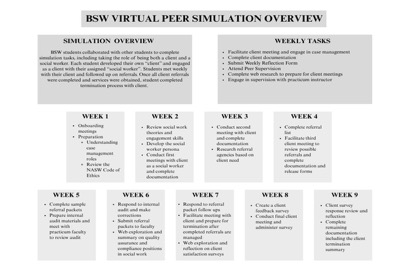
Figure 2
MSW Virtual Peer Simulation Overview
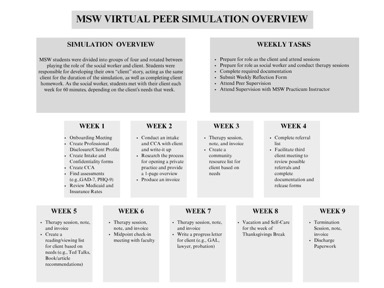
BSW students were tasked with one client case over a nine-week period, and were given guidelines on client needs and the services to be provided. MSW students were given a structure for a nine-week VPSim, with an emphasis on demonstrating the use of clinical social work skills. Students sent documentation and simulated referrals directly to the faculty overseeing the simulation for review weekly.
Practicum faculty provided oversight of both cohorts of students through regular interaction and feedback, reviewing weekly reflection forms and client documentation. Moreover, the practicum faculty offered one-on-one consultations, a midsemester check-in, and a debriefing close-out session to students.
Cost and Time Commitment
The research team implemented VPSim using no funding and accumulated no financial costs. Compared to existing research on simulation costs, VPSim did not require financial support, as costs examined in other studies, such as staffing costs, catering, and technology, were not needed to implement the simulation.
While there was no financial commitment, VPSim involved a time commitment for practicum faculty. In consideration of the demanding pandemic workload, the faculty who created the simulation model allowed for independent student scheduling of meetings primarily to guide how students engaged with VPSim without faculty participation.
Two practicum faculty led the planning and implementation of each BSW/MSW VPSim. Prior to the start of the simulation, these faculty spent approximately 2 to 3 hours to outline a schedule of tasks that reflected competency-based learning opportunities, and created cloud-based storage for student documentation. Students already had access to university platforms and course materials, such as Zoom for scheduled meetings and Google Drive for housing simulation materials. The practicum faculty developed the accompanying research study, spending approximately 5 to 6 hours to outline the study procedures and submit for Institutional Review Board (IRB) approval.
Additionally, the practicum faculty implemented one onboarding meeting for each BSW/MSW cohort, and scheduled regular check-in meetings with the participating students. Faculty saved time by not participating in the simulations or peer supervision; however, the practicum faculty spent approximately one to three hours per week over a nine-week period during the semester for indirect VPSim monitoring, documentation review and feedback, and technical support. After the conclusion of the simulation, the practicum faculty spent a total of three hours conducting focus group discussions with participants. Overall, practicum faculty spent an estimated 35 hours planning and overseeing the simulation, and an estimated nine hours on the research study portion, totaling 44 hours.
Research Study
Participation in VPSim was offered to students by practicum faculty to supplement their practicum experience during the pandemic, with the intent of mirroring typical practicum agency learning opportunities. The practicum faculty developed an accompanying research study, which aimed to identify application of skills and competencies during VPSim, as well as student perspective of the impact of peer supervision. The study examined the following questions:
- To what extent does VPSim support the development of social work competency and skills for students?
- What are the students’ key takeaways regarding VPSim?
Participants
To enhance partnerships and student diversity, participation for the graduate-level simulation was extended to a partnering school of social work. A total of 15 social work students participated in the simulation, with nine consenting to participate in the research study. Study participants included one senior BSW student, five generalist-year MSW students, and three advanced-year MSW students. Five students were associated with the host university, and four were from the partnered institution and reflected varied program types, such as full-time and part-time plans of study. Over the course of the semester, all students were in a practicum seminar course and completing practicum hours, under CSWE COVID provisions.
Although demographic data would have been helpful for research purposes, the research team considered confidentiality, conflicts of interest, and dual roles (e.g., professor/researcher–student relationship) and thus did not collect participant-specific demographic data. Both universities were in the southern United States in urban cities. The host institution is a large public university (30,000 or more students). In the fall of 2020, the student body demographics reflected 49% female and 51% male. Nonbinary data was not collected. Regarding race and ethnicity, 54% were White, 16% African American/Black, 11% Latino/a/x, 1% bi/multiracial, 8% Asian, 1% unknown, 0.2% American Indian, 0% Native Hawaiian or other Pacific Islander, non-Hispanic, and 5% international.
The partner institution is a small private university (fewer than 5,000 students). In the fall of 2020, the partner university student body demographics reflected 63% female and 13% male. Nonbinary data was not cited. Regarding race and ethnicity, the firgures were 1% White, 74% African American/Black, 1% Latino/a/x, 0.24% bi/multiracial, 0.24% Asian, 22% unknown, 0.80% American Indian, 0.16% Native Hawaiian or other Pacific Islander, non-Hispanic, and 0.64% international.
Procedures
Students from both the host and partner institutions who participated in the simulations were sent a recruitment email inviting them to participate in a qualitative study which would ask participants to give consent for the research team to review and analyze existing content (i.e., weekly reflections), and also to participate in a focus group.
For students to be eligible for this study, they needed access to technology for teleconferencing and reliable internet. All participants were required to be over the age of 18, enrolled as a student at either of the participating universities, and have completed the simulation. Incentives were not provided by the research team for participating in the study.
Data Collection
Data for this study were collected from two sources: weekly reflections and focus groups. Participants granted access to weekly online reflections that consisted of 14 fill-in-the-blank questions. Question subjects included (a) general reflections based on experience in the role of client or social worker; (b) perceptions of peer supervision; (c) strengths and challenges; and (d) what social work theories, skills, CSWE EPAS competencies (CSWE, 2015), and ethics were utilized. At the end of the simulation, the researchers interviewed participants during the focus groups for approximately one hour using the same 11-question protocol. The participants were asked about their experiences and perspectives in relation to VPSim, such as their perceptions of their skill development and peer supervision. Questions included: Did you experience any challenges? What was it like working with other peers either in peer supervision or in session? What were the most important things you learned from the simulation?
Data Analysis
To capture participants’ experiences, the study employed a qualitative research design analyzing focus groups and weekly reflections using Reflexive Thematic Analysis (Braun & Clarke, 2021). The research team adopted a constructivist epistemology, viewing knowledge as bidirectional through language and experience. Moreover, the team emphasized trusting participants’ meaningful experiences, used a data-driven approach to avoid any preconceptions, and applied both semantic and latent coding to reflect explicit and interpreted meaning.
The researchers followed the six outlined RTA phases (Braun & Clarke, 2021) of becoming familiar with the data, generating codes, developing themes, checking themes, creating definitions and names, and reporting. A semantic coding approach was used to reflect explicit meaning as well as a latent coding approach for sections of the data that needed more interpretation. The primary author conducted an independent coding of the data in collaboration with the research team to reach reflexivity.
Findings
Skill Development
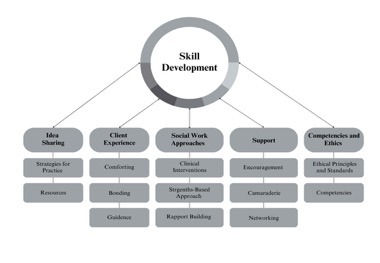
In assessing participant skill development, five major themes emerged: Client Experience, Social Work Approaches, Idea Sharing, Support, and Competencies and Ethics. (See Figure 3.)
Figure 3
Skill Development Themes
Theme 1: Idea Sharing
The first theme presented as Idea Sharing. and included two subthemes of Strategies for Practice and Resources. Participants highlighted peer supervision as a time to discuss approaches they were trying each week, as well as for sharing resources. Participant #1 reflected,
I think it was pretty helpful to do peer supervision. I liked whenever we were able to listen to other students … like if they felt they were at a standstill with their client and didn’t really know what to do next for this session. It was helpful to hear what techniques they came up with to continue.
Regarding resources, participant #7 reported, “We always share with each other a new activity or give advice onhow to be a better therapist.” Overall, participants used their peer supervision time to consult with peers to inform their work in the simulation.
Theme 2: Client Experience
The second theme, Client Experience, reflected participants’ experiences in the role of the client. The first subtheme that emerged was Comforting, explained this way by one participant: “The social worker made me feel very comfortable and confident that I could make it through the rough time I was having” (Participant #4). The participants noticed the importance of reassurance and validation in working with clients. The second subtheme, Bonding, captured the development of the client–social worker relationship over time. Participant #3 reported, “I feel that the bond between the social worker and myself continues to grow for the better and for that I’m very appreciative.” The last subtheme was Guidance, and reflected participants’ appreciation of the instruction and information provided to support the client’s situation. For example, Participant #5 stated, “I felt guided and connected through the social worker’s appropriate and genuine approach.” Overall, participants were able to reflect on their experiences as a client, and highlighted some of the key skills social workers need to deliver quality services.
Theme 3: Social Work Approaches
In the third theme, Social Work Approaches, participants denoted a specific social work skill set developed through simulation. The first subtheme was Clinical Interventions,highlighting specific modalities such as Cognitive Behavioral Therapy (CBT), Motivational Interviewing, etc. For example, Participant #2 reported, “CBT was used to help the client understand how her thoughts and feeling[s] affect her behaviors and trying to change her thought pattern.” Another subtheme that emerged was the use of strengths-based approaches to highlight positive qualities of clients. Participant #6 reflected, “This week I checked in on all the client’s spheres (school, work, home, family, church, physical health, church, and creative outlet) and encouraged him to continue his good habits and explore additional opportunities for wellbeing.” The final subtheme related to Social Work Approaches was Rapport Building, which focused on creating connection between the social worker and client. For instance, Participant #2 stated, “Empathetic listening was used to help the client feel that she was being heard and understood.” Collectively, participants shared examples of effective applications of social work skills during the simulation.
Theme 4: Support
Participants reported high levels of Support, the fourth theme, in the context of the following subthemes: Camaraderie, Encouragement, and Networking. Participants expressed a mutual understanding with each other through Camaraderie. For example, Participant #7 noted, “[I am] very thankful for my group because it was definitely an open door for us to talk about anything, like whatever came to our mind.” Encouragement was also expressed: “We positively uplifted each other during this time of uncertainty regarding the presidential election” (Participant #7). Lastly, participants recognized the benefit of Networking as a form of support. Participant #8 reported the following regarding networking:“… just like building more connections outside of your cohort or your client/therapist relationships.” Participants found support in various ways through simulation.
Theme 5: Competencies and Ethics
The final theme that surfaced was Competencies and Ethics. Participants reflected on their knowledge and practice based on the National Association of Social Workers (NASW) Code of Ethics (National Association of Social Workers, 2021) and the CSWE Educational Policy and Accreditation Standards (EPAS) (CSWE, 2015), which were current in the fall of 2020. Regarding the first subtheme, Ethical Principles and Standards, Participant #2 shared, “I use the ethical value of the importance of human relationships to help her to understand how the relationship with her mother and father has affected all other relationships in her life.” Here this student can easily identify how they applied the value in a client situation.
The second subtheme, Competencies, focused on the use of the nine social work competencies when working with clients (CSWE, 2015). For example, Participant #9 commented: “For me, I would have to say like being able to engage with the individual and assess the situation that they’re dealing with to be able to better provide the therapeutic services that best fit their needs.” In this example, the student underscores the use of engagement and assessment to inform a client-centered intervention. Ultimately, participants were able to identify how their professional ethics and learned competencies appeared in their practice during simulation.
Skills Development Related to Competencies and Code of Ethics
In addition to data themes, the study assessed how participants tied their learning opportunities to the CSWE competencies (CSWE, 2015). In their weekly reflections, participants were asked to identify specific competencies that corresponded to the work they engaged in that week. A total of these competencies for the duration of VPSim indicated that competency 7, Assessment, was the most frequently reported competency used in action by participants. Competencies 1, Ethics and Professionalism; 2, Diversity and Difference; and 6, Engagement, appeared a total of nine times in student reflections. Less frequently identified competencies in action were competencies 4, Research; 8, Interventions; and 9, Evaluation. Participants did not report demonstrating competencies 3, human rights and justice; and 5, policy practice, throughout their VPSim experience. Table 2 provides a frequency overview of competencies acknowledged by participants in their weekly reflections.
Table 2
Frequency of Participant Acknowledgement of 2015 CSWE EPAS (N = 9)
| CSWE 2015 Competencies | Frequency | % |
| Competency 1: Demonstrate Ethical and Professional Behavior | 9 | 19.15 |
| Competency 2: Engage Diversity and Difference in Practice | 9 | 19.15 |
| Competency 3: Advance Human Rights and Social, Economic, and Environmental Justice | 0 | 0 |
| Competency 4: Engage In Practice-informed Research and Research-Informed Practice | 3 | 6.38 |
| Competency 5: Engage in Policy Practice | 0 | 0 |
| Competency 6: Engage with Individuals, Families, Groups, Organizations, and Communities | 9 | 19.15 |
| Competency 7: Assess Individuals, Families, Groups, Organizations, and Communities | 11 | 23.40 |
| Competency 8: Intervene with Individuals, Families, Groups, Organizations, and Communities | 4 | 8.51 |
| Competency 9: Evaluate Practice with Individuals, Families, Groups, Organizations, and Communities | 2 | 4.26 |
Within the weekly reflections, participants also provided their perspective on how the NASW Code of Ethics (2021) was a factor in their simulation work. Participants had the opportunity to identify how the profession’s values and ethical codes appeared in their simulated work, and how this influenced their role as a social worker. MSW participants reflected most frequently on how they upheld values, notably the dignity and worth of the person and the importance of human relationships. When reflecting on specific ethical standards used, the BSW participant noted primarily they were upholding their ethical responsibilities to clients.
Key Takeaways from VPSim
The key takeaways from the experience, highlighted in participant responses and identified as main themes in study responses, were Lessons Learned, Self-Reflection, Valuable Learning Experience, and Support. Regarding overall lessons learned,Critical Thinking was described by participantsas a subtheme. Participant #8 shared, “Critical thinking, like sometimes the first thing that comes to your mind, is not always the right thing you should say or you should do.” Flexibilitywas identified as another subtheme of lessons learned, where participants noted the importance of being flexible:
Even though you have to plan like a whole day of work or maybe even set a date and time you know to meet with that client and anything can come up or that could cause you to switch and jump to like another day, another time. And that may throw everything else off” (Participant #4).
Others discussed another subtheme, Transferable Skills, which could be used in practice in various systems: “Since clinical social work is so intimate, I think it really helped me build those personal skills that will be beneficial in a micro or a mezzo or a macro setting” (Participant #8).
The second main theme in responses was Self–Reflection, in which participants reflected on how their own interests or thoughts on their practice perspective shifted over time. Participant #4 shared, “It got me thinking about doing group counseling sessions. And I came into this being like, nope, nope, nope, I’m not clinical. I want to do research, but yeah, that was really interesting for me.” The third main theme from the data was that participants felt that they had a valuable learning experience. “This opportunity to participate in virtual placement has been extremely valuable. I really enjoyed the feedback and bouncing ideas off other students to get different perspectives” (Participant #1). A final theme in the data noted that participants identified support as a key takeaway from the experience: “We are supporting one another and understanding that we all are in this together” (Participant #6).
Discussion
This study sought to deliver a meaningful simulation-based learning experience while addressing the financial and logistical challenges typically associated with traditional simulation methods. Specifically, it explored social work students’ perceptions of Virtual Peer Simulation (VPSim) as a tool for enhancing the development of core social work competencies. Findings are discussed below.
Cost and Time Effectiveness of VPSim
VPSim addressed the challenges of simulation related to faculty planning time, costly budgets, and time-limited simulations, with participants noting an increase in skill development and a valuable learning experience. Simulations involving actors, physical locations, and intense scheduling typically require at least four months of planning (Bogo et al. 2014), while VPSim preparation took about one month for material production and preparation and schedule confirmations, excluding the IRB process. While the cost per student for traditional simulations ranges from $40 to $70 (Bogo et al., 2014) to cover space, actors’ fees, and technology, VPSim operated without any direct financial cost or indirect cost related to faculty time. Finally, most simulations tend to be time-limited to a few hours or a day, whereas VPSim engages students weekly in simulation with the same client over a nine-week period.
VPSim is a cost-free and time-efficient model for providing a safe learning space for students to practice. Previous studies (Badger & MacNeil, 2002; Bogo et al., 2014) referred to the costs per student for planning and simulation, in addition to equipment costs. Participants in this study report experiencing benefits from participating in the simulation, which is primarily driven by peer-to-peer interactions and facilitated with faculty time and effort, without funding required to pay for standardized simulation. Faculty and staff time and effort requires planning that can be implemented into course design or practicum preparation. This study can support the feasibility of conducting virtual peer simulations without additional funding.
Additionally, VPSim aligns well with Kourgiantakis et al.’s (2020) emerging best practices for simulation, including key features such as the use of a theoretical framework, clear competencies, onboarding process, realistic scenarios, assessment tools, actively engaged students, feedback, and space for student reflection, debriefing, and evaluation.
Skill Development
Participants perceived VPSim as contributing to their knowledge and skill development in social work. Participants cite that their key takeaways from this experience related to learning skills, discovering more about themselves, and feeling supported. In acting as clients and social workers for an extended period, participants developed skills for interacting with clients and applied competencies and values. Finally, findings indicate weekly peer supervision sessions were beneficial in offering support and resources to participants.
Kourgiantakis et al. (2020) discussed that simulation can help address current challenges in social work learning such as limited opportunities for practice. VPSim focused on generalist and clinical skills and provided students with a realistic experience of developing rapport and having regular client meetings. Additional research (Kilgour et al., 2015; Tufford et al., 2022) has highlighted the positive impact of role-playing and reflection in contributing to learning. When participants play the role of the client receiving services, they are able to observe how the social worker (i.e., other participants) utilizes social work skills such as engagement, assessment, intervention, and evaluation to foster a sense of connection. Moreover, participants expressed the use of critical thinking in their simulated client interaction, which helped them to both frame questions for the client and respond to the client. Other participants formulated how the simulation translates into actual client work and social work practice.
Peer-facilitated interaction was unique to this simulation, as compared to other simulations in which the participants interact with a trained actor, practicum faculty, or student from a discipline outside of social work. Moreover, peer supervision provides an opportunity to connect and debrief. The study supports Mills and Swift’s (2015) work on the benefits of peer supervision, such as critical thinking and problem-solving. Due to the pandemic, students had limited time to connect with their peers outside of their fully online courses. In contrast, students who engaged in the simulation were also able to participate in and increase connection opportunities outside of class. Peer supervision provides an extra level of peer interaction and support through virtual platforms. Additionally, the use of virtual platforms provided students the opportunity to practice social work via teleconference platforms, which can support methods for more accessible client engagement (Ng et al., 2022). The simulation experience provides a feasible way for students to integrate course material into practice with simulated situations involving technology.
Strengths
This study, and the format of VPSim, offer strengths related to social work simulation research. First, this study contributes to the growing literature on social work simulation while presenting a cost-free option for hands-on practice experience, with no additional cost to students or social work departments. The only required items for the simulation were access to the technology, which included internet, a video platform, and cloud-based storage system, all of which the students typically have access to already from the university through their tuition and fees.
A second area of strength is improved time efficiency relating to planning for the simulation. VPSim still requires an extensive amount of planning by the practicum faculty for multiple weeks of content; however, time is saved by omitting recruitment and training of actors or coordinating with other disciplines, since students used prior experiences and creative and critical thinking to develop their own client profiles. A third strength of the study is that it highlights collaboration and networking. VPSim models how to give the students the ability to network across cohorts and partner programs, which they may not have had an opportunity to interact prior to the simulation. In addition to networking, VPSim provides students with the opportunity to engage in professional collaboration through simulation and peer supervision meetings.
Limitations
This study had a limited sample size of only nine participants consenting. In addition, only one BSW student participated, compared to eight MSW participants; thus, the results may be missing viewpoints from a BSW perspective. Another limitation is that the simulation and focus groups were conducted by faculty members from the host university, which could have affected the participants’ responses to the focus group. This study did not capture participants’ specific demographic information, such as age, race and ethnicity, gender identity, etc., which may have been helpful in further analyzing the results. Finally, prior research showed that observation and prompt feedback from faculty is key to learning for students (Kourgiantakis et al., 2019). Increased work demands for faculty due to the pandemic meant that direct observation of students and feedback by practicum faculty did not occur in this study. This limitation could have also resulted in participant bias in reporting their own perspectives.
Future Research
This study opens continued opportunities for future research. From a finance and equity standpoint, simulation can be costly to educational institutions. Research is needed to determine how to best replicate full or partial elements of the VPSim model within other institutions that are seeking a cost-effective solution to simulation. Considerations should be given to what resources institutions have available, such as faculty effort for planning and providing oversight —including direct observation and feedback—of the simulation, , as well as the availability of technology, including accessibility for students who require accommodations such as closed captioning or visual modifications.
Simulation literature (Kourgiantakis et al., 2020; Sunarich & Rowan, 2017) and this study have shown that simulation should be used to supplement in-person practicum experience rather than replace it. Further research may address how to supplement practicum experiences most effectively through simulation, such as incorporating student-led simulation and peer supervision regularly into practicum seminars. While the sample in this study was small, additional research can explore how the model would operate with larger groups of students, perhaps by separating larger classes into smaller groups in which students can explore a range of client scenarios, and then share and process them with the larger class.
Instructors teaching practicum courses can also incorporate the model into course assignments, providing students with more practical and reflective opportunities. Regular incorporation of the model, with the addition of direct faculty oversight, can allow for further research and assessment, in addition to the opportunity to provide more long-term and diverse simulated client interventions. While simulations can be incorporated into required course content, programs may have the opportunity to provide simulations as implicit curriculum. To generate additional research and encourage student participation in both required and optional simulations, further consideration should explore how social work programs can count a portion of simulation towards practicum hours.
VPSim operated for nine weeks with no financial costs and a smaller faculty scheduling commitment than a more traditional simulation. While VPSim was piloted as a supplement for agency practicum experience during a global pandemic, this model can be used as a sustainable way to encourage skill development beyond the era of COVID-19. VPSim offers a practical and cost-free way to use technology and peer interactions to supplement practicum education experiences while simultaneously building social work skills.
Acknowledgments
The authors thank Candice Whiteside, LCSW, for her review and feedback on earlier drafts of this manuscript. We also acknowledge the support of Dr. Jessamyn Moxie, Dr. Alicia Dahl, and the Office of Undergraduate Research at the University of North Carolina at Charlotte.
References
Anderson, D. D., Gundersen, C. B., Banken, D. M., Halvorson, J. V., & Schmutte, D. (1989). Undergraduate role players as “clients” for graduate counseling students. Teaching of Psychology, 16(3), 141–142. https://doi.org/10.1207/s15328023top1603_11
Asakura, K., Gheorghe, R. M., Borgen, S., Sewell, K., & MacDonald, H. (2021). Using simulation as an investigative methodology in researching competencies of clinical social work practice: A scoping review. Clinical Social Work Journal, 49(2), 231–243. https://doi.org/10.1007/s10615-020-00772-x
Asakura, K., Occhiuto, K., Todd, S., Leithead, C., & Clapperton, R. (2020). A call to action on artificial intelligence and social work education: Lessons learned from a simulation project using natural language processing. Journal of Teaching in Social Work, 40(5), 501–518. https://doi.org/10.1080/08841233.2020.1813234
Badger, L. W., & MacNeil, G. (2002). Standardized clients in the classroom: A novel instructional technique for social work educators. Research on Social Work Practice, 12(3), 364–374. https://doi.org/10.1177/1049731502012003002
Baker, E., & Jenney, A. (2023). Virtual simulations to train social workers for competency-based learning: A scoping review. Journal of Social Work Education, 59(1), 8–31. https://doi.org/10.1080/10437797.2022.2039819
Banach, M., Rataj, A., Ralph, M., & Allosso, L. (2020). Learning social work through role play: Developing more confident and capable social workers. The Journal of Practice Teaching and Learning, 17(1), 42–60. https://doi.org/10.1921/jpts.v17i2.1308
Bay, U., Maghidman, M., Waugh, J., & Shlonsky, A. (2021). Guidelines for using simulation for online teaching and learning of clinical social work practice in the time of COVID. Clinical Social Work Journal, 49(2), 128–135. https://doi.org/10.1007/s10615-021-00807-x
Bogo, M., Rawlings, M., Katz, E., & Logie, C. (2014). Using simulation in assessment and teaching: OSCE adapted for social work. Council on Social Work Education.
Bond, W. F., Gonzalez, H. C., Funk, A. M., Fehr, L. S., McGarvey, J. S., Svendsen, J. D., & Sawicki, R. (2017). Deliberate practice with standardized patient actors and the development of formative feedback for advance care planning facilitators. Journal of Palliative Medicine, 20, 631–637. https://doi.org/10.1089/jpm.2016.0431
Bragg, J. E., Adamson, T., McBride, R., Miller-Cribbs, J., Nay, E. D. E., Munoz, R. T., & Howell, D. (2020). Preparing students for field education using innovative field labs and social simulation. Field Educator, 10(2). https://tinyurl.com/2kxdwmkz
Branch, K. C., Ayers, D. J., & Baker, S. K. (2023, August 1). Standard technical communicators: A novel simulation center staffing model. Society for Simulation in Healthcare. https://tinyurl.com/d3p86fr3
Braun, V., & Clarke, V. (2021). One size fits all? What counts as quality practice in (reflexive) thematic analysis? Qualitative Research in Psychology, 18(3), 328–352. https://doi.org/10.1080/14780887.2020.1769238
Carter, K., Swanke, J., Stonich, J., Taylor, S., Witzke, M., & Binetsch, M. (2018). Student assessment of self-efficacy and practice readiness following simulated instruction in an undergraduate social work program, Journal of Teaching in Social Work, 38(1), 28–42. https://doi.org/10.1080/08841233.2018.1430095
Clark Dula, C. A., Jackson, K., King, S. A., & Nebergall, S., & Matthews, D. E. (2024). Developing supervisory and precepting skills through simulation: Near peer teaching in a skills laboratory. Currents in Pharmacy Teaching and Learning, 16(9), 1–8. https://doi.org/10.1016/j.cptl.2024.102121
Council on Social Work Education. (2015). 2015 educational policy and accreditation standards for baccalaureate and master’s social work programs. https://tinyurl.com/ye3apbak
Council on Social Work Education. (2024). Summary of the 2022-2023 Annual Survey of Social Work Programs. https://tinyurl.com/5akzfxrp
Dalwood, N., Bowles, K.-A., Williams, C., Morgan, P., Pritchard, S., & Blackstock, F. (2020). Students as patients: A systematic review of peer simulation in health care professional education. Medical Education, 54(5), 387–399. https://doi.org/10.1111/medu.14058
Dewey, J. (1938). Experience and education. Macmillan.
Egonsdotter, G., & Bengtsson, S. (2023). Reflections in case-based learning: Experiences of computer-based simulations in social work education. Journal of Social Work Education, 59(4), 964–976. https://doi.org/10.1080/10437797.2022.2033655
Flaherty, H. B. (2022). Teaching note: Using technology to enhance experiential learning through simulated role plays, Journal of Social Work Education, 58(4), 1–8. https://doi.org/10.1080/10437797.2022.2050869
Golia, G. M., & McGovern, A. R. (2015). If you save me, I’ll save you: The power of peer supervision in clinical training and professional development. British Journal of Social Work, 45(2), 634–650. https://doi.org/10.1093/bjsw/bct138
Harris, S., & Newcomb, M. (2024). A simulated placement: Using a mixed-reality learning environment for social work education. Australian Social Work, 77(3), 351–364. https://doi.org/10.1080/0312407X.2023.2231416
Hodges, B., Hanson, M., McNaughton, N., & Regehr, G. (2002). Creating, monitoring, and improving a psychiatry OSCE: A guide for faculty. Academic Psychiatry, 26(3), 134–161. https://doi.org/10.1176/appi.ap.26.3.134
Kilgour, P. W., Reynaud, D., Northcote, M., & Shields, M. (2015). Role-playing as a tool to facilitate learning, self-reflection and social awareness in teacher education. International Journal of Innovative Interdisciplinary Research, 2(4), 8–20. https://tinyurl.com/3y93v8wc
Kourgiantakis, T., Sewell, K. M., & Bogo, M. (2019). The importance of feedback in preparing social work students for field education. Clinical Social Work Journal, 47, 124–133. https://doi.org/10.1007/s10615-018-0671-8
Kourgiantakis, T., Sewell, K. M., Hu, R., Logan, J., & Bogo, M. (2020). Simulation in social work education: A scoping review. Research on Social Work Practice, 30(4), 433–450. https://doi.org/10.1177/1049731519885015
Krishnan, S., Ademi, Z., Malone, D., Abebe, T. B., & Lim, A. (2025). Substitution of a traditional face-to-face workshop with virtual escape room in higher education: A cost-effectiveness analysis. Simulation in Healthcare, 20(1), 61–69. https://doi.org/10.1097/SIH.0000000000000811
Lee, E., Kourgiantakis, T., & Hu, R. (2022). Developing holistic competence in cross-cultural social work practice: Simulation-based learning optimized by blended teaching approach. Social Work Education, 41(5), 1–18. https://doi.org/10.1080/02615479.2021.1892055
Lee, T. D., Lee, C., Newton, M., Vos, P., Gallagher, J., Dickerson, D., & Regenthal, C. (2024). Peer to peer vs. virtual rehearsal simulation rehearsal contexts: Elementary teacher candidates’ scientific discourse skills explored. Journal of Science Teacher Education, 35(1), 63–84. https://doi.org/10.1080/1046560X.2023.2181505
Lie, S. S., Alvestad, R. W., Helle, N., Vikman, M. D., & Dahl-Michelsen, T. (2024). Exploring VR simulation in healthcare and social work education: Students’ experiences with VR simulation as preparation for professional practice. Uniped, 47(1), 18–31. https://doi.org/10.18261/uniped.47.1.3
Maloney, S., & Haines, T. (2016). Issues of cost-benefit and cost-effectiveness for simulation in health professions education. Advances in Simulation, 1(13), 1–6. https://doi.org/10.1186/s41077-016-0020-3
Meredith, C., Heslop, P., & Dodds, C. (2023). Simulation: Social work education in a third place. Social Work Education, 42(6), 917–934. https://doi.org/10.1080/02615479.2021.1991908
Miller-Cribbs, J., Wells, S., Bragg, J., & Miller, G. (2017). Addressing Grand Challenges through innovative simulation. Council on Social Work Education 63rd Annual Program Meeting, Grand Challenges Teaching Institute, Dallas, Texas.
Mills, F., & Swift, S. J. (2015). What can be gained through peer supervision? Educational and Child Psychology, 32(3), 105–118. https://doi.org/10.53841/bpsecp.2015.32.3.105
National Association of Social Workers. (2021). Code of Ethics. https://tinyurl.com/newxet2f
Napan, K. (2021). The spirit of peer supervision. In K. O’Donoghue & L. Engelbrecht (Eds.), The Routledge International Handbook of Social Work Supervision (pp. 272–283). Routledge. https://doi.org/10.4324/9780429285943
Ng, B. P., Park, C., Silverman, C. L., Eckhoff, D. O., Guest, J. C., & Díaz, D. A. (2022). Accessibility and utilisation of telehealth services among older adults during COVID-19 pandemic in the United States. Health & Social Care in the Community, 30(5), 1–13. https://doi.org/10.1111/hsc.13709
Odefey, K. (2025, March 28). The cost of video production in 2025: Comprehensive pricing guide. Synthesia. https://www.synthesia.io/learn/video-production/cost
Osborne, V. A., Benner, K., Sprague, D. J., & Cleveland, I. N. (2016). Simulating real life: Enhancing social work education on alcohol screening and brief intervention. Journal of Social Work Education, 52(3), 337–346. http://doi.org/10.1080/10437797.2016.1174629
Petracchi, H. E., & Collins, K. S. (2006). Utilizing actors to simulate clients in social work student role plays: Does this approach have a place in social work education? Journal of Teaching in Social Work, 26(1-2). https://doi.org/10.1300/J067v26n01_13
Rogerson, C. V., Diggins, R., Anderson, W. L., O’Neil, J., & Straw, A. A. V. (2020). Heed the call: A simulated model for future field education practice and response to COVID-19. Field Educator, 10(2). https://tinyurl.com/5a4dpp68
Ruiz-Ortega, D., Ricoy-Cano, A. J., Garcia-Domingo, M., & de la Fuente-Robles, Y. M. (2023). Learning through simulation: A systematic literature review of the use of virtual reality and augmented reality in social work education. International Social Work, 67(4), 1059–1074. https://doi.org/10.1177/00208728231208002
Senvisky, J. M., McKenna, R. T., & Okuda, Y. (2023). Financing and funding a simulation center. National Library of Medicine. National Institutes of Health. https://www.ncbi.nlm.nih.gov/books/NBK568786/
Share, P., & Pender, J. (2024). Role-playing the future: A simulation-based exploration of AI in social work. Ubiquity Proceedings, 4(1), 1–9. http://doi.org/10.5334/uproc.149
Skeen, A. (2023). Field education as the signature pedagogy of social work. Advances in Social Work, 23(1). https://doi.org/10.18060/26234
Sunarich, N., & Rowan, S. (2017). Social work simulation education in the field. Field Educator, 7(1). https://tinyurl.com/2pxxum3w
Todd, S. L., Occhiuto, K., Asakura, K., & Grassau, P. (2021). Navigating uncertainty in clinical social work practice: A pilot simulation-based study. Clinical Social Work Journal, 49(2), 286–297. https://doi.org/10.1007/s10615-021-00800-4
Tortorelli, C., Choate, P., Clayton, M., El Jamal, N., Kaur, S., & Schantz, K. (2021). Simulation in social work: Creativity of students and faculty during COVID-19. Social Sciences, 10(1), 1–15. http://doi.org/10.3390/socsci10010007
Tufford, L., Asakura, K., & Bogo, M. (2018). Simulation versus role-play: Perceptions of prepracticum BSW students. Journal of Baccalaureate Social Work, 23(1), 249–267. https://doi.org/10.18084/1084-7219.23.1.249
Tufford, L., Gauthier, L., Katz, E., & Jenney, A. (2022). Towards understanding the client and observer in the peer-to-peer role-play. Social Work Education, 41(6), 1387–1404. https://doi.org/10.1080/02615479.2021.1956451
Tulleners, T., Taylor, M., & Campbell, C. (2021). Peer group clinical supervision for community health nurses: Perspectives from an interpretive hermeneutic study. Journal of Nursing Management, 30(3), 684–693. https://doi.org/10.1111/jonm.13535
UCLA Simulation Center. (2026). Standardized patient FAQ. Retrieved February 9, 2026, from https://sim.ucla.edu/sp-program/standardized-patient-faq
Vassos, S., Harms, L., & Rose, D. (2019). The value of mixing it up: Student experiences of a multimodal approach to supervision on placement. The British Journal of Social Work, 49(5), 1274–1295. https://doi.org/10.1093/bjsw/bcy105
Washburn, M., Bordnick, P., & Rizzo, A. (2016). A pilot feasibility study of virtual patient simulation to enhance social work students’ brief mental health assessment skills. Social Work in Health Care, 55(9), 675–693. https://doi.org/10.1080/00981389.2016.1210715
Washburn, M., & Zhou, S. (2018). Teaching Note—Technology-enhanced clinical simulations: Tools for practicing clinical skills in online social work programs. Journal of Social Work Education, 54(3), 554–560. https://doi.org/10.1080/10437797.2017.1404519
Washburn, M., Zhou, S., Sampson, M., & Palmer, A. (2021). A pilot study of peer-to-peer SBIRT simulation as a clinical telehealth training tool during COVID-19. Clinical Social Work Journal, 49(2), 136–150. https://doi.org/10.1007/s10615-021-00799-8
White, B., Yeung, P., Chilvers, B. L., & O’Donoghue, K. (2021). Reducing the “cost of caring” in animal-care professionals: Social work contribution in a pilot education program to address burnout and compassion fatigue. Journal of Human Behavior in the Social Environment, 31(7), 828–847. https://doi.org/10.1080/10911359.2020.1822249