Abstract
African schools of social work are increasingly consolidating their Indigenous practices of education, with practicum that responds to the unique contexts of both student learners and partner agencies being central to this endeavor. This article presents one of the first overviews of the state of practicum education in Africa, drawing on a survey of 41 schools of social work across many regions of the continent. Quantitative results were augmented by the insights from 28 social work educators and students who participated in focus group discussions. Results reveal a strong commitment to practicum education despite limited institutional support.
Keywords: practicum education, social work education, Africa, TEFL project, institutional support
Social work education combines coursework and applied learning, also known as practicum, internship, field placement, field education, or field instruction. As is the case internationally, practicum is widely recognized as an integral component of social work education in Africa, enabling students to translate theoretical knowledge into professional practice. Amadasun (2021) observed that social work training institutions devote considerable effort to fieldwork education to ensure that competent social work professionals are trained. It must be recognized, however, that before the introduction of Western social work education and practice models, African societies had well-established social welfare systems informed by African philosophies, cultures, and pedagogies. These systems emphasized kinship networks, collective responsibility, and reciprocity to promote individual and community well-being (Asamoah, 2018).
During the colonial era, these Indigenous social welfare systems were replaced by Western models introduced through colonial administration and educational structures. Kaseke (1991) noted that these imported models often failed to acknowledge the diversity, complexity, and contextual realities of African societies. Since the 1950s, Western social work education has continued to exert significant influence on the mission, vision, and pedagogical strategies of social work training institutions in Africa. This dominance has shaped teaching, learning, and practice approaches, often privileging externally developed theories over local knowledge systems (Amadasum, 2021). Consequently, Twikirize and Spitzer (2019) argued that social work education struggles to fully reflect African social realities and developmental priorities.
Notably, the documentation of African Indigenous knowledge until recently has been predominantly published by non-African scholars who may not fully grasp the intricate nuances of African societies (Bhangyi & Makoha, 2023). Twikirize and Spitzer (2019) argued that the continued reliance on imported theories and concepts not only constrains the relevance of social work education and practice but also limits the capacity of African social work educators to advance locally grounded academic activities and research. More recently, a positive shift has emerged, marked by the growing presence of Indigenous African scholars and increased calls for decolonial and contextually relevant social work education (Chilanga, 2022; Gray, 2016; Ncube & Noyoo, 2020).
Despite these developments, social work education and training vary considerably within and across countries in Africa (Chilanga, 2022). Several countries offer social work programs at certificate, diploma, and bachelor’s levels. While some have moved towards offering master’s and PhD programs, others offer no formal education and training in the discipline (Rautenbach, 2021). Where social work degree programs are not offered, students often go to neighboring countries to further their social work education. Students explore diverse social issues, including but not limited to poverty, inequality, mental health, child protection, social justice, and community development. Rautenbach (2021) indicated that only 37 of the 54 African countries have schools of social work affiliated with the International Association of Schools of Social Work (IASSW). As far as authors are aware, only South Africa, Namibia, Nigeria, and Zimbabwe have functional and legally established statutory social work councils in Africa. The accreditation of social work programs in Africa follows standards set nationally by national quality assurance and accreditation agencies (Hayward, 2006). In countries such as South Africa, Kenya, Uganda, Cameroon, Nigeria, Ghana, and Mozambique, institutional and program accreditation involve self-assessments, peer reviews, site visits, and a review report. Boboyi (2024) noted that assessment often focuses on quality, capacity, outcome, and areas of improvement.
Although the classroom and applied learning components of social work education are equally important, little is known about the state of practicum education in Africa. Against this backdrop, this study aimed to document the current state of social work field education in Africa, and to reflect upon the prospects and challenges for the continued consolidation of the training of social workers dedicated to improving individual and community well-being from an African perspective.
Existing Research
Practicum in Social Work Education and Practice
Social work field education in Africa is embedded within broader curricular frameworks that seek to integrate theory, practice, values, and ethics (Mwansa, 2010, 2011). Practicum is widely regarded as a core and compulsory component of social work education that introduces students to various social work interventions through guidance and feedback from experienced agency social workers (Bogo, 2006; Ross & Ncube, 2018). According to Nhapi and Dhemba (2020), practicum enables students to integrate classroom knowledge into actual practice, thereby bridging the gap between theory and practice. Applied learning in practicum also provides an opportunity to determine students’ suitability for professional practice in Africa (Amadasun, 2021; Robertson, 2013; Sowbel, 2012), helping students develop competence and professional ethical understanding in the workplace. As Ncube and Noyoo (2020) noted, it is widely accepted across South African social work teaching and practice institutions that all social workers must possess a fundamental knowledge of the professional principles, values, and ethics that guide and inform their practice.
Practicum and Curriculum
Some African scholars argue that before Western models were introduced, African societies already had systems of support rooted in Indigenous philosophies (Twikirize & Spitzer, 2019). Today, modern social work placement programs in formal agencies still grapple with the tensions between imported models and local realities. Although curricula vary across institutions, Hall (1990) found that universities integrate preparatory seminars and orientation, learning agreements, and field manuals to structure learning and clarify expectations for students and supervisors. In some universities, undergraduate practicum starts in the second year, while other schools initiate practicum in the fourth year (Schmidt & Rautenbach, 2016). Twikirize and Tusasiirwe (2015) observed that most universities require substantial practicum hours, with many schools mandating 500 hours across at least two placements in different settings. Singini (2025) added that placements occur across diverse settings, including government ministries, local authorities, nongovernmental organizations, and community-based charity organizations in rural and urban contexts. As Bhangyi and Makoha (2023) noted, there is a growing trend toward the use of nontraditional agencies for practicum. According to Tanga (2013), these placements offer students an opportunity to integrate empirical and practice-based knowledge to enhance their professional competency. Schmidt and Rautenbach (2016) found that placements provide students with support, opportunities to discuss feedback, and a variety of learning experiences.
Securing Practicum Placement
Social work in Africa has traditionally relied on the goodwill of practicing social workers and their employing organizations to deliver practicum education. Research also shows that access to and selection of placements are among the most challenging aspects in Africa due to the limited screening of practicum agencies (Tanga, 2013). Dhemba (2012) found that the responsibility for securing placements is shared between faculty coordinators and students, with students often taking a leading role in identifying placements. Ferguson and Smith (2012) noted that in the face of financial constraints, some students tend to select placements based on proximity and affordability rather than learning potential. Along the same lines, Nadesan (2020) found that some placements fail to provide students with sufficient practice opportunities, especially in negotiating and mediating professional ethical conflicts. The same author adds that successful practicum outcomes depend on the relationships among key entities, including universities, agencies, and students. Literature highlights that although some universities have well-established partnerships (Nadesan, 2020), others rely on informal relationships (Dhemba, 2012).
Practicum Placement Models
Practicum placement models are essential pedagogical strategies that shape how social work programs deliver professional education (Dhemba, 2012; Hall, 1990). Traditionally, practicum models commonly used include placing students in community agencies (Schmidt & Rautenbach, 2016). Hall (1990) argued that without a well-structured practicum component, social work education risks reproducing abstract and culturally misaligned approaches that may fail to respond to local realities. The existing literature indicates that African universities employ several placement models, often embedded in institutional capacity, curriculum structure, student demographics, and national professional requirements (Dhemba, 2012; Ross & Ncube, 2018).
While every social work program has its methods for conducting practicum education, our literature review identified several practicum placement models. The most dominant model in African universities is block placements, in which, after completing all coursework, the student spends four or five days per week working at an agency for a period ranging from at least one month to one year, depending on the school (Dhemba, 2012). Schmidt and Rautenbach (2016) argued that, despite the postponement of theory application until a certain level of knowledge is attained, block placements allow students to fully immerse themselves in the placement and engage in intellectually and professionally stimulating tasks.
Concurrent placement occurs alongside classroom instruction, with student time divided between classroom and practicum-based learning. The concurrent placement model has been praised for facilitating the immediate application of classroom theory to practice (Schmidt & Rautenbach, 2016). Greenblatt et al. (2019) discussed the rotational placement model as an alternative to traditional placements, noting that rotational models broaden student experience by rotating placements externally (at different agencies) or internally (across departments within an agency).
On the other hand, the in-service placement model is used when practicum is designed as a component of ongoing professional development. The program is developed in partnership with communities and placement agencies, with a strong focus on developmental principles, serving the community while also providing a foundation for student experiential learning (Schmidt & Rautenbach, 2016). The Department of Social Services at Kaduna Polytechnic in Nigeria offers an in-service practicum in which students work within communities to identify needs and, thereafter, develop macro, mezzo, and micro interventions (Hall, 1990). Ross and Ncube (2018) felt that regardless of the placement modality, agencies and practicum instructors must orient students to the setting and ensure that learning objectives are met. Across all placement models, supervision serves as the key mechanism connecting practicum experience to social work education programs (Canavera & Akesson, 2018).
Practicum Supervision
Another significant aspect of practicum is the supervision that students receive. Practicum supervisors play a critical role in shaping students’ learning and practice development by providing guidance, support, and constructive feedback (Singini, 2025). Professional social work in Africa has historically privileged a one-to-one apprenticeship practicum involving both agency-based and academic supervisors (Bhangi & Makoha, 2023; Ross & Ncube, 2018). However, sustaining this approach is increasingly challenged by managerial pressure in contemporary social and human service sectors (Alschuler, 2021; Ncube & Noyoo, 2020; Poggenpoel, 2018). Thus, group supervision in practicum has become an acceptable alternative to individual supervision in many African universities (Schiff & Zeira, 2016). The usefulness of group supervision during practicum includes the mutual aid students offer one another and the provision of a safe space for students to discuss their concerns and anxieties (Alschuler, 2021). Schiff and Zeira (2016) argued that group supervision fosters peer feedback and students’ ability to develop their own self-supervision skills.
Dhemba (2012) explained that some West African social work institutions require field placements to have at least three on-site instructors to support student learning. Among these are the practicum coordinator (who oversees all internships at the site), a pedagogical counsellor (who can be called upon for technical support), and, for each intern, an internship overseer (who serves as the point of contact for the student, teachers, and administrators regarding placement-based issues). While this model promises strong support for student learning, it also strains resources for most agencies.
Currently, it is not uncommon for practicum students to receive supervision from multiple supervisors, including an agency-based instructor and their academic supervisor (Ncube & Noyoo, 2020). Poggenpoel (2018) highlighted that interdisciplinary practicum supervision now includes supervision provided by instructors outside the practicum agency, faculty members, contracted social workers, and individual instructors from other disciplines such as psychology, law, economics, and demography. Canavera and Akesson (2018) noted that modelling and coaching are delivered through a hybrid approach that incorporates both online and on-site supervision of practicum students, especially in West Africa. Nevertheless, Ross and Ncube (2018) noted that quality and adequate supervision remain essential for students to demonstrate acceptable performance competencies in the profession. Although the central importance of practicum in shaping future professionals cannot be underestimated, it may also be the most challenging part of social work education.
Challenges in the Management of Placements
Research indicates that one of the greatest challenges facing social work practicum is the increasing number of social work students participating in undergraduate practicum (Dhemba, 2012; Singini, 2025; Tanga, 2013; Veta & McLaughlin, 2023). Schmidt and Rautenbach (2016) observed that the increasing number of social work students in African universities exacerbates pressure on placements where students can gain practical experience. According to Tanga (2013), difficulties in securing an appropriate practicum placement may result in students’ feelings of inadequacy in professional practice and a disconnect between classroom learning and practicum. Arkin (1999 also reported stress among students in practicum. Importantly, this becomes a real challenge in contexts where a limited number of agencies are able and willing to take on students (Singini, 2025). Veta and McLauglin (2023) observed that agencies’ hesitation to accept students may result from work-related and economic struggles.
Following colonial and postcolonial legacies, social work learning and practice approaches in Africa often privilege externally developed theories over local knowledge systems (Amadasun, 2021; Twikirize & Spitzer, 2019). Singini (2025) argued that the Association of Social Work Schools in Africa lacks an established curriculum to guide practicum across universities in Africa. But according to Gray et al. (2017), practicum should prepare practitioners to be both conventional and flexible in addressing Africa’s socioeconomic issues. Adding to the lack of oversight is the inadequate practicum experience, including lack of office equipment and space, in social work schools and agencies (Tanga, 2013). Additionally, most schools have higher student-to-faculty and staff ratios, which increases the workload for academic supervisors (Engelbrecht, 2010).
Conceptual Framework
Recent scholarship by Bhangyi and Makoha (2023) has drawn on the existing African research and the state of knowledge about social work practicum education to propose a model describing seven approaches for decolonial fieldwork education in African social work, illustrated in Figure 1.
Figure 1
Seven Approaches for Decolonial Fieldwork Education in African Social Work (Bhangyi & Makoha, 2023)
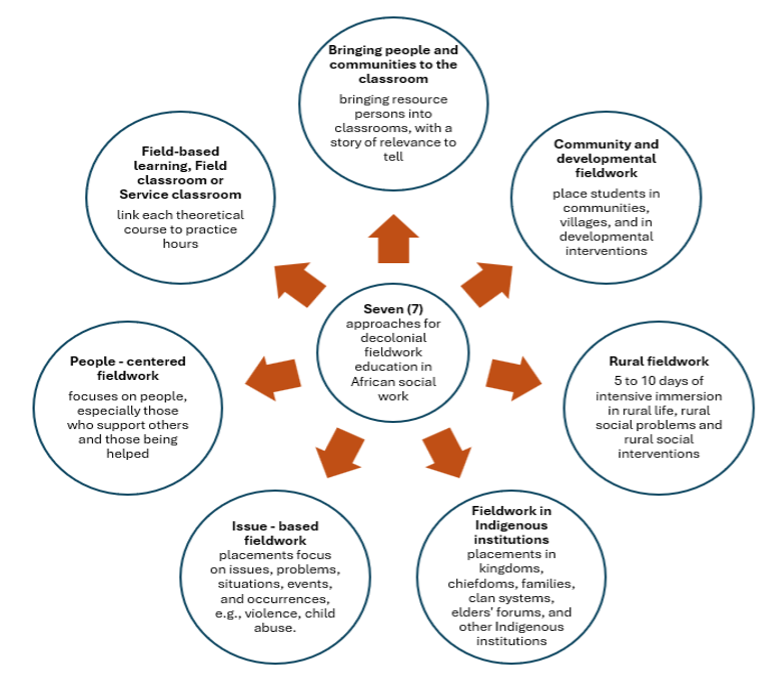
With their emphasis on close relationships with rural and local community actors, collective approaches to intervention, and models of field education that take into account Indigenous knowledge and cultural practices, these seven approaches provide a helpful framework for analyzing the findings of this study.
Methods
This study on the state of African social work field education is part of the Transforming the Field Education Landscape (TFEL) project (Transforming the Field Education Landscape, n.d.) and aims to establish a snapshot of the structure and delivery of field education programs and field resources within African schools of social work. A survey, in English and consisting of 95 questions (19 open-ended questions, 29 Likert Scale questions, and 47 closed-ended questions) was adapted[1] and reviewed several times by the team, which comprised graduate student research assistants (the majority of whom were of African origin) and faculty members. It was then further reviewed and validated by TFEL’s African partners. Focus groups with students, educators, and field partners provided a deeper understanding of the qualitative nature of current field education models. Ethical approval was obtained from the McGill University Research Ethics Board (REB#20-07-037) and the University of Calgary Research Ethics Board (REB#19-0901) before data collection, and all participants provided informed consent.
Survey
A letter of initial contact and a flyer were developed to invite field education coordinators and department heads from as many social work schools or universities in Africa as possible, using publicly available organizational contact information on African school websites. Coauthors also contacted national, regional, and international social work associations[2], asking them to share the recruitment flyer with their member schools. Recruitment materials were also shared on the TEFL project website and social media platforms, during an online African social work conference in Rwanda, and via email to the personal networks of the TFEL Africa Project subcommittee across Africa. Multiple and ongoing recruitment strategies were necessary due to the limited publicly available contact information on African schools’ websites, a significant barrier for the researchers.
The Qualtrics survey remained open for eight months, from November 2021 to June 2022, as we endeavored to reach as many African schools as possible. In total, 56 survey respondents represented schools of social work in Africa. After data cleaning, 15 incomplete surveys and duplicate responses were removed. Of the 65 institutions contacted, 41 completed surveys, for a response rate of approximately 63%. A majority of the responding schools (63%) offer full-time BSW programs (lasting four [74%] or three [11%] years), while 37% offered part-time BSW programs. Most MSW programs (72%) were full-time (all two-year programs), while 38% were part-time. Survey data were exported from Qualtrics to SPSS in order to complete descriptive and cross-tabulation analyses.
Focus Groups
Preliminary survey results were presented for validation at the Association of Social Work Educators in Kenya (ASWEK) international social work conference hosted at Masaai Mara University in Kenya in May 2022. Members of the study team, in collaboration with ASWEK, then invited conference attendees to participate in focus group discussions to validate our quantitative findings and provide qualitative illustrations of field education experiences across different African contexts. Three focus group discussions (FGDs) with approximately nine to ten participants each and one or two TFEL project] facilitators were held in May 2022. Participants were recruited through convenience sampling, and 28 in-person conference attendees from different schools of social work in Africa participated, including 16 social work educators (practicum coordinators and directors, practicum instructors, and faculty members) and 12 social work students. Apart from soliciting validation of our quantitative results, the focus group guiding questions included: What do you consider good practices in field education? What are the challenges to achieving these good practices? Participants engaged in discussion for approximately one hour. Focus group recordings were transcribed verbatim, manually coded, and then thematically analyzed. Coding and theme identification were discussed collectively by all coauthors to arrive at a shared analysis.
Findings
Survey results provided rich information on the social work practicum. Insights from participants in the focus group discussions augmented these survey results. Here, we begin by presenting the survey findings according to key themes that echo our literature review: models of social work placements, placement selection, practicum challenges and student support, and relationships with agencies. We then share the reflections of focus group participants to further illustrate and nuance these themes.
Theme 1: Social Work Placement Models
The survey asked respondents to indicate practicum hours completed by the BSW and MSW students (see Figure 2).
Figure 2
Number of Practicum Hours
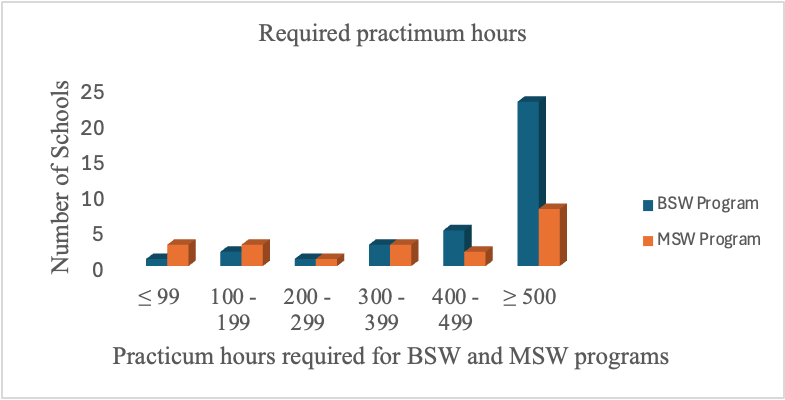
The results showed that 65% (n = 23) of the schools in our study require undergraduate students to complete 500 or more practicum hours during their program. Similarly, 40% (n = 8) of the schools with an MSW program reported that graduate students are required to complete 500 or more hours on practicum. Results indicated that the prevalence of concurrent practicum models (offering practicum concurrently with full-time coursework) is very similar to that of block placements (offering more full-time practicum with no or very few classes) for both undergraduate and graduate programs, with some schools offering both options (see Table 1).
Table 1
Practicum Schedule Over an Academic Year
| Practicum schedule over the academic year | BSW program (n = 33) | MSW program (n = 22) |
| Concurrent with full-time coursework (either two semesters or three quarters) | 13 (40%) | 9 (41%) |
| Both concurrent and block placement | 8 (24%) | 4 (18%) |
| Block placement (few, if any, concurrent courses) | 12 (36%) | 9 (41%) |
| Total | 33 (100%) | 22 (100%) |
The survey further inquired whether a practicum seminar is taken concurrently with either the first or second practicum placement in the BSW and MSW curricula. The results showed that 24 (80%) of the responding schools indicated that their BSW curricula require a concurrent seminar during the first and second BSW practicums. Similarly, 15 graduate schools (71%) indicated that the practicum seminar is taken concurrently with the MSW foundation-year practicum, while 13 schools (70%) indicated that the practicum seminar is conducted concurrently with the MSW advanced-year practicum.
Theme 2: Responsibility for Securing Practicum Opportunities
The responding schools also were asked to report on who is responsible for finding field placements for their social work students, whether the responsibility lay with the student, the practicum coordinator, or the faculty member (see Figure 3).
Figure 3
Responsibility to Find Practicum Placement
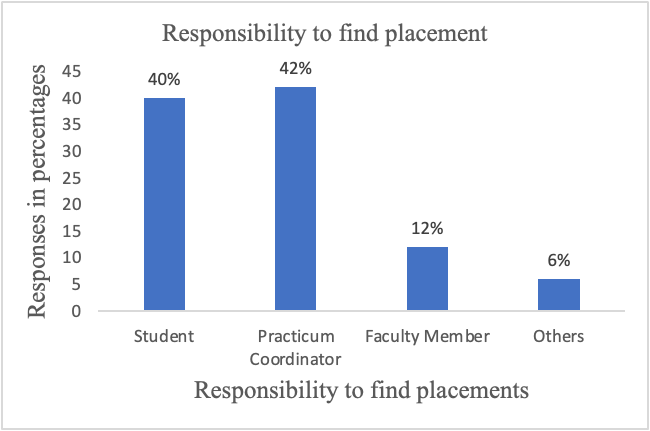
The results indicated that responsibility for finding placements falls most often on students themselves or on field coordinators, depending on the school. Other stakeholders in social work education, including practicum directors and faculty members, also share the responsibility in a smaller number of schools
Table 2
Practicum Coordinators/Directors’ Perspectives on Establishing Practicum Placement
| Statement | Strongly disagree/ disagree/ somewhat disagree | Strongly agree/agree/ somewhat agree | Not applicable/no response |
| 1. Having an appropriate practicum placement for students is an ongoing challenge. | 7 (17%) | 28 (68%) | 6 (15%) |
| 2. Pressures to increase students’ enrollment have affected practicum education processes, including identifying and providing appropriate placements to students. | 6 (15%) | 29 (70%) | 6 (15%) |
| 3. Because of the large numbers of students, placing students in practicum settings we would otherwise not choose to use is sometimes necessary. | 10 (24%) | 24 (59%) | 7 (17%) |
| 4. The region where we place students has adequate practicum opportunities to provide the full range of expected learning activities and experiences. | 15 (36%) | 20 (49%) | 6 (15%) |
| 5. The number of students admitted to my school considers the number of practicum opportunities typically available each year in this geographic area. | 27 (65%) | 8 (20%) | 6 (15%) |
| 6. It is not easy to cultivate new practicum opportunities because of the range of responsibilities assigned to the practicum coordinator. | 14 (34%) | 21 (51%) | 6 (15%) |
| 7. It is difficult to cultivate new practicum placements because of the complexity of student needs and requests, which often necessitate the design of unique and individualized practicum experiences. | 12 (29%) | 22 (54%) | 7 (17%) |
Beyond the basic responsibility of finding a placement, our survey also asked school representatives for their perspectives on the challenges of identifying field partners for the practicum. The results (see Table 2) indicated that African universities are under pressure to increase student enrollment, resulting in large numbers of social work students. Identifying and providing suitable placements for social work students is becoming increasingly challenging. It was also revealed that the number of social work students admitted by universities in a given academic year is not necessarily aligned with the number of practicum opportunities available to students in their respective locations.
Theme 3: Support for Practicum Students
Survey respondents were asked to report on the type of practicum support provided to BSW and MSW students in their schools. Table 3 provides a snapshot of the variety of forms of support available across the schools that responded to our survey.[3]
Table 3
Practicum Support Provided by the School for BSW & MSW Students
| Type of practicum support for BSW & MSW students | Yes | No |
| The school has a field office that provides support for BSW or MSW onsite students (n = 34) | 15 (44%) | 19 (56%) |
| The school has a field office that provides support for online/distance or blended BSW or MSW students (n = 19) | 6 (32%) | 13 (68%) |
| Administrative assistant or office professional assigned to field education functions (n = 35) | 12 (34%) | 23 (66%) |
| Faculty liaison who engaged in teaching and research to monitor students’ field education and communicate with the placement agency and supervisor during the student field education experience (n = 35) | 28 (80%) | 7 (20%) |
| Faculty liaison who monitors students’ field education and communicates with the placement agency and supervisor during the student field education experience (n = 33) | 20 (61%) | 13 (39%) |
| Sessional/part-time faculty liaison who monitors students’ field education and communicates with the placement agency and supervisor during the student field education experience (n = 33) | 9 (27%) | 24 (73%) |
| Combination of field faculty liaison and sessional/part-time supervision models (n = 34) | 13 (38%) | 21 (62%) |
| Online/distance or blended curriculum for BSW, MSW, or both BSW and MSW programs (n = 35) | 19 (54%) | 16 (46%) |
| Online/distance or blended program with field education staff distinct from field education staff for the onsite program (n = 18) | 6 (33%) | 12 (67%) |
The faculty liaison model, in which a faculty member who is also engaged in teaching and research monitors students’ practicum and communicates with the placement agency and supervisor during the practicum, was the most common form of support, implemented by 80% of the responding schools. Support was also offered in other ways. For example, most schools (54%) reported a combination of online and in-person practicum-related curriculum for BSW and MSW programs. Universities reported having dedicated offices to support practicum students more often for in-person placements (44%) than for online, distance, or blended programs (32%). Only 34% of the schools had administrative staff assigned to practicum functions. Support was offered in other ways. For example, a faculty liaison model, in which a faculty member who is also engaged in teaching and research monitors students’ practicum and communicates with the placement agency and supervisor during the practicum, was implemented by 80% of the responding schools.
Table 4
Prevalence and Types of Student Special Needs Within Placements
| Percentage of student placement | Other unique designs | Outside business hours | Within workplace | Disrupted and replaced |
| 20% or more | 14 (40%) | 4 (11%) | 9 (26%) | 1 (3%) |
| 11–20% | 4 (11%) | 4 (11%) | 4 (11%) | 1 (3%) |
| 6–10% | 2 (6%) | 2 (6%) | 3 (9%) | 2 (6%) |
| Less than 6% | 15 (43%) | 25 (71%) | 19 (54%) | 31 (89%) |
| Total | 35 (100%) | 35 (100%) | 35 (100%) | 35 (100%) |
Survey respondents were further asked about the prevalence of students presenting special needs in relation to their placements. The results presented in Table 4relate to the complexity of students’ placement needs, which require unique, individualized placement experiences tailored to each student. Such unique arrangements include placements outside school or agency business hours; within students’ current workplaces; and those disrupted by issues such as illness, family crisis, or conflict within the practicum setting.
Theme 4: Relationship with Practicum Agencies
While some universities have highly developed collaborations with agencies and organizations for student placement, and some lecturers have strong relationships with field supervisors, many universities leave students to find placements on their own and negotiate directly with agencies.
Table 5
Practicum Coordinators/Directors’ Perspectives on the School’s Relationship with Practicum Agencies
| Statement | Strongly disagree/ disagree/ somewhat disagree | Strongly agree/ agree/ somewhat agree | Not applicable/no response |
| 1. Most community agencies are committed to providing quality practicum instruction on an ongoing basis. | 14 (34%) | 21 (51%) | 6 (15%) |
| 2. Practicum opportunities depend heavily upon the willingness of agencies and their social workers to provide voluntary practicum instruction. | 0 (0%) | 35 (85%) | 6 (15%) |
| 3. Within the past five years, it seems that agencies have been struggling to provide practicum instruction, as agency budgets have been cut and staff positions lost. | 8 (20%) | 25 (60%) | 8 (20%) |
| 4. Within the past five years, practicum disruptions due to agency staffing and funding changes have become more common. | 10 (24%) | 23 (56%) | 8 (20%) |
| 5. My school is developing partnerships with community agencies to enhance collaboration in practicum every year. | 2 (5%) | 32 (78%) | 7 (17%) |
| 6. My school enjoys strong support from community agencies for many aspects of the practicum. | 7 (17%) | 28 (68%) | 6 (15%) |
It was also established that community agencies were committed to providing quality instruction while supporting social work schools in all aspects of practicum education. Most survey respondents reported that practicum opportunities for students depend heavily on agencies’ goodwill to take on students. Results further revealed that most African institutions invest significant time and other resources in developing collaborations with community agencies to facilitate practicum partnerships.
Insights from African Educators and Students on the State of Practicum Education
To explore and illustrate the meaning of our quantitative results, we drew data from our focus group discussions (FGDs) that addressed parallel themes. FGD participants were asked, overall, to identify promising social work practices. There was a relative consensus among participants that placements should be formal, well-structured, and guided by policy to ensure that universities and agencies meet students’ interests:
It needs a formal, organized structure and policy that involves three structures. That is the agency, the organization where the student is supposed to visit. Then, there is the supervisor at the institution where the student trainee is learning. Then, we have the agency supervisor, who will supervise the student in the placement organization. Moreover, it will also depend on the student’s passion. The student’s choice of experience depends on their qualifications and areas of interest. (Student participant FGD 1)
Some participants mentioned that formally aligning practicum with the social work education curriculum might not only help to improve assessment for social work students but also bring increased standardization among the many social work schools in Africa:
I believe field practice, in terms of education, begins with curriculum development, because if the curriculum is poorly designed, those who enter the field to conduct assessments may not know what to look for. I believe fieldwork is also an integral part of the training. We need to assess whether this person can perform well in the role, meet the program’s expectations, and align with their stated outcome. Therefore, if we fail to develop the program or curriculum from that level, we may not achieve significant progress in the field. (Faculty participant FGD 1)
Another curriculum-related issue that many FGD participants noted was that student instruction is very often carried out by parasocial workers—individuals who are not necessarily educated or trained in social work but are called upon to supervise social work students in practicum:
Now, you will find that many organizations in [our country] that offer social services, such as social work, are run by parasocial workers. People who are not necessarily trained as social workers often end up supervising social workers. So, I surveyed students, and one of their requests was to be helped with the job description because the people in the organizations are parasocial workers. They do not clearly understand the roles of social workers. So, you find that students do what the supervisors tell them, even if it is not the role they are supposed to perform. (Student participant FGD 3)
Unfortunately, the FGD participants reported minimal collaboration between supervisors, practicum coordinators and directors, and agency instructors. The participants considered that partnerships in practicum education programs needed urgent attention, and expressed the benefits of working in partnerships. During the FGD session it also emerged that resources available to social work education programs varied across different universities, with funds allocated to practicum education in particular being limited in African schools:
The main challenge is resource availability, as we need to hire supervisors when we bring students on board. Hiring supervisors means the department must manage those supervisors, number one. Number two, we need to train supervisors to understand the nature of our program. If they are not trained, it becomes an impediment to our students. (Faculty participant FGD 1)
Participants mentioned that some universities support social work educators in meeting students in the agency and engaging with them, a way to compensate for the lack of direct social work supervision. In other universities, field liaisons are not financially compensated for supervision expenses. Compensation for students, faculty liaisons, and field instructors for practicum-related expenses (such as transportation, meals, accommodations, and telecommunications) was raised as a strain:
I realize that our system allocates funds for field education. Sometimes a student is placed in [another city] 500 kilometers from here, and the institution has not facilitated your going. Moreover, if you go by your own means (transport fare), you will probably not get a refund, so I only go if I am provided with transport. (Faculty participant FGD 3)
The FGDs echoed the survey data in that, in practice, students often take on the responsibility of identifying agencies and establishing appropriate placement opportunities, expressing dismay that universities have little choice but to leave this responsibility to students: “In our organization, we receive students from social work programs, and no social work institution has ever contacted us to request that we admit their students for an internship. However, students come looking for internships, and we take them” (Field educator participant FGD 3). They argued that students often have less bargaining power to negotiate suitable placements with agencies, but also that students may select agencies less for educational quality than for basic convenience.
From my experience with field education, I have found that, as is the case at other universities, when we send our students into the field to find an organization, they tend to choose organizations that are convenient for them in terms of transportation and accommodation. In such circumstances, students may not dwell much on their learning expectations in the organization. (Faculty participant FGD 3)
During FGD sessions, participants emphasized the importance of individualizing practicum experiences to enhance students’ skills and knowledge and enable them to apply their learning experiences in social work practice settings where they reside.
Discussion
This study provides a snapshot of the state of social work practicum education in Africa. This discussion section situates our survey and focus group findings within the broader debate on social work practicum education in Africa. The findings should be understood in the broader context of the development of the social work profession in Africa.
Historically, social work education in Africa has been shaped by colonial legacies and the use of models imported from Western literature (Asamoah, 2018; Canavera et al., 2020; Mupedziswa et al., 2021; Twikirize & Spitzer, 2019). Thus, the practicum as a core pedagogical component has been influenced by these histories (Bhangyi & Makoha, 2023). Our findings, therefore, highlight the structural, pedagogical, and contextual realities shaping practicum education across the African schools that participated in our study. The findings illustrate a practicum landscape marked by institutional commitment yet constrained by resource limitations, uneven infrastructure, and the colonial historical legacy of the development of the social work profession on the continent. Despite these challenges, schools reported enacting or striving toward many of the decolonial fieldwork approaches suggested in our conceptual framework, including linking decolonial curriculum to field practice, ensuring rural practice, partnering with Indigenous institutions, and prioritizing community- and developmental-oriented fieldwork (Bhangyi & Makoha, 2023).
The findings highlight the common practice in African universities of beginning practicum in the first or second year of their programs, allowing students to grow in knowledge, skills, and values over the course of their studies. As several scholars note, practicum is the “signature pedagogy” of social work education and is essential for developing practical skills, professional knowledge, and ethical competencies (Amadasun, 2021; Bogo, 2006), a commitment that has been enthusiastically adopted by African schools. However, our findings demonstrate diversity in how social work schools structure practicum education. A significant portion of BSW and MSW programs require 500 or more practicum hours, an expectation that underscores a strong commitment to practicum as a central pedagogy of social work in Africa and that ensures that students are immersed in local communities and are exposed to culturally relevant forms of practice (Ibrahima & Mattaini, 2019; Kreitzer, 2012).
Survey results show that schools use both concurrent and block placement models with similar levels of prevalence, and some programs employ hybrid approaches. This diversity reflects attempts by different schools to balance learning with local realities. Concurrent models allow students to integrate theory and practice interactively, a benefit highlighted in the literature and by educators from many African regions (Dhemba, 2012; Schmidt & Rautenbach, 2016). Meanwhile, block placement models offer full-time engagement, which allows students to focus on meeting agency requirements for applying knowledge gained in the classroom without the pressure of other academic work (Dhemba, 2012).
Yet focus group discussions with students and educators from different schools in different countries indicate that, regardless of the model used, resource constraints significantly affect practicum implementation. Participants described situations in which academic supervisors lack transport allowances for field visits, leaving some students in distant placements unsupervised or minimally supervised. This illustrates how geographical location, funding, and institutional capacity profoundly shape the quality of practicum education in Africa.
Furthermore, the frequent reliance on parasocial workers (individuals without formal social work education or practicum instruction training) in field agencies signals the gap between curriculum design and implementation. While allowing for exposure and learning from community leaders, some participants felt that parasocial workers lacked knowledge of the profession’s role and ethical competence, leaving students vulnerable to misaligned responsibilities, and thereby raising concerns about the fidelity of the practicum experience. This finding aligns with that of Ferguson and Smith (2012), who emphasized the importance of students finding placements that allow them to integrate the core social work skills of listening, observation, and critical reflection, with an empathetic, nonjudgmental approach. Therefore, even as the African schools demonstrate a strong commitment to practicum, the current placement models operate within postcolonial structural constraints that challenge the realization of the intended pedagogical objectives.
Another significant theme of our findings concerns who is responsible for securing practicum placement. Depending on the school, survey findings revealed that although responsibility is shared to some extent, students or practicum coordinators bear the largest burden. These findings align with those of Gray et al. (2017), who found that social work practicum coordinators face several challenges in coordinating placements and matching students with supervisors. Focus group discussions, however, suggested that, in practice, students overwhelmingly assume responsibility for identifying and negotiating placement opportunities, often without significant university support. Participants expressed concerns that students have less bargaining power, especially when negotiating individually with practicum agencies, making them more vulnerable to inequitable exploitation or unsuitable learning arrangements. Of note, the International Association of Schools of Social Work (IASSW) and the International Federation of Social Workers (IFSW) stipulate that practicum education should occur in settings that reinforce students’ knowledge and skills (IFSW, 2020; IFSW & IASSW, 2014). Existing studies, such as those by Kreitzer et al. (2023) and Anka (2014), highlight the role of the Association for Social Work Education in Africa (ASWEA) in addressing hegemonic practices by creating culturally relevant education and practices that equip practitioners for social work in Africa.
Student responsibility for finding placements and the lack of resources to support practicums raise critical equity issues in practicum access. Students from marginalized backgrounds, such as those with limited financial resources or fewer social networks, may struggle to secure placements that align with their professional and career development interests. These findings align with Tanga (2013), who found that students travel to distant regions, often away from universities, in both rural and urban areas, to secure placements, creating hardship in low-resource environments.
The pressure on universities to increase enrollment compounds these problems. Many schools in our study agreed that increased enrollment has affected the availability of appropriate practicum placements, sometimes forcing students into lower-quality placements or in fields of practice they would otherwise not choose. In line with Ncube and Noyoo (2020), our findings suggest a practicum ecosystem characterized by competition and uneven access, in which students are admitted to programs without a parallel expansion of practicum opportunities, often resulting in a structural mismatch that disadvantages students and constrains practicum agencies. Therefore, there is a need for systemic reforms that redistribute responsibility for placement sourcing away from students and towards stronger school engagement with practicum agencies.
Although schools participating in this study assign a university supervisor to support students during practicum, practicum support varies across institutions and is characterized by significant gaps. Survey data revealed that only 44% of the schools in our study have dedicated practicum offices, and just 34% have administrative support specific to practicum functions, indicating that practicum in many African schools is administratively underresourced. The findings further show a widespread use of faculty liaisons, a model that demonstrates academic staff’s significant commitment to supporting students. Despite strong willingness and commitment to offer quality practicum instruction, focus group findings indicate that many faculty and agency instructors lack the resources to perform their supervisory duties effectively, especially when placements are in rural or remote regions far from the university, despite these settings being so critical to student learning (Bhangyi & Makoha, 2023). This aligns with previous studies documenting practicum challenges related to inadequate financial resources and limited staffing in African universities (Gray et al., 2018; Nadesan, 2020; Singini, 2025).
In addition, our findings highlight the growing necessity to support students with unique placement needs, including those requiring flexible hours, workplace-based placements, and placements disrupted by illness or family crises. These complex needs require institutional flexibility, yet many schools in Africa lack not only infrastructure but also policies to accommodate such unique practicum circumstances. Evidence from Balyejjusa et al. (2021), Ncube and Noyoo (2020) and Twikirize and Tusasiirwe (2015) highlights that some African schools provide clear, well-detailed fieldwork manuals to help students access practice literature that informs their understanding of practicum training concepts. Moreover, Nadesan (2020) suggested that the availability of locally developed practicum instruction manuals, orientation meetings, and regular placement visits greatly improves the quality of partnerships among all parties involved in practicum.
Accordingly, relationships between universities and practicum agencies emerged as a critical theme, indicating that staff in field placement agencies are committed to providing practicum instruction, despite it being voluntary. Yet our findings indicate that practicum agencies also face budget cuts, staff shortages, and growing service demand—all of which compromise their ability to serve as practicum partners. Our findings further show that many schools endeavor to build and maintain good relationships between students, supervisors, and placement agencies. Although the experiences vary across schools, these relationships remain fragile, informal, and heavily dependent on goodwill. But the individualized approach of students seeking their own placements also means the schools lose the opportunity to build more lasting relationships with field agencies. Unfortunately, FGD participants emphasized that, in the presence of resource constraints, collaboration between universities and agencies ultimately is often minimal.
The lack of coordinated collaboration contradicts best practices emphasized by the International Federation of Social Workers (IFSW) and the International Association of Schools of Social Work (IASSW) on the necessity of reciprocal partnerships to ensure ethical and quality practicum instruction (IFSW, 2020; IFSW & IASSW, 2014). Participants also articulated the transformative nature of stronger partnerships, expressing their desire for Memoranda of Understanding (MOUs), ongoing communication mechanisms, shared training opportunities, and collaborative supervision models to strengthen practicum education across the continent. In the same line, Anka (2014) argued for an MOU to assist both universities and practicum agencies in planning placements that best meet students’ aspirations, promote professionalism, and foster collaborations for experiential learning.
Limitations
This study was conducted during the COVID-19 pandemic, and the findings should be considered in that context. Recruitment challenges (as detailed in the Methods section) resulted in a limited sample of African schools of social work. In particular, there was low representation of respondents and participants from Central and Northern Africa. Finally, internet availability and connectivity issues may have affected potential participants’ capacity to complete the online survey, which was also only available in English.
Conclusion
This study is one of the first to go beyond single-case or country-specific studies to highlight trends in practicum education across different regional and institutional settings in Africa. The scan reveals that, while practicum remains a compulsory and valued component of social work education, it is often marginalized due to limited resource allocation, inadequate supervisor training, and inconsistent institutional support. Despite substantial challenges, many schools are integrating decolonial approaches to practicum, as suggested by Bhangyi and Makoha (2023), especially by prioritizing rural and community-based practice and partnering with Indigenous organizations (Nhapi, 2020; Opobo et al., 2025). The findings suggest that broader adoption of these contextually grounded practices by the Association of Social Work Education in Africa (ASWEA), the Association of Schools of Social Work in Africa (ASSWA), and independent national associations could significantly strengthen the quality and relevance of practicum across the continent. Key improvements include hiring qualified and competent agency instructors, formalizing partnerships through Memoranda of Understanding (MOUs), developing robust practicum manuals, providing supervisor orientation and training, and ensuring adequate practicum duration to allow students to integrate theory and practice. While institutional leadership and government support are essential to addressing systemic barriers, practicum educators must also play their part in advancing equitable, contextually relevant practicum experiences. Therefore, our findings underscore the challenges facing practicum education in social work schools and the considerable potential for transformation when schools, agencies, and professional bodies in Africa collaboratively commit to strengthening structures and aligning practicum with professional and community realities.
[1] The original survey upon which this study is based was designed by the CSWE in the United States. It was adapted for the African context with their permission.
[2] This included the International Association of Schools of Social Work (IASSW), Association of South African Social Work Education Institutions (ASASWEI), Association of Social Work Educators in Kenya (ASWEK), Association of the Schools of Social Work in Tanzania (ASSWOT), National Association of Social Workers of Uganda (NASWU), Rwanda National Organization of Social Workers, Senegal Association of Social Workers, Tanzania Association of Social Workers, The National Association of Social Workers Zimbabwe, the Association of Schools of Social Work in Africa (ASSWA), the International Federation of Social Workers (IFSW), and others.
[3] The number of responses to each statement varies because the statements did not apply to all programs.
References
Alschuler, M. (2021). Social work group supervision. In K. O’Donoghue & L. Engelbrecht (Eds.), The Routledge international handbook of social work supervision (1st ed., pp. 284–293). Routledge Publications.
Amadasun, S. (2021). Is the signature pedagogy still worthwhile? An empirical study of field practice experience among social work students in Nigeria. Social Work Education, 40(2), 229–243. https://doi.org/10.1080/02615479.2020.1771300
Anka, A. (2014). Social work in Africa: Exploring culturally relevant education and practice in Ghana. Ethics and Social Welfare, 8(2), 205–213. https://doi.org/10.1080/17496535.2014.896162
Arkin, N. (1999). Culturally sensitive student supervision: Difficulties and challenges. The Clinical Supervisor, 18(2), 1–16. https://doi.org/10.1300/J001v18n02_01
Asamoah, S. (2018). Historical overview of the development of communal labor from pre-colonial to post-independent Ghana. International Journal of Scientific and Research Publications, 8(4), 10–16. https://doi.org/10.29322/IJSRP.8.4.2018.p7603
Balyejjusa, S. M., Makoha, G., & Bhangyi, B. V. (2021). A handbook of social work field-work practice. Faculty of Arts and Social Sciences, Kyambogo University, Kampala.
Bhangyi, V. B., & Makoha, G. (2023). Decolonizing social work fieldwork education in Africa: Approaches, challenges and prospects. In J. M. Twikirize, S. Tusasiirwe, & R. Mugumbate, R., Ubuntu philosophy and decolonizing social work fields of practice in Africa (pp. 71–87).
Boboyi, A. (2024). Strategies for sustaining the accreditation of the Bachelor of Social Work in South Africa. Research in Educational Policy and Management, 6(2), 91–103. https://doi.org/10.46303/repam.2024.24
Bogo, M. (2006). Field instruction in social work: A review of the research literature. The Clinical Supervisor, 24(1-2), 163–193. https://doi.org/10.1300/j001v24n01_09
Canavera, M., & Akesson, B. (2018). Supervision during social work education and training in Francophone West Africa: Conceptual frameworks and empirical evidence from Burkina Faso and Côte d’Ivoire. European Journal of Social Work, 21(3), 467–482. https://doi.org/10.1080/13691457.2018.1441131
Canavera, M., Akesson, B., Landis, D., Armstrong, M., & Meyer, E. (2020). Mapping social work education in the West Africa region: Movements toward indigenization in 12 countries’ training programs. International Journal of Social Welfare, 29(1), 83–95. https://doi.org/10.1111/ijsw.12372
Chilanga, E. (2022). The current state of developmental social work theory and field education in Africa: A scoping review. Transforming Social Work Field Education, 69. https://tinyurl.com/33rx9u5t
Dhemba, J. (2012). Fieldwork in social work education and training: Issues and challenges in the case of Eastern and Southern Africa. Social Work & Society, 10(1), 1–16. http://nbn-resolving.de/urn:nbn:de:hbz:464-sws-13
Engelbrecht, L. (2010). Yesterday, today, and tomorrow: Is social work supervision in South Africa keeping up? Social Work/Maatskaplike Werk, 46(3), 324–342. https://doi.org/10.15270/46-3-162
Ferguson, I., & Smith, L. (2012). Education for change: Student placements in campaigning organizations and social movements in South Africa. British Journal of Social Work, 42(5), 974–994. https://doi.org/10.1093/bjsw/bcr143
Gray, M. (Ed.). (2016). The handbook of social work and social development in Africa. Taylor & Francis.
Gray, M., Agllias, K., Mupedziswa, R., & Mugumbate, J. (2017). The role of social work field education programs in the transmission of developmental social work knowledge in southern and eastern Africa. Social Work Education, 36(6), 623–635. https://doi.org/10.1080/02615479.2017.1310833
Gray, M., Agllias, K., Mupedziswa, R., & Mugumbate, J. (2018). The expansion of developmental social work in Southern and East Africa: Opportunities and challenges for social work field programs. International Social Work, 61(6), 974–987. https://doi.org/10.1177/0020872817695399
Greenblatt, A., Muskat, B., & Perlman, I. (2019). 10 years later… Are rotational field placements working? Clinical Social Work Journal, 47(1), 43–52. https://doi.org/10.1007/s10615-018-0694-1
Hall, N. (1990). Social work training in Africa: A fieldwork manual. Journal of Social Development in Africa. https://www.ifsw.org/wp-content/uploads/2021/12/Article-3.pdf
Hayward, F. M. (2006, June). Quality assurance and accreditation of higher education in Africa. In Conference on higher education reform in Francophone Africa: Understanding the keys of success (pp. 1–61).
Ibrahima, A. B., & Mattaini, M. A. (2019). Social work in Africa: Decolonizing methodologies and approaches. International Social Work, 62(2), 799–813. https://doi.org/10.1177/0020872817742702
International Federation of Social Workers (IFSW). (2020). 2020 to 2030 global social work and social development agenda: “Co-building inclusive social transformation.” https://tinyurl.com/yswdp8ha
International Federation of Social Workers (IFSW) & International Association of Schools of Social Work (IASSW) (2014). Global definition of the social work profession. https://www.ifsw.org/what-is-social-work/global-definition-of-social-work/
Kaseke, E. (1991). Social work practice in Zimbabwe. Journal of Social Development in Africa, 6(1), 33–45. https://n2t.net/ark:/85335/m57m0730j
Kreitzer, L. (2012). Social work in Africa: Exploring culturally relevant education and practice in Ghana. University of Calgary Press.
Kreitzer, L., Ouedraogo, V., Lombard, A., Twikirize, J., Abukari, Z., Tassé, A., & Musah, Y. (2023, February). Reclaiming the history of social work education in Africa: Initial learnings from the Association for Social Work Education in Africa (ASWEA) document analysis project. Bulletin of the Social Work History Network, 9(1), 41–42. https://hdl.handle.net/20.500.14078/3469
Mupedziswa, R., Modie-Moroka, T., & Malinga, T. (2021). Social work education in Botswana amid the COVID-19 pandemic: Reflections, strategies, and lessons. African Journal of Social Work, 11(4), 164–171. https://tinyurl.com/492rvtmn
Mwansa, L.-K. J. (2010). Challenges facing social work education in Africa. International Social Work, 53(1), 129–136. https://doi.org/10.1177/0020872809348959
Mwansa, L.-K. (2011). Social work education in Africa: Whence and whither? Social Work Education, 30(1), 4–16. https://doi.org/10.1080/02615471003753148
Nadesan, V. (2020). Challenges of social work students from historically disadvantaged universities during placements in semi-rural areas in South Africa. Southern African Journal of Social Work and Social Development, 32(3), 17. https://doi.org/10.25159/2708-9355/6509
Ncube, M., & Noyoo, N. (2020). The search for relevance: Social work supervision in a social development approach in South Africa. In T. Kleibl, R. Lutz, N. Noyoo, B. Bunk, A. Dittmann, & B. Seepamore, B. The Routledge handbook of postcolonial social work (pp. 337–347). Routledge.
Nhapi, T. (2020). Social work decolonization: Forays into Zimbabwean experiences, challenges, and prospects. Social Work & Policy Studies: Social Justice, Practice and Theory, 3(2), 1–15. https://tinyurl.com/3ca4dmej
Nhapi, T. G., & Dhemba, J. (2020). Embedding the developmental approach in social work education and practice to overcome poverty: The case of Southern Africa. Greenwich Social Work Review, 1(1), 11–20. https://tinyurl.com/nhf4wjm3
Opobo, T., Abalo, J., Mugumya, F., Kafuko, A., & Twikirize, J. (2025). Social work education in Uganda: A paradigm shift through the community social labs approach. Journal of Social Work in Developing Societies, 7(2), 67–85. https://doi.org/10.4314/jswds.v7i2.5
Poggenpoel, L. (2018). Social workers’ perceptions and experiences of fieldwork supervision in the Bachelor of Social Work degree [Master’s thesis, University of the Western Cape]. https://tinyurl.com/6jdpfxfr
Rautenbach, J. V. (2021). Global directory of schools of social work: Census 2020. International Association of Schools of Social Work (IASSW). https://tinyurl.com/2sryzme2
Robertson, J. S. (2013). Addressing professional suitability in social work education. The Journal of Practice Teaching and Learning, 11(3), 98–117. https://doi.org/10.1921/jpts.v11i3.278
Ross, E., & Ncube, M. E. (2018). Student social workers’ experiences of supervision. Indian Journal of Social Work, 79(1), 31–54. https://tinyurl.com/rw9n3m69
Schiff, M., & Zeira, A. (2016). Group supervision in social work field education: The perspective of supervisors. In I. Taylor, M. Bogo, M. Lefevre, & B. Teater (Eds.), Routledge International Handbook of Social Work Education (pp. 254–262). Routledge.
Schmidt, K., & Rautenbach, J. V. (2016). Field instruction: Is the heart of social work education still beating in the Eastern Cape? Social Work/Maatskaplike Werk, 52(4), 589–610. https://doi.org/10.15270/52-4-532
Singini, T. (2025). Challenges faced by social work students during field placements in Malawi. International Journal of Research and Innovation in Social Science, 9(11), 4017–4030. https://doi.org/10.47772/IJRISS.2025.91100311
Sowbel, L. R. (2012). Gatekeeping: Why shouldn’t we be ambivalent? Journal of Social Work Education, 48(1), 27–44. https://doi.org/10.5175/JSWE.2012.201000027
Tanga, P. T. (2013). The challenges of social work field training in Lesotho. Social Work Education, 32(2), 157–178. https://doi.org/10.1080/02615479.2012.741578
Transforming the Field Education Landscape. (n.d.). https://tfelproject.com
Twikirize, J. M. & Spitzer, H., Eds. (2019). Social work practice in Africa: Indigenous and innovative approaches. African Books Collective. Fountain Publishers.
Twikirize, J. M. & Tusasiirwe, S. (2015). Social work field education guidelines for students and supervisors. Fountain Publishers.
Veta, O. D., & McLaughlin, H. (2023). Social work education and practice in Africa: The problems and prospects. Social Work Education, 42(8), 1–12. https://doi.org/10.1080/02615479.2022.2029393