The impacts of climate change, ecological degradation, environmental injustice, and natural resource depletion are dramatically affecting the quality of all life on earth and the social, political, and economic systems on which all humans and nonhumans depend. Climate change increases the likelihood of extreme weather events that contribute to droughts, heatwaves, cold snaps, storm surges, hurricanes, and wildfires (Dominelli, 2023). The impacts of climate change are far-reaching, causing damage to the physical environment and affecting biodiversity, food security, livelihoods, energy security, human health, and socioeconomic activity (Dominelli, 2023). In southern Alberta in Western Canada, there is an urgent need for the social work profession to support communities in adapting to changing environments and to take action on climate change. This is particularly important given recent disaster events such as floods and wildfires in Alberta (King, 2024; Swensrude, 2023).
The United Nations 2030 Agenda for Sustainable Development and the 17 Sustainable Development Goals (SDGs) provide a comprehensive framework to address these complex challenges (United Nations, 2023). Green Social Work (GSW) practice principles align with the United Nations 2030 Agenda for Sustainable Development and can serve as an important framework for social work education. GSW values equity, social inclusion, resource distribution, and sustainable practices through environmental frameworks, environmental justice, and social justice principles (Dominelli, 2012, 2014, 2018). Social justice and climate justice issues, and social, economic, and environmental inequities, are deeply intertwined, and are increasingly recognized as central to social work practice. (Beltrán et al., 2016; Council on Social Work Education [CSWE], 2015; Dewane, 2011).
Research indicates that current and future generations of social workers must increase their awareness of how environmental concerns influence social, political, and economic systems (Drolet et al., 2015). GSW practice recognizes the interconnectedness of societal and environmental structures that contribute to human well-being through affirming human rights, utilizing sustainable resource practices, and addressing structural and social injustices (Dominelli, 2023). Furthermore, GSW recognizes that environmental issues disproportionately affect vulnerable populations such as youth, older adults, people experiencing houselessness, those living in poverty, racialized communities, and Indigenous communities, leading to environmental injustice (Boetto, 2017). Despite increased scholarly attention to environmental challenges, students and professionals report difficulties incorporating the environmental perspective into their social work practice (Wu & Greig, 2022).
The Climate Action and Advocacy in the Airways (CA3) project, described in this article, adopted a GSW approach to promote climate awareness within social work education, and offers a model of how to integrate environmental advocacy in social work practice. Practicum education needs to incorporate climate change adaptation and disaster risk reduction topics in experiential education (Drolet et al., 2015). The integration of climate justice and sustainability within social work practice requires intentional attention in practicum learning, as this is where students translate theory into practice (Wu & Greig, 2022). The implications for field education are described below.
Field Placement Development
Programs can expand partnerships with organizations engaged in environmental justice, community resilience, disaster response, sustainable housing, and related initiatives. This broadens the scope of social work field sites beyond traditional human service settings, positioning students to engage directly with communities affected by climate-related inequities.
Learning Objectives and Competencies
Field education curricula should include competencies that link environmental, structural, and social determinants of health and well-being (Drolet et al., 2015). For example, students could demonstrate the ability to assess how environmental issues intersect with poverty, health disparities, and displacement. Integrating these outcomes ensures students can apply a climate justice lens to practice at micro, mezzo, and macro levels.
Supervision and Reflective Practice
Field instructors and supervisors can be trained to facilitate reflection on how climate justice informs ethical decision-making, community engagement, and advocacy. Structured reflection activities—such as field journals or supervision discussions—can help students connect environmental issues to social work values, such as human rights and social justice.
Community-Engaged Learning
Field education can incorporate community-based projects focused on sustainability, such as local climate adaptation planning or resource access initiatives. These projects reinforce students’ understanding of collective empowerment and intergenerational responsibility.
Policy and Advocacy Practice
Students can be guided to identify and engage with policies that impact climate justice (e.g., health, housing, labor, energy, or environmental regulation) within their field agencies, helping them to see advocacy as an integral part of sustainable social work practice.
The CA3 Project
The CA3 project aimed to increase awareness, encourage public participation, and enhance the visibility of climate action initiatives in southern Alberta. The project created new opportunities for practicum students to engage in self-directed experiential learning by developing a podcast series and creating 17 SDG fact sheets. This article presents the CA3 project with a focus on climate action podcast episodes, SDG factsheets, and a climate action exhibition for knowledge mobilization, while sharing students’ leadership and reflections on their experiential learning experiences and the implications for GSW education and practice.
Project Description: The Podcast Series on Climate Action and Advocacy
The CA3 project is a partnership between the Transforming the Field Education Landscape (TFEL) partnership (TFEL, 2025) and CJSW radio at the University of Calgary in Alberta, Canada. The mission of CJSW radio is to provide space to foster creativity, collaboration, and communication between University of Calgary students and community stakeholders (CJSW 90.9 FM, n.d.-a). CJSW radio is a volunteer-led not-for-profit organization run by and for communities, focusing on local issues (CJSW 90.9 FM, n.d.-b). Our partnership with CJSW radio created an opportunity for students to mobilize community members by providing key information on climate action initiatives in southern Alberta through the creation of the eleven episodes of the podcast series. “Community” is used here in a broader sense, referring to residents in the southern Alberta region who experience similar climatic events (e.g., floods and wildfires) and share common concerns regarding these extreme events.
Students conducted research and engaged in applied experiential learning through community involvement, collaboration, and research to develop their respective podcast episodes. Students contributed to this project in various capacities. Several BSW and MSW students contributed to the project as part of their practicum, while others contributed as research assistants. In total, 11 social work postsecondary students engaged in conversations with community members and practitioners to create a prerecorded podcast that was aired on CJSW radio and was featured online on Apple Podcast, Spotify, and CJSW’s websites.
By embracing a storytelling approach, the podcasts highlight the value of dialogue for climate change advocacy. A group supervision approach was adopted, wherein the principal investigator (a professor of social work at the University of Calgary) and a research collaborator (a postdoctoral research associate in the faculty of social work at the University of Calgary) jointly supervised students through weekly supervision meetings. This approach allowed students to ask questions, learn from others, and engage in group discussion.
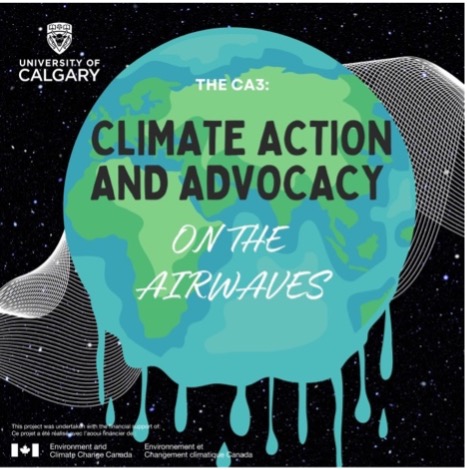
Reyan Jamaleddine (an undergraduate student at the University of Calgary), served as the executive producer of the CA3 podcast series, and provided oversight for the pre- and post-recording of each podcast episode. Her role included training students in podcast development, booking studio times, editing podcasts, and creating soundbites. Jamaleddine created the graphic for the podcast series displayed on CJSW radio’s webpage (See Figure 1).
Figure 1
Climate Action and Advocacy Podcast Graphic Design
Podcasts Series: The Student Experiential Learning Process
The podcast development process began with students reviewing the academic and grey literature and publicly available data sources in climate action and advocacy. Students then engaged in applied research through discussions with community members to learn about current environmental and climate-related community issues. Leveraging their learnings from these processes, they selected a topic area and began planning each podcast, including the title, content, potential guest speakers, and other relevant details. Students created a draft of their storyboard and script, which was reviewed by TFEL team members. After several rounds of review, each draft script was finalized, and students practiced reading their scripts aloud.
The next step was recording the episode, which took place at the CJSW radio station in order to access professional equipment, including microphone, computer, and audio editing software. After recording, the executive producer worked with the students in postproduction to edit the podcast as needed for flow and easy listening for the audience. After all these steps were completed, the podcast series was uploaded by CJSW Radio, as well as to Spotify and Apple podcast sites with assistance from the podcast coordinator, Kaamil Kareemi (CJSW 90.0 FM, n.d.-b, 2025a, 2025b). The podcasts created by social work practicum students focus on a range of topics, from disaster recovery to community gardens, food security, and sustainability (see Table 1).
Table 1
Climate Action and Advocacy on the Airwaves Podcasts and Creators
| Podcast episode title | Podcast creator |
| Rising Waters, Rising Resilience: The Quest for Sustainable Recovery | Andrea Murphy |
| In Full Bloom: Community Gardening and Climate Resilience | Suraj Khatiwada |
| Hidden in Plain Sight: The Overlooked Plight of Homeless Evacuees | Diana Ly |
| Plates Half Full: Unveiling the Layers of Food Insecurity | Sewak Subedi Gautam |
| From Dustbowl to Decolonization: The Promise of Natural Based Solutions | Simon Evans |
| Beyond Net Zero: Charting the Path for a Just Transition | Rachel Pettigrew |
| Fix it, Don’t Ditch it: Repair Exchanges and Sustainable Living | Natalie Calles |
| Green Gen-Z: The Sustainable Revolution | Sheikh Sabrina Ahmed |
| Educating Alberta Youth on Climate Change: Protecting the Future | Emily Babcock |
| Connecting Through Climate Cafes: Navigating the Climate Crisis Together | Paige Eaglesham |
| Faith in Action: Small Communities, Big Impact | Angele Enanga |
Environmental justice is an overarching theme emphasizing the need for equitable distribution of risk and resources and unpacking structural and systemic injustices (Dominelli, 2014). From advocating for equitable disaster preparedness strategies that incorporate vulnerable populations’ needs, to community gardens that create sustainable food practices, students identified the role of equitable resources in supporting human and nonhuman well-being today and in the future (Dominelli, 2014). The podcasts serve as a tool to mobilize and inspire change, emphasize community initiatives tackling climate change, and provide an educational resource for students and the community. The TFEL project created a Podcast Guidebook that served as a resource for podcast development and can contribute to advancing this approach to climate advocacy (Transforming the Field Education Landscape [TFEL], 2021).
Sustainable Development Goals (SDG) Factsheets
The United Nations’s 17 Sustainable Development Goals (SDGs) collectively work towards economic, social, and environmental sustainability through a global partnership (United Nations, n.d.). Postsecondary students involved in the CA3 project also created factsheets on the 17 SDGs (see Table 2). Integrating GSW and the SDGs into social work education demonstrates social work’s responsibility to address climate change and take action at individual, community, national, regional, and international levels (Dominelli, 2023). Practicum students researched how each goal is being implemented at provincial, national, and international levels, and critically evaluated ways to improve its implementation.
Table 2
Student-Created Fact Sheets on Each SDG
| SDG # & Title | Student creator |
| #1 No Poverty | Diana Ly |
| #2 Zero Hunger | Sewak Subedi Gautam |
| #3 Goof Health and Wellbeing | Regina Contreras |
| #4 Quality Education | Sara Guentheruni |
| #5 Gender Equality | Mafani Malange |
| #6 Clean Water and Sanitation | Rachel Pettigrew |
| #7 Affordable and Clean Energy | Nidhi Kotikalapudi |
| #8 Decent Work and Economic Growth | Emily Babcock |
| #9 Industry, Innovation, Infrastructure | Angele Alami |
| #10 Reduced Inequities | Roselle Pangilinan |
| #11 Sustainable Communities | Andrea Murphy |
| #12 Responsible Consumption | Natalie Calles |
| #13 Climate Action | Nidhi Kotikalapudi |
| #14 Life Below Water | Paige Eaglesham |
| #15 Life on Land | Simon Evans |
| #16 Peace, Justice, and Strong Institutions | Rachel Pettigrew |
| #17 Partnership for the Goals | Treeva Hakim |
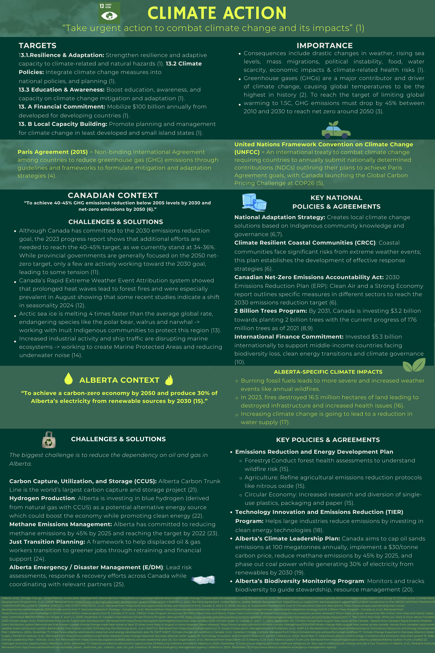
The fact sheets demonstrate the interconnectedness of sustainable development, as achieving one goal can be influenced by the success of another goal. For example, SDG #6, on clean water and sanitation within Alberta, can progress through clean energy initiatives that reduce the need for water usage in fossil fuel refining, which supports SDG #7, affordable and clean energy (TFEL, 2025). As stated in SDG #8, increasing clean energy initiatives within Alberta can support economic growth through job creation (TFEL, 2025). Additionally, there was a connection between SDG #4, quality education, and SDG #5, gender equality, as incentivising programs to encourage women to achieve higher education addresses barriers to education (TFEL, 2025). The development of the student-created fact sheets allowed students to understand the importance of their chosen SDG in a provincial and federal context while exploring the interconnectedness of each goal (see Figure 2).
Figure 2
SDG Student Fact Sheet, SDG #13 Climate Action
Climate Exhibition
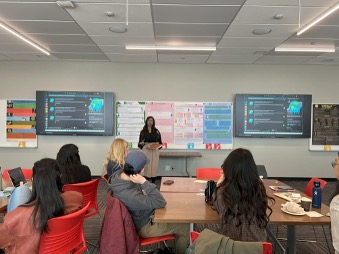
The CA3 exhibition showcased the student-created podcasts and SDG factsheets at the University of Calgary Office of Institutional Commitments. It was an important event to emphasize the importance of GSW practice and mobilize community-based action. The CA3 exhibition was a weeklong poster and podcast presentation organized in collaboration with the TFEL Event Series, the Sustainable Development Goals Alliance (SDGA) student group, and the Office of Institutional Commitments at the University of Calgary (see Figure 3). The exhibition allowed viewers to learn about the importance of collective action in sustainability and climate action within southern Alberta. The full booklet on the CA3 podcast series and the 17 SDG factsheets can be found on the TFEL website (TFEL, 2025).
Several students who contributed to this project through developing the podcast series and factsheets were also involved in organizing and hosting the exhibition. Their involvement included logistics, such as renting space, printing factsheets in poster format, and arranging catering services. Students hosted different sessions of the exhibition, including the opening session and a conversation on green social work. Students were highly encouraged to participate in the exhibition and showcase their work; participation was not mandatory.
Figure 3
Climate Action and Advocacy Exhibition
Student Reflection on Experiential Learning
The students who worked on the 11 podcasts episodes and 17 SDG fact sheets gained a deeper understanding of sustainability, individual and collective responsibility and accountability to the environment, and the interconnections to climate action. Student reflection on the research process and key learnings demonstrate that this experience gave them new perspectives on the importance of GSW within social work practice. One MSW student stated, “The process also strengthened my research skills and ability to translate complex data into accessible knowledge, a key competency for both academic and professional settings” (TFEL, 2025). The CA3 project created new learning opportunities for practicum students to develop research skills, critical thinking, and the ability to apply a GSW approach within their practice. These experiences align with the University of Calgary Experiential Learning Framework by offering students the opportunity to acquire and develop new skills through interactions with the community (University of Calgary, 2025).
Students involved in the project learned the importance of collaboration and collective action. For example, one MSW student stated, “I recognized the importance of interdisciplinary collaboration, as achieving SDG #11 requires cooperation between policymakers, urban planners, and social service providers” (TFEL, 2025). Students expressed increased awareness about the importance of community action to create change. One MSW student explained,
Through my research I not only learned about the devastating impacts of climate change, pollution, and overfishing; but I also uncovered many groups that are putting in the work on the frontlines, which sparked some much-needed hope and inspiration during our climate crisis (TFEL, 2025).
This reflection illustrates how students identified that their research inspired hope by learning about community resiliency in climate change.
The students involved also identified challenges in sustainability and community action and the need for further action and awareness. A BSc student stated, “This process allowed me to understand the gaps in climate-related discussions and where more advocacy is required” (TFEL, 2025). Furthermore, the CA3 project allowed students the opportunity to research their areas of interest and understand them within a GSW context. As a MSW student explained, “Some of my key interests as a social worker include sustainable development and green social work, and I learned more about them on a macro scale when doing my research for this project” (TFEL, 2025). The lessons learned by the students involved with the project show how research, collaboration, community, hope, advocacy, and personal responsibility connect to GSW practice.
The CA3 project exemplifies the importance of social work students participating in applied learning in GSW practice. The podcasts and SDG factsheets allowed them to learn about GSW practice from hands-on experience in student-led research. Students who participated in the CA3 project learned the widespread implications of environmental injustice, the importance of community collaboration, and sustainable practices.
Conclusion
The CA3 project demonstrates the importance of experiential learning for social work students in climate action. It is critical for students to develop an understanding of the interconnections between climate change, injustice, and community engagement. The 17 SDG fact sheets allow students to interpret complex data and information and learn how to communicate it to the general public.
Students with diverse backgrounds share their perspectives while amplifying community voices and lived realities of climate change. For example, the podcasts evidence how youth and Indigenous communities are disproportionally affected by climate change. Podcast listeners are encouraged to think critically about their consumption, eco-anxiety and well-being, and the importance of individual and collective action.
Further, the CA3 project advances student learning on GSW practice in applied education. Postsecondary students learn about the need for the social work profession to incorporate GSW practice to support communities’ adaptation to changing environments. The need for GSW education will only increase as climate change continues to affect all areas of life. The CA3 project showcases how student-led research and community mobilization can be achieved through a podcast series, SDG factsheets, and a climate action exhibition, creating meaningful engagement with GSW practices.
Funding Statement
The CA3 project was support in part by funding from a Mobilizing Alberta grant, Environment and Climate Change Canada, and the Social Sciences and Humanities Research Council (SSHRC).
References
Beltrán, R., Hacker, A., & Begun, S. (2016). Environmental justice is a social justice issue: Incorporating environmental justice into social work practice curricula. Journal of Social Work Education, 52(4), 493–502. https://doi.org/10.1080/10437797.2016.1215277
Boetto, H. (2017). A transformative eco-social model: Challenging modernist assumptions in social work. British Journal of Social Work, 47(1), 48–67. https://doi.org/10.1093/bjsw/bcw149
CJSW 90.9 FM. (n.d.-a). About. https://cjsw.com/about/
CJSW 90.9 FM. (n.d.-b). CA3: Climate action and advocacy on the airwaves podcasts. https://cjsw.com/program/ca3-climate-action-and-advocacy-on-the-airwaves-podcasts/
CJSW 90.9 FM. (2025a). CA3: Climate action and advocacy on the airwaves podcasts. Apple Podcasts. https://tinyurl.com/ycf6ztjm
CJSW 90.9 FM. (2025b). CA3: Climate action and advocacy on the airwaves podcasts. Spotify. https://tinyurl.com/29xamknp
Council on Social Work Education. (2015). Curricular guide for environmental justice. https://www.cswe.org/products/curricular-guide-for-environmental-justice/
Dewane, C. J. (2011). Environmentalism and social work: The ultimate social justice issue. Social Work Today, 11(5), 20. https://www.socialworktoday.com/archive/092011p20.shtml
Dominelli, L. (2012). Green social work: From environmental crises to environmental justice. Polity.
Dominelli, L. (2014). Promoting environmental justice through green social work practice: A key challenge for practitioners and educators. International Social Work. 57(4), 338–345. https://doi.org/10.1177/0020872814524968
Dominelli, L. (2018). The Routledge handbook of green social work. Routledge.
Dominelli, L. (2023). Social work practice during times of disaster: A transformative green social work model for theory, education, and practice in disaster interventions. Routledge. https://doi.org/10.4324/9781003105824
Drolet, J., Wu, H., Taylor, M., & Dennehy, A. (2015). Social work and sustainable social development: Teaching and learning strategies for “green social work” curriculum. Social Work Education, 34(5), 528–543. https://doi.org/10.1080/02615479.2015.1065808
King, J. (2024, November 3). Another record-breaking wildfire season comes to an end in Alberta. Global News. https://tinyurl.com/mrx8hdsp
Swensrude, S. (2023, June 23). Alberta floods: Rivers receding west of Edmonton, some evacuation orders dropped. Global News. https://tinyurl.com/yav5jmtu
Transforming the Field Education Landscape (TFEL) (2021). Podcast Guidebook. University of Calgary. https://tinyurl.com/5n94j7dv
Transforming the Field Education Landscape (TFEL) (2025). Climate Action & Advocacy: A Podcast Series & 17 Sustainable Development Goal Fact Sheets. University of Calgary. https://tinyurl.com/5n7j8f8z
United Nations. (n.d.). Transforming our world: The 2030 agenda for sustainable development. Department of Economic and Social Affairs. https://sdgs.un.org/2030agenda
United Nations. (2023). Global sustainable development report 2023: Times of crisis, times of change: Science for accelerating transformations to sustainable development. https://tinyurl.com/2pnrn6jz
University of Calgary (2025). Experiential learning plan. https://tinyurl.com/mm4ca78h
Wu, H., & Greig, M. (2022). Adaptability, interdisciplinarity, engageability: Critical reflections on green social work teaching and training. Healthcare (Basel, Switzerland), 10(7), 1245. https://doi.org/10.3390/healthcare10071245