Abstract
This qualitative case study employs classic grounded theory to explore the experience of a Master of Social Work (MSW) program field director during the development of a new MSW program. By abstracting data, the findings revealed the grounded theory of focused student engagement as a solution to the main concern of loss. This is achieved through a social process of anticipating (growth, needs), sacrificing (money, time), investing (personal connection, quality work), and deciding (engaging, problem-solving). Implications are anticipatory cautions, self-assessed capacity, and needed support, including guidance for field directors embarking on inaugural MSW field programs.
Keywords: MSW field pedagogy, MSW program development, student engagement, sacrifice
From 2010 to 2020, Master of Social Work (MSW) programs in the United States increased by 53%, with a projected 25% growth rate from 2020 to 2026 (Council on Social Work Education [CSWE], 2025). Currently, there are 360 accredited MSW programs, and over 900 social work programs total in the US (CSWE, 2026). This statistical trend is expected to meet the need for ongoing MSW student growth (CSWE, 2025). The social work profession is anticipated to grow 7% through 2032, making it one of the fastest-growing professions in the country, with nearly 65,000 new social work positions added each year (U.S. Bureau of Labor Statistics, 2025). Economic demand compels the growth of MSW programs; MSW programs, in turn, supply the market with qualified clinical social work professionals.
With each new MSW degree program comes a new MSW field education program. MSW field education has specialized standards and considerations for programmatic development and implementation. As the signature pedagogy of social work programs, field education benchmarks span across nine competencies, integrating classroom and applied skills (CSWE, 2022). Thus, two people within one MSW program develop two connected programs: one in the administrative realm and the other in the practice community. Field education standards require both instruction and socialization for experiential learning (CSWE, 2022, p. 20), adding additional challenges to structural programmatic development. Discussion of this is compelled by the evident growth of the social work profession, the expansion of social work higher education, and the proliferation of new programs across the country.
Challenges
Growth presents unique challenges for the creation of new MSW field programs, such as meeting the demand for quality field practicum opportunities and establishing advanced field placements. BSW programs expanding into the MSW are faced with a plethora of obstacles in securing advanced field placements, such as agency funding cuts, increased caseloads, and staff reduction (Bogo et al., 2022; Drolet et al., 2023; Lynch et al., 2023); dwindling agency support in field education due to a decrease in placement opportunities and available agency supervisors (Bogo et al., 2022; Drolet et al., 2023); dependency on telehealth (Ashcroft et al., 2021); and insufficient resources, time constraints, and demanding workloads (Wayne et al., 2006). Drolet et al. (2023) found that students felt their wellness and self-care were prioritized in MSW field placements, even amid demands and current challenges; however, this feeling was uncertain for field directors and supervisors.
Austerity Policies
Field placements traditionally have been perceived as mutually beneficial both for agencies and for field practicum students, as well as for the field program itself; however, according to Eaton (2026), contemporary austerity policies, such as reduced or absent staff available to supervise students, can threaten or limit the efforts of potential field agency partners. A reliance on agency partners’ altruism to provide, create, and modify field practicum placements for social work programs has been noted in the literature. Challenges arise from such reliance, since providing such support is conditional and voluntary (Dill, 2025; Lynch et al., 2023). For example, when the demands of a field director’s administrative role result in less frequent contact with agency partners (Dill, 2025), this may make securing field placements more difficult. Additional obstacles to agency altruism are privatization and focused clinical social work (Eaton, 2026).
Clinical Focus
As prescribed in CSWE’s 2022 EPAS (CSWE, 2022), macro, mezzo, and micro approaches all are required competencies for application and integration within field education. However, students are presenting increased preferences for clinical field placements (Eaton, 2026; Karabanow et al., 2020). This preference is connected to higher salaries for private counseling positions and the privatization of behavioral health services (Eaton, 2026; U.S. Bureau of Labor Statistics, 2025). This narrowed understanding of social work field education limits students’ interest in community-based practice, although macro practicum opportunities are present in micro settings (Karabanow et al., 2020). Additionally, direct-practice and advanced clinical placements are not always readily available to students in MSW programs, especially in counseling settings. This presents an additional challenge to field directors securing limited clinical placements for the many MSW students requesting them. While austerity policies and student preference for clinical placements present added challenges for MSW field directors, there are potential stopgaps.
Stopgaps
To address the challenges specific to new MSW field program development, such as unpaid field placements, lack of existing faculty resources, and consideration of unique field education challenges, compensation and mentorship can provide stopgaps. Compensation for field students and field supervisors would lessen the reliance on altruism. Mentorship for field supervisors when integrating existing faculty into these roles would provide additional support to field directors when creating new field education programs.
Compensation
Added compensation for students, supervisors, and field program directors would be one response to austerity policies impacting altruistic efforts. To address ethical concerns about unpaid work in MSW field practicum, employment-based field placements may be a remedy (Eaton, 2026; Lynch et al., 2023). Compensation for field students, whether at their place of employment or in new settings, would provide a “more equitable field experience” (Lynch et al., 2023, p.1). With such placements, field directors must modify conventional supervisory techniques to ensure students are afforded graduate-level learning opportunities and encounter new realms of competency-based practice in the field. While field directors are given time and effort considerations for new programming—not necessarily as compensation, but perhaps as course releases—additional support is needed as the program establishes itself and grows beyond its current faculty capacity. Agency-based field supervisors for MSW field placements are traditionally not reimbursed for their services (CSWE Spark, 2024). However, more universities are offering stipends to field supervisors. Federal workforce training grants also allow field supervisor stipends (Grants Office Communities, 2026).
Mentorship
Additional support can be found through existing faculty resources. Wilderman et al. (2025) found that integrating existing faculty as field supervisors can create stability and reduce growing pains for a new MSW field department. Holcomb (2024), in a study of formal mentorship, found that field directors reported the highest interest in both providing and receiving mentorship. Formal mentorship can foster a positive culture in social work programs, provide support, and create connections within environments where online work can lead to disconnection (Holcomb, 2024). Research suggests that due to the responsibility faced by field directors, mentorship for them should be required and integrated into EPAS guidelines (Holcomb, 2024). Field directors report a general lack of training, support, and most importantly, preparation for new MSW programs within their roles from their educational institutions (Holcomb, 2024).
As MSW programs increase nationwide to meet the social work profession’s forecasted job growth, challenges must be addressed to lessen the burden on administrators creating these programs, especially in the realm of field practicum. As a community-driven endeavor, field directors face obstacles, as do potential field sites, due to funding cuts, austerity policies, and the strains of altruism on agencies, which affect their capacity to formalize field placement opportunities. This study explores some of the administrative complexities faced by a field director when creating a new MSW field program, offering a unique and classic grounded theory that delineates the process for solving challenges.
Methodology
This research study is a qualitative, exploratory study that employs classic grounded theory methods to generate substantive theory particular to this case study (Glaser, 1978, 1998, 2001). The purpose of the study was to explore the particular experiences of the field director responsible for developing and implementing a new MSW program at a rural, regional, and public university. Because the problem area is not assumed a priori in classic grounded theory, interview questions pertain to experience in a particular area, and abtractions of particpant data lead to the main concern, or problem definition (Glaser, 1978). Classic grounded theory presents a single spill question to begin the interviews; the spill question for this study was “What has been your experience in designing and implementing a new MSW program, especially in the context of field pedagogy?” This project has been reviewed by the IRB of this university and approved as protocol #2525014. Records pertaining to proposal review and approval are available upon request.
Classic (Glaserian/Orthodox) grounded theory is a data-driven, inductive research method that can be used with both qualitative and quantitative data and varied sample sizes. The topic of interest drives constant comparative data coding to identify core, substantive, and theoretical codes that feed into a basic social process. The researcher abstracts data to identify and name the stages of a social process, thereby revealing a main concern and solution. The method is a heuristic, participant-driven, strengths-based process. The method differs from traditional qualitative data analysis in that a problem area is not defined a priori, sampling is theoretical as opposed to variable-based, data is abstracted by the researcher as opposed to a reliance on quotes as evidence, codes are conceptualizations as opposed to descriptions, and literature is integrated into the results as comparative analysis so as to not influence the emergent theory (Glaser, 1978, 2001).
Theoretical sampling is a purposive, non-probability–based sampling method that focuses on a specific group of interest because of their knowledge and experience relevant to the topic. Purposive sampling was used in this study because it aligns with theoretical sampling and does not extend beyond the MSW program at this university. The researcher, the first new faculty member in the MSW program of three faculty (program director, field director, and assistant professor), proposed the study to the directors, and throughout the study discussed with them consent, data checking, and willingness to publish the results. This process was revisited throughout data collection and manuscript preparation, with participants continuously updated on the study findings. The research process was navigated by sharing all materials, theoretical implications, and rationale with participants.
The study sample initially consisted of the primary faculty responsible for developing the new MSW program (the program director and the field director). Both participants answered the same spill question; however, data analysis revealed minimal thematic connections between them. This study pertains to the field director only, who was the previous field director at this university’s BSW program, and is a career field educator and licensed doctoral social worker.
While rare in classic grounded theory, case studies have been used to generate grounded theory (Laws & McLeod, 2004; ResearchGate, 2015). Additionally, initial case studies can direct subsequent theoretical sampling (Al Adwan, 2017; Charmaz & Thornberg, 2021). Although unconventional, case studies can direct theoretical sampling to test hypotheses, which is a requirement in classic grounded theory (Glaser, 1978). Saturation for this case study was not possible since sampling did not extend beyond this case; however, the study does suggest a theoretical sampling frame and supports future comparative analysis for focused student engagement. As mentioned above, this initial case study limits the sample to one field director, as opposed to also including the program director, due to the original study not presenting associated codes or themes.
Data were collected through four one-hour interviews with the participant. Interviews were recorded, transcribed, and hand-coded. Adjusted conversational interviewing was the engagement mode during the interviews, which uses flexibility to determine concepts embedded in participant reports, ensuring that the researcher clarifies concepts by checking with the participant (Glaser, 2001). Follow-up questions during the interviews were clarifying and comprehension-checking requests; the spill question remained the same for each interview. The data collected from the transcribed interviews were fractured, sorted into open codes for 13 categories, and sorted again into four substantive codes. Sorting and coding required constant comparison of data, delimiting codes, and selective coding. Memoing, which is ongoing through the method, is the recording of ideas and abstractions during sorting and coding and delimits theoretical codes. Abstraction began during the third sort, when the theoretical codes emerged. The problem area was identified in the third sort as well. The solution to the problem area was evident in the fourth sort. Theoretical codes overlap helped identify the basic social process from the third sort to the fourth sort. An existing complementary theory was identified after abstraction was completed; then the main concern, basic social process, and grounded theory were named.
Classic grounded theory treats existing complementary theories as additional data and are presented with results in a comparative analysis (Glaser, 1978, 1998, 2001). In classic grounded theory, the researcher is expected to be completely honest about the data, and a literature review is not conducted beforehand (Glaser, 1998). Since it is not the intent of classic grounded theory to support established theories, a hypothesis is not defined a priori; the literature is interwoven with the results and presented after the research findings. The comparative analyses, hypotheses, and conceptualized emergent theory are presented below.
Results
The major hypothesis of loss is the main concern, and focused student engagement (the “personal touch”) is the solution to the main concern, with this solution being achieved through the basic social processes of anticipating, sacrificing, investing, and deciding. The emergent grounded theory is focused student engagement.
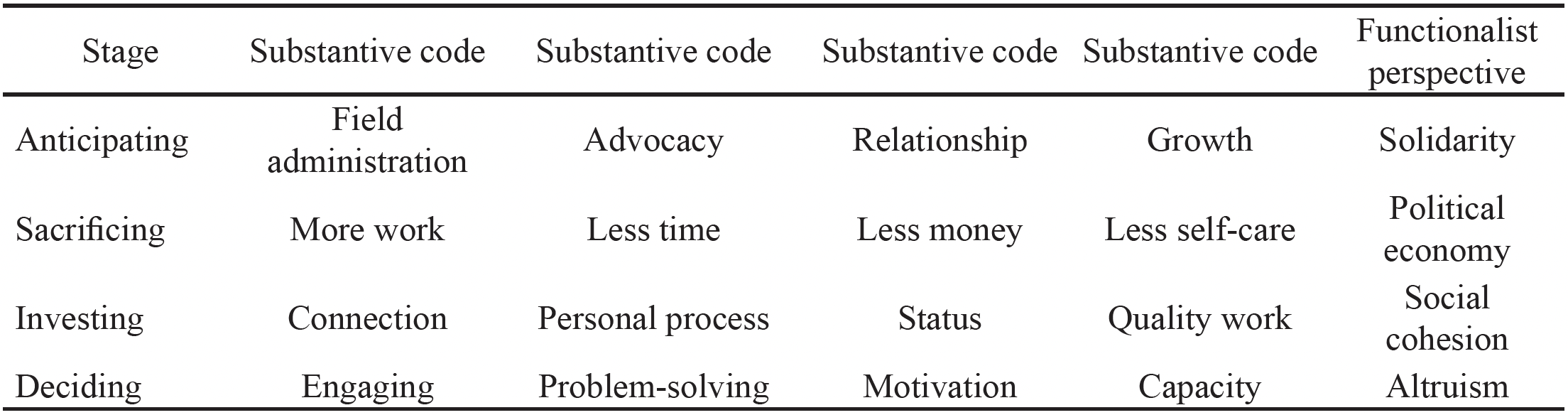
Loss, the main concern, is inevitable given the tremendous change involved in designing and implementing a new MSW field program. Routines and schedules that were running smoothly are about to be significantly disrupted. This change will result in a loss of time, money, and self-care practice, and in increased administrative politics that perhaps are not at the forefront of BSW programming. The main concern consists of experiencing, acknowledging, and anticipating this loss as the program grows. Focused student engagement, i.e., the personal touch, which is the solution to the main concern and the grounded theory itself, is focused primarily on quality, i.e., enhanced interactions with MSW students within field practicum; however, engagement also includes advocacy for the field program itself during its design and implementation. Increased and focused engagement with students in the new MSW field program creates immediacy, offers a solution or antidote to eventual loss, relieves pressure from the stress involved in problem-solving new programming, and is a reward to the field director when navigating loss. This reward is a commitment to the new MSW field program through student engagement. See Table 1 for social process stage codes, main concern, solution, and theoretical codes. This table presents the timing of the emergent theory’s main concern and solution with repeating substantive codes’ and how they build theoretical codes.
Table 1
Substantive and Theoretical Codes’ Connection to Corresponding Stages and Grounded Theory

The Functionalist Perspective and Sacrifice
Existing theoretical connections, used as comparative data in classic grounded theory, point to an association with Durkheim’s functionalist perspective on sacrifice that overlaps with the basic social process stages (Datta, 2019; Jones, 1981; Ptacek, 2015). Durkheim and modern theorists assert that sacrifice can strengthen social cohesion, especially in times of stress. Sacrifice presents a paradox. It is required for cohesion and to smooth out the developing field of graduate pedagogy; however, the field director must also advocate for the program while being careful with resources. Sacrifice then becomes less of a professional issue and more of a personal one, since personal time and financial gains are lost, while the field department’s needs cannot be compromised.
According to Durkheim, sacrifice, in simple terms, is giving up something contracted, expected, deserved, or rewarded (Allen, 2013; Datta, 2019; Jones, 1981; Pickering, 1984; Ptacek, 2015; Weddle, 2017). Sacrifice can be perceived as not advocating for what has been agreed upon in employment, such as pay, or as similar to family systems that expect unbalanced responsibilities. The person doing the sacrificing is relinquishing an earned token to support or build community or a program, or perhaps foregoing financial rewards, whether in terms of unpaid work, increased workload, or lack of commensurate pay. In any context, sacrifice can be perceived as a gift given to others, with the expectation of an in-kind or greater return (Hallgarth, 2024).
In modern investigations of sacrifice, fiscal impacts are integrated in the context of capitalism and political economy (Datta, 2019). Fiscal sacrifice implies that inequities are present and that, to make a monetary sacrifice, one must have the capacity to do so (Datta, 2019; Shilling & Mellor, 2013, p. 85). This fiscal loss can create power inequities, and such gift-giving may lessen social cohesion. In this study, the participant provided gifts of time and quality work, while sacrificing monetary gains such as overtime, because they had the capacity to do so. The participant had the freedom to make this choice, while others may not, thus possibly lessening social cohesion due to a lack of mutuality. These actions overlap dimensions of social cohesion, altruism, and political economy, since the complexities of sacrifice lie in the capacity to give, the expectation of return, and the ability to create social truths within a collective. Table 2 presents the basic social process stages, their substantive codes, and the Durkheimian functionalist perspectives connections. This table shows how the stages are built through substantive codes and their theoretical overlap to Durkheimian concepts of sacrifice. For example, sacrificing entails more work and less time, thus linking monetary ability (political economy) to making such a sacrifice.
Table 2
Basic Social Process Codes with Durkheimian Functionalist Perspective Connections
Focused Student Engagement Basic Social Process Stages
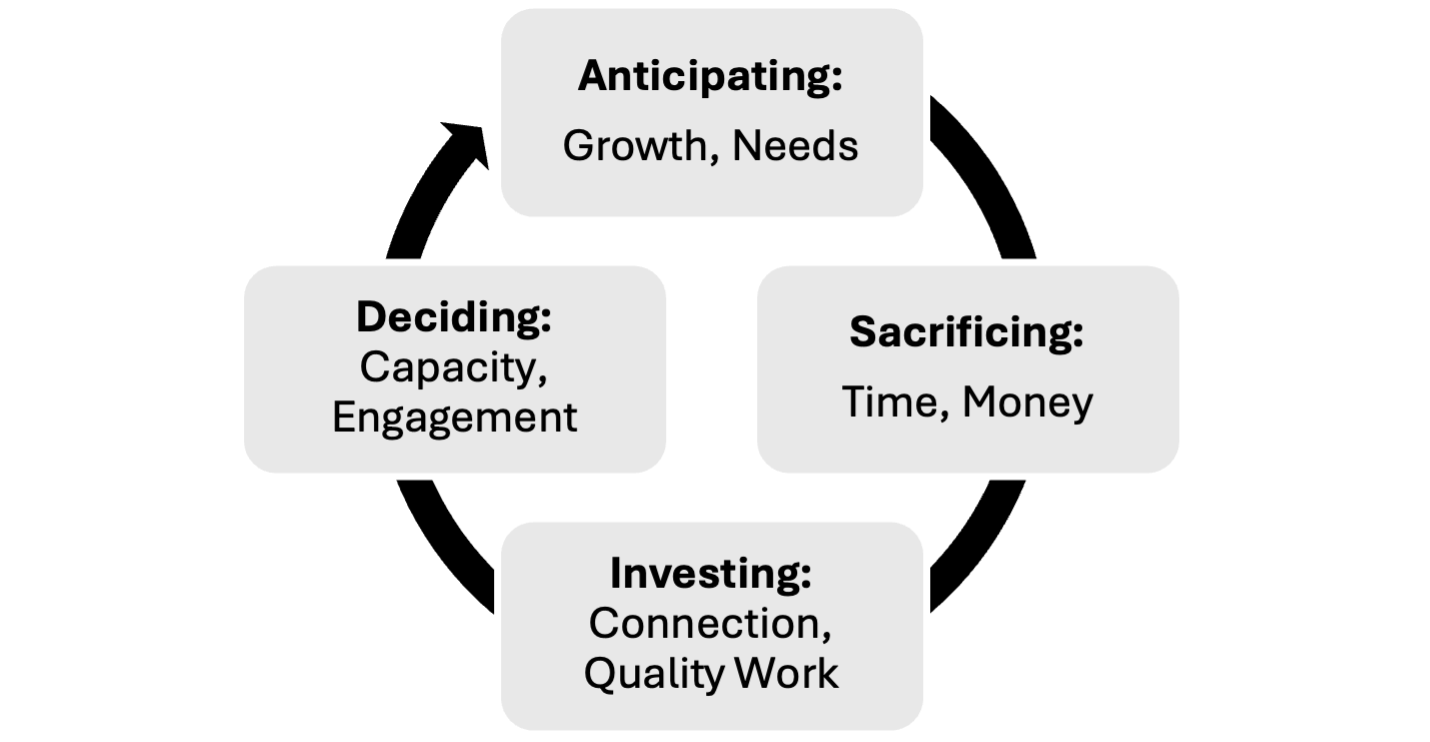
The main hypothesis supports a generated theory of focused student engagement, achieved through four social process stages: anticipating, sacrificing, investing, and deciding. The stages present (a) action-oriented innovation to solve the main concern of loss, (b) redirection by focusing on student engagement to offset sacrifice, and (c) anticipating growth and investing in quality field education to control outcomes for a personalized graduate-level student experience. Figure 1 presents the basic social process stages of focused student engagement, the grounded theory, and the substantive codes in the cycle. In this figure, process stages are shown in sequence with prominent theoretical codes as drivers of each stage. For example, the beginning stage, anticipating, is driven by program growth. Next is sacrificing, driven by increased time investment, then investing in the work, and ultimately deciding through full engagement in the process.
Figure 1
Basic Social Process Stages of Focused Student Engagement Grounded Theory
Anticipating Stage
The first social process stage that propels the resolution of loss is anticipating. Anticipating is an abstracted perspective of the participant’s navigation of overall program growth and specific field administration. It includes field program advocacy and relational interaction with the program director. Anticipating program growth requires mindfulness, new graduate-level discourse, and operational concerns. These include anticipating the time required to secure new field placements, advancing clinical opportunities for existing BSW placements to transition into MSW placements, and defining the necessary, action-oriented details in practicum competencies, assessment, and evaluation. Anticipating requires liaising with the program director and developing new field placement initiatives.
The anticipating stage assesses the understanding of other entities, such as university administration and community partners, related to field pedagogy, including how it differs from classroom teaching, the time required to secure field placements, and the general challenges of field directorship. At this stage the field director must advocate for the needs of the new MSW field program within the dyad of the new MSW faculty (program director and field director) for best practices, CSWE competencies, and strategic field internships. The anticipating stage overlaps with conceptualizations of sacrifice through the component of solidarity, since the field director must establish loyalty to the program’s growth process and align with the program director, thereby increasing camaraderie between them.
Sacrificing Stage
The second social process stage is sacrificing (also a theoretical code) that is the most notable code in its immediacy, repetition, quantity, and breadth. Sacrificing best symbolizes the recurrence of the main concern, loss, andis an abstraction of the acceptance of loss of time, money, and self-care. An increase in political elements in graduate-level studies is also a new challenge seen in the sacrificing stage, due to the time required to provide rationale and financial justifications. Offload and overload course additions are common for the field director during the development of a new MSW field program. Due to increased workload, greater complexity at the graduate level, and rigorous curriculum expectations, time disappears, disruptions are frequent, and self-care is neglected.
In the sacrificing social process stage, the field director becomes very attentive to stress and capacity thresholds, including lost time and wages. This loss is experienced through increased work hours, steep learning curves, and uncompensated overtime. There is also intentional mindfulness of program growth, recognizing that growth would increase the need for sacrifice if it were not accounted for in programmatic design. Intrinsic motivation becomes essential in the sacrificing stage to continue quality programming. While the sacrificing stage moves into other stages, it is time limited during the initial implementation of the new MSW field practicum pedagogy; the threshold is the participant’s assessment of capacity. If capacity has been reached, then help is requested. Sacrificing interrupts established routines; thus, an effort is made to rebalance and return to a smoother flow in operations.
Investing Stage
The third basic social process stage is investing. Investing is an abstraction that represents the participant’s personal connections, personal process, status, and creation of quality work. Essentially, the participant assesses challenges through the anticipating and sacrificing stages, then chooses to commit fully to the process. This involves focusing on personal connections within the new MSW program dyad of program director and field director, as well as connections with students. Becoming invested in the social process is required to continue to the next stage. There is a sense of control and even empowerment because the field director can choose to invest in the process. Although the consequences of not investing would be severe, there is still a choice to be made. In the face of adverse challenges, the field director becomes even more invested in the new MSW field education pedagogy.
A factor in the personal process of the investing stage is that the quality of the work is highly important; high-quality work is intrinsically valued. Intensifying one’s investment, or “upping one’s game” (direct quote from participant), creates a definitive intentionality. Unique and specialized programmatic approaches are prioritized, as is the mantra of the “personal touch”(direct quote), meaning individualized, personalized, and customized student engagement. In the investing stage, for the field director, showing the students that they are valued, respected, and important becomes foremost. From a functionalist perspective, social cohesion is most evident in the investing stage. The participant reveals that, through their sacrifice, the greater good is served by putting personal gain aside.
Deciding Stage
The fourth stage of the basic social process is deciding. Engaging is forefront in this stage, as is problem-solving. Motive is assessed, expectations weighed, capacity considered, and teaching prioritized in the deciding stage. Like investing, deciding also allows for a choice in how to solve problems and evaluate solutions. The grounded theory is most prominent in this stage, since it is a commitment to act on the solution of the main concern; engagement is decided upon to counteract loss. Deciding allows for a choice of a particular activity.
The deciding stage involves adjusting to the expectations of the graduate curriculum, addressing the increased rigor required, making changes to enhance more rigorous field placements, and focusing teaching in the field seminar to provide students with a high-quality experience. During the deciding stage, the field director “figures it out” (direct quote) as a process and maintains continuous problem-solving to increase the appearance, value, and status of the new MSW field practicum program. Motivation must be negotiated; extrinsic motivation is lacking due to a lack of financial reward, such as a raise, so intrinsic motivation is the primary incentive. Belief in the new program’s field curriculum and efficacy is essential in the absence of extrinsic motivation. Setting high expectations for student engagement also alleviates some of the stress caused by the lack of extrinsic rewards. Deciding aligns most closely with elements of altruism from the functionalist perspective; the reward is being a support to the program administrator and to students attending the new program. The gift given in this stage shows both students and faculty that the field director actively assists, supports, and delivers during the developmental programmatic efforts of the new MSW curriculum.
Through the four basic social process stages—anticipating, sacrificing, investing, and deciding—the emergent grounded theory of focused student engagement is supported. Durkheim’s functionalist perspective connects to the process stages via solidarity in anticipating, political economy (fiscal capacity) in sacrificing, social cohesion in investing, and altruism in deciding.
Conclusion
The classic grounded theory of focused student engagement, with the corresponding theoretical overlay of the functionalist perspective and purpose of sacrifice, reveals how a field director experiences loss and motivation when designing and implementing a new MSW field practicum program. In this case study, the participant presented problem-solving through an investment in student engagement, which offset the consequences and hardships inherent in developing a new MSW field program. The case study findings raise the question of whether sacrifice is necessary in the development of new MSW field programming, or whether other options are possible, such as anticipating the amount of work and time involved, to ensure field directors have the capacity for such an undertaking and are rewarded accordingly.
The main limitation of this study is that it cannot be generalized beyond this location, sample, and experience. However, classic grounded theory uses theoretical sampling to establish structure and framing for future studies to add to the knowledge base, which this research provides as an initial case study. A notable limitation is that sampling originally was a dyad; however, the separate participants’ theoretical codes and social processes did not correspond, which is unusual in classic grounded theory research; thus, it was not appropriate to combine the findings, which arrested theoretical sampling.
One recommendation for educational and comparative analyses is a side-by-side reading of both case studies of program director and field director. This may be helpful for smaller social work schools with an administrative and field dyad responsible for developing a new MSW program (Russell & Moyer, 2026). Next steps involve theoretical sampling beyond this study, with field directors undertaking the same MSW program development process. Additionally, investigation of differences in student engagement between on-campus and online MSW programs is recommended.
Implications
Study findings present a grounded theory of focused student engagement that operates through basic social processes of anticipating, sacrificing, investing, and deciding. Field directors can reasonably expect an increase in workload, self-assessment of their extrinsic and intrinsic motivation, and a steep, hurried learning curve; voicing these concerns and unspoken demands can be empowering. Findings that address these challenges include mindfulness and intentionality, capacity building, and acceptance of disruptions and difficulties. Field directors’ choosing how to invest in their program and engaging in self-directed decision-making can provide a sense of agency and even pride in the quality of work accomplished. Assessing potential loss and anticipating solutions can provide rewards through focused student engagement. Assessing the impending sacrifice cannot be overstated and must be navigated, if not fully counteracted. Increased resources, training, and support for field directors who are designing new MSW programs are recommended, and perhaps CSWE involvement via policy and advocacy is necessary, as MSW programs are projected to grow nationally. Engaging the entire program—faculty, students, and community—would support field directors undertaking the monumental task of designing new field practicum programming.
Creating a unique and effective field practicum program within a new MSW program is a daunting endeavor, especially for the field director responsible, given the interactions within the program and university, and beyond with community partners and potential field sites. Camaraderie within the dyadic relationship between program director and field director can alleviate stress. Locating empowerment where choices can be made, as in the investing and deciding process stages, can guide where to place priorities and energy. The consequences would be severe if one did not choose focused student engagement, but there is still a choice.
These findings can guide social work faculty when developing MSW programming, especially for field departments. Cautionary remarks and suggested actions within the findings may be helpful to field directors, perhaps igniting ideas and anticipating challenges to address before commencing the design and implementation of new MSW field programs. These findings can give field directors a glimpse of strategic, preemptive problem-solving techniques.
References
Al Adwan, A. S. (2017). Case study and grounded theory: A happy marriage? An exemplary application from healthcare informatics adoption research. International Journal of Electronic Healthcare, 9(4), 294–318. https://doi.org/10.1504/IJEH.2017.10006684
Allen, N. (2013). Using Hubert and Mauss to think about sacrifice. In J. Meszaros & J. Zachhuber (Eds.), Sacrifice and Modern Thought (pp. 147–162). Oxford University Press.
Ashcroft, R., Sur, D., Greenblatt, A., & Donahue, P. (2021). The impact of the COVID-19 pandemic on social workers at the frontline: A survey of Canadian social workers. The British Journal of Social Work, 52(3), 1724–1746. https://doi.org/10.1093/bjsw/bcab158
Bogo, M., Sewell, K. M., Mohamud, F., & Kourgiantakis, T. (2022). Social work field education: A scoping review. Social Work Education, 41(4), 391–424. https://doi.org/10.1080/02615479.2020.1842868
Charmaz, K., & Thornberg, R. (2021). The pursuit of quality in grounded theory. Qualitative Research in Psychology, 18(3), 305–327. https://doi.org/10.1080/14780887.2020.1780357
Council on Social Work Education (2022). 2022 educational policy and accreditation standards (EPAS). https://www.cswe.org/sites/default/files/2026-07/2022_EPAS.pdf
Council on Social Work Education (2025). 2023–2024 social work education in the United States. https://www.cswe.org/sites/default/files/2026-07/2023_24_Annual_Survey.pdf
Council on Social Work Education. (2026). Accreditation. Retrieved August 6, 2026. https://www.cswe.org/accreditation/
CSWE Spark (2024). Field directors: Hire/pay for external field supervisors. [Online forum post]. Retrieved August 6, 2026. https://spark.cswe.org/discussion/hirepay-for-external-field-supervisors
Datta, R. P. (2019). You only get what you give? A new radical Durkheimian political economy of sacrifice. Ḯstanbul Ṻniversitesi Sosyoloji Dergisis, 39(1), 85–108. https://dx.doi.org/10.26650/SJ.2019.39.1.0029
Dill, K. (2025). Contemporary practicum issues: An online update. Applied Learning in Social Work Education, 15(1). https://tinyurl.com/2bz3j42z
Drolet, J., Chilanga, E., Fischer, L. J., Kaushik, V., Khatiwada, K. McConnell, S. M., McKee, E., Nicholas, D., Salim, S., Sussman, T., & Walsh, C. (2023). The most significant challenges in social work field education: Perceptions of field educators and students in Canada. Applied Learning in Social Work Education, 13(2). https://tinyurl.com/uya5n97m
Eaton, A. D. (2026). Current issues with social work field education and ideas for change. Social Work Education, 45(1), 153–162. https://doi.org/10.1080/02615479.2025.2484360
Glaser, B. G. (1978). Theoretical sensitivity. Sociology Press.
Glaser, B. G. (1998). Doing grounded theory: Issues and discussions. Sociology Press.
Glaser, B. G. (2001). The grounded theory perspective: Conceptualization contrasted with description. Sociology Press.
Grants Office Communities (2026). Behavioral health workforce ed. and training: Child, adolescent & YA. Retrieved August 6, 2026. https://tinyurl.com/2mhfx27k
Hallgarth, M. (2024). Prophetic contrasts: How Durkheim and Girard affirm the religious gift of peace. Religions, 15(12), 1545. https://doi.org/10.3390/rel15121545
Holcomb, D. (2024). Social work leadership attitudes on formal mentorship: Impact on field directors. Applied Learning in Social Work Education, 14(1). https://tinyurl.com/yt6xefek
Jones, R. A. (1981). Robertson Smith, Durkheim, and sacrifice: A historical context for the elementary forms of the religious life. Journal of the History of the Behavioral Sciences, 17(2), 184–205. https://tinyurl.com/3ma8defs
Karabanow, J., Oulton, S., Bowers, M., & Hall, C. (2020). Doing critical clinical work from the ground up: Exploring the Dalhousie school of social work community clinic. In C. Brown & J. E. McDonald (Eds.), Critical clinical social work. Counterstorying for social justice (pp. 386–404). Canadian Scholars.
Laws, K., & McLeod, R. (2004). Case study and grounded theory: Sharing some alternative qualitative research methods with systems professionals. [Conference paper.] System Dynamics Society 2004 Conference. Retrieved April 22, 2026. https://tinyurl.com/pyve4bdc
Lynch, M., Stalker, K., & McClain-Meeder, K. (2023). Emerging best practices for employment-based field placements: A path to a more equitable field experience. Applied Learning in Social Work Education, 13(2). https://tinyurl.com/5n7cy3hh
Pickering, W. S. F. (1984). Durkheim’s sociology of religion: Theories and themes. Lutterworth Press.
Ptacek, M. (2015). Durkheim’s two theories of sacrifice: Ritual, social change, and “les formes élémentairese la vie religieuse.” Durkheim Studies, 21, 75–95. https://www.jstor.org/stable/26356653
ResearchGate. (2015). What’s the difference between case studies and grounded theory research: When to use both? [Online forum post]. Retrieved April 22, 2026. https://tinyurl.com/4w47539p
Russell, A., & Moyer, M. (2026). Flying without a net: A grounded theory of archetypal individuation when designing a Master of Social Work program. Social Work Education,1–13. https://doi.org/10.1080/02615479.2026.2678889
Shilling, C., & Mellor, P. A. (2013). “Making things sacred”: Re-theorizing the nature and function of sacrifice in modernity. Journal of Classical Sociology, 13(3), 319–337. https://doi.org/10.1177/1468795X13480643
U.S. Bureau of Labor Statistics. (2025). Occupational outlook handbook: Social workers. Retrieved April 22, 2026. https://www.bls.gov/ooh/community-and-social-service/social-workers.htm
Wayne, J., Raskin, M., & Bogo, M. (2006). The need for radical change in field education. Journal of Social Work Education, 42(1), 161–169. https://www.jstor.org/stable/23044084
Weddle, D. L. (2017). Sacrifice in Judaism, Christianity, and Islam. New York University Press.
Wilderman, S., Rinks, B., & Paulson. J. (2025). Engaging faculty in field education: Strategies for expanding placements and strengthening student supervision. Applied Learning in Social Work Education, 15(2). https://tinyurl.com/v73s39a7