Abstract
Practicum education lacks consistent and meaningful mechanisms to collect antiracism, diversity, equity, and inclusion (ADEI) data from agency partners. This qualitative study explores the experiences of practicum directors (N = 11) across accredited programs regarding how ADEI within agencies is assessed. Participants completed semistructured interviews between November 2023 and February 2024. Themes that emerged included the lack of cohesive ADEI collection and assessment strategies, the prevalence of discrimination within practicum placements, and the sociopolitical complexities associated with ADEI. Findings suggest challenges in assessing and evaluating ADEI practices. Implications for practicum directors and the signature pedagogy of social work are explored.
Keywords: ADEI, practicum directors, signature pedagogy, assessment, discrimination
The Council on Social Work Education’s (CSWE) stance on ADEI-related content, and its expectations of programs to teach this content to students, have evolved significantly over time. The 1994 accreditation standards mandated programs to evaluate students on their ability to understand and appreciate diversity (CSWE, 1994). In the next iteration, CSWE (2001) mandated programs to evaluate students on their ability to understand, affirm, and respect people from diverse backgrounds. In 2008, CSWE designated practicum as the signature pedagogy of social work education and began evaluating students on their demonstration of competency, versus the previously held content-based approach. Programs were required to evaluate students on their knowledge about diverse populations and ability to demonstrate insight and self-awareness as it related to diverse world views (CSWE, 2008). With the next iteration, CSWE required programs to evaluate students on their ability to engage in diversity in practice (CSWE, 2015). Students were expected to understand how diversity shaped the experiences of people as well as how to utilize skills of self-awareness and self-regulation to manage biases.
The latest Educational Policy and Accreditation Standards (EPAS) (CSWE, 2022) ushered in substantial changes related to ADEI content. These changes require programs to assess students’ ability to engage ADEI in practice through the demonstration of cultural humility, critical reflection, self-awareness, and self-regulation to manage the influence of bias, power, privilege, and values. ADEI terminology and principles were integrated throughout all nine competencies established by CSWE for social work education, including the addition of an entire competency (Competency 3) devoted to ensuring a commitment to cultural humility and use of antioppressive practices. These principles culminate in practicum education, where students are required to demonstrate competency in these areas throughout all levels of practice. The 2022 EPAS mandates all social workers to act from an antiracist and antioppressive framework, recognizing the influence of White supremacy across all systems, and calls social workers to be agents of change in dismantling racism (Copeland & Ross, 2021; Keeney et al., 2024).
Despite updated EPAS requirements, there is a notable lack of literature on how to best prepare students to work with diverse communities and operationalize ADEI concepts within practicum placements (Kennett & Robinson-Dooley, 2023; Lanzier et al., 2025). The literature suggests that practicum education offices do not thoroughly investigate agencies during the partnering process regarding agency culture, policies that uphold antiracist sentiments, and practices that promote systemic racism (Cox & Singh, 2025; Keeney et al., 2024). Some assert that the matching process itself contributes to inequity and oppressive practices (Lanzier et al., 2025). Research suggests that students of color often experience microaggressions, discrimination, feelings of invisibility, and tokenization in practicum, and that there are inconsistent responses by practicum education offices to address these issues (Davis & Mirick, 2022; Gooding & Mehrotra, 2021; Mehrotra & Gooding, 2023).
While practicum educators broadly embrace the integration of ADEI content, and express a belief in the importance of this work, there is a lack of mechanisms to fully assess and evaluate ADEI within practicum in a way that is meaningful (Apgar et al., 2025; Cox & Singh, 2025; Kennett & Robinson-Dooley, 2023; Krase et al., 2026). The lack of student preparedness for engaging in ADEI work, inconsistent responses to ADEI related issues within practicum, and lack of meaningful mechanisms to assess and evaluate ADEI within partner agencies who are tasked to support the next generation of social workers is concerning, particularly given practicum education’s signature pedagogy designation.
Study Objectives
Because practicum directors are responsible for organizing, implementing, and evaluating the signature pedagogy of social work education, it is critical to study this population to understand how ADEI information is collected and analyzed. This study explored the experiences of practicum directors regarding how they assess agency and supervisor commitment to, and practices of, ADEI principles.
Methods
This study used a narrative approach to explore the experiences of practicum directors related to assessing agency and supervisor commitment to, and practices of, ADEI at the time of initial partnership and throughout the relationship. This approach provides an understanding of participants’ experiences through construction of their story, lending to a greater understanding of social context (Butina, 2015; Padgett, 2017). This approach is particularly relevant given the past, and current, dynamics related to ADEI within higher education.
Given the role of the researcher as the instrument, it is critical to disclose the author’s background (Padgett, 2017). The author is a 44-year-old, White cis-female who has been a practicing social worker for 20 years and employed within higher education for 15 years, currently as a practicum director at a mid-sized state institution. She brings a deep understanding of the role and the struggles practicum directors may encounter, as well as insight into the dynamics found within higher education. The author embraces ADEI as a requisite component of social work education and practice, and so findings should be interpreted through this lens.
Participants, Recruitment, and Sampling
An invitation to participate in this study was sent to all accredited social work programs via the CSWE-managed Spark page, as well as to two widely used social work faculty listservs: The Association of Baccalaureate Social Work Program Directors (BPD) and MSW-ED. Email invitations for participation were sent in November 2023 and again in January 2024. Participants were considered eligible to engage in this study if they were currently employed within a Council on Social Work Education–accredited program and held the title practicum director or practicum coordinator. Purposive sampling was used; the invitation was sent directly to each listserv and the CSWE-managed Spark page (Rubin & Babbie, 2016). To increase response rate, snowball sampling was used; participants were encouraged to forward the invitation to colleagues (Rubin & Babbie, 2016). The study was approved by the author’s Institutional Review Board (IRB). No compensation was offered to participants.
The sample consisted of 11 (N = 11) social work practicum education directors from across the United States. The average age of participants was 49 (the youngest was 35; the oldest, 66). Eight participants identified as White, two as African American, and one as biracial. Ten participants identified as female and one as male. Seven participants indicated their highest level of education was an MSW, while the remaining four indicated earning a PhD or a DSW. Ten participants reported holding a nontenure staff or faculty role, and one participant held a tenure-track position but had not achieved tenure. The average length participants served as practicum director was 4.7 years (the shortest was less than a year; the longest, 11 years). Seven participants reported being employed at state institutions and four at private institutions. Participants represented six of the ten CSWE regions. (See Table 1.)
Table 1
Demographics of Participants
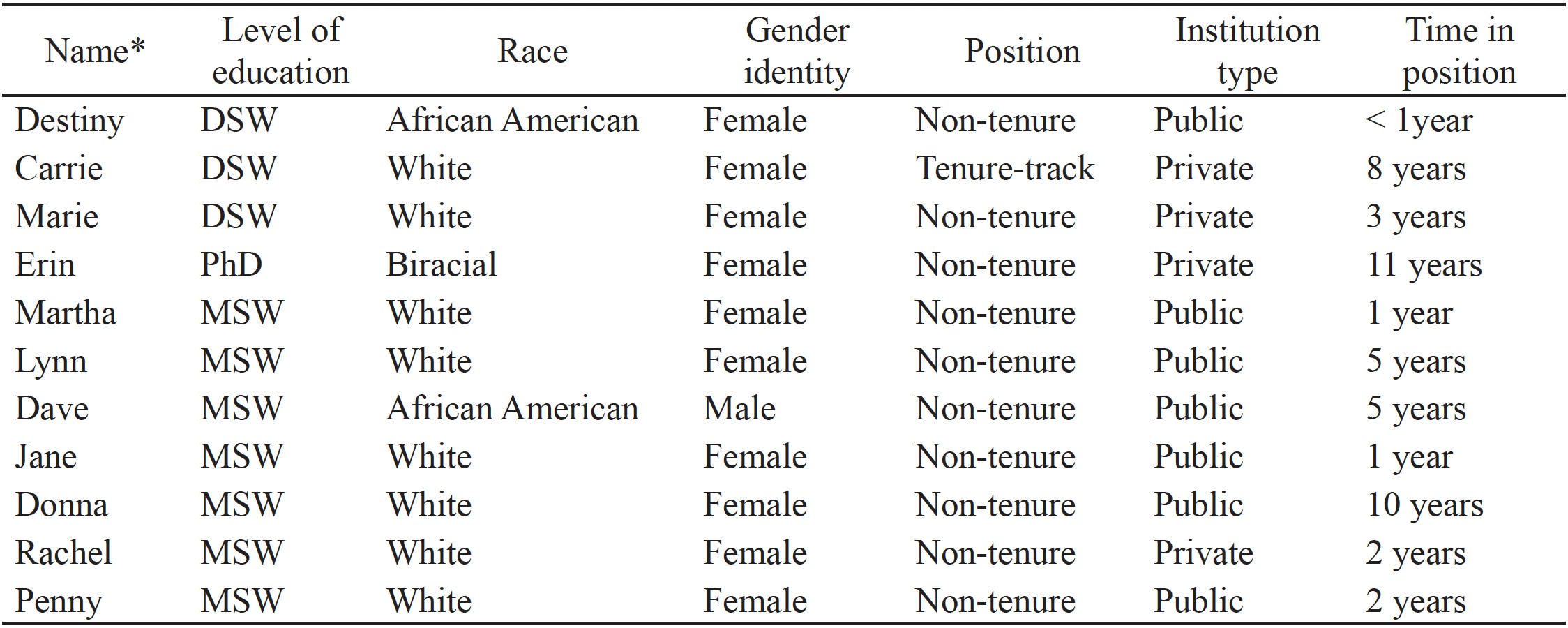
*Pseudonyms assigned to participants
Data Collection and Analysis
Data were collected in a series of one-time, recorded Zoom interviews. Interviews began in November 2023 and concluded in February 2024. Participants engaged in a 12-question semistructured interview. Interview questions and relevant probes were constructed by the author, and a pilot test of the interview guide was conducted prior to the interviews. Participants were asked demographic, program, and institutional information questions. Other questions asked how student internship placements occur and how agency and supervisors are initially assessed relating to their commitment to, and practices of, ADEI, as well as any existing ongoing efforts. Participants were asked whether students were ever dismissed from, or removed, due to ADEI concerns at their internship. Finally, participants were asked to provide a general assessment of the internship agencies and supervisors with whom their program partnered regarding ADEI practices. Interviews were conducted in a private setting to ensure confidentiality; interview time averaged 43 minutes (the shortest was 35 minutes; the longest, 57 minutes). Interviews were transcribed, and member-checking occurred to ensure accuracy and resonance.
Thematic analysis (Braun & Clarke, 2006, 2019) was used to analyze the qualitative data. Each interview was transcribed using the Zoom transcription feature and pseudonyms were assigned to participants. The author listened to each recording and corrected discrepancies in the transcript. Repeated rounds of reading the transcripts occurred, and during this process notes were made to document the initial codes generated as well as observations and trends (Padgett, 2017). An open coding system was utilized to organize, collate, and sort content into potential themes. The generated codes were derived from the data themselves, rather than from a specific theoretical underpinning (Braun & Clarke, 2006). Generated themes were meaning-based concepts, and direct quotations from the data were grouped under thematic headings to illustrate each theme in the participants’ own words (Braun & Clark, 2019). Throughout this iterative process, the author utilized peer debriefing, journaling, and the creation of an audit trail of the codes generated and decisions made throughout the analysis. This process considered issues of trustworthiness, credibility, and reliability through the use of peer debriefing, member-checking, thorough rereading of the transcribed interviews, and reflexive journaling (Boyatzis, 1998; Braun & Clarke, 2006; O’Connor & Joffe, 2020; Padgett, 2017).
Findings
All participants reported significant concerns related to collecting data on ADEI within practicum education. While all participants expressed a commitment to assessing and collecting this data, none had an established or standardized process. Furthermore, participants expressed various degrees of comfort in addressing ADEI topics with students, practicum faculty, and placement agencies.
After collecting and analyzing the data, three themes emerged. These included a lack of cohesive ADEI collection and assessment strategies, the prevalence of discrimination within practicum placements, and the sociopolitical complexities associated with ADEI. Each theme was present in all interviews and mentioned multiple times, with various examples provided below.
Theme 1: Lack of Cohesive ADEI Collection and Assessment Strategies
The 2022 EPAS intentionally prioritizes ADEI, which extends to the agencies’ practicum education partners for student internship experiences (CSWE, 2022). Prior to this focus on ADEI, the 2015 EPAS required students to demonstrate competence in engaging diversity and difference in practice, as well as in advancing human rights and social, economic, and environmental justice (CSWE, 2015). Despite the previous need to collect data on diversity-related areas, and current ADEI practices, none of the participants reported having formalized programmatic tools or resources to measure ADEI practices within agencies.
Martha indicated, “I don’t have a formal way of assessing agencies, I just know a lot of agencies and the work they do.” Carrie affirmed this sentiment, sharing, “I have nothing to measure it [ADEI] on paper but I trust the work agencies are doing.” Destiny indicated that she is employed at a Historically Black College and University (HBCU) and as such there are no assessment tools because “Most of the supervisors and agencies are filled with Black women. So, there are no formal or explicit ADEI practices, it’s just who they are.” While some participants expressed trust in the work agencies were doing related to ADEI, one participant shared that collecting data was a newer phenomenon. Rachel stated, “We really haven’t measured things related to diversity before and ADEI was not really on my radar until recently.”
In response to the need to collect data, participants shared a variety of ways in which they are attempting to achieve this. Some participants indicated they have updated the guide that liaisons use when completing site visits to reflect ADEI-focused questions; however, this has produced inadequate data. Dave shared, “The problem is the liaisons are not asking these questions because they are afraid someone will become uncomfortable.” Donna further indicated, “We want liaisons to ask these questions [related to ADEI] but many do not. They just don’t want to say the words.” Other participants reported a focus on student feedback to supply assessment data on ADEI. Erin shared,
We ask students a question, just before they graduate, to give us input specifically on ADEI in the placement…so it is at least on our final survey. I just don’t know what we do with the data once we get the answers.
Other participants shared that they take initiative to explore agency data relating to ADEI. Penny shared she asked her graduate assistant to “look at agency websites and see if they have a robust, forward-facing DEI statement.” Other participants shared that they review the partner agency’s website to gather information on their mission, values, and any noted ADEI content. Jane summarized a sentiment that resonated in many of the interviews, indicating, “We have agencies say they are committed to ADEI practices but I am just not sure how far along they are in implementing it into their daily work.” While many participants shared that they had good working relationships with agencies and trust the work many are doing as it relates to ADEI, there is a clear lack of formalized assessment tools to gather this critical data, and no processes in place to utilize meaningfully any information collected.
Theme 2: Prevalence of Discrimination Within Practicum Placements
Despite the profession’s commitment to antioppressive and antiracist practice, all participants reported students encountering various forms of overt and covert discrimination within their internships. Penny asserted, “At one agency, Black students were asked to do custodial work as opposed to White students, who were given more opportunities to interact with the clients and meet the public.” Jane indicated a student of color was placed at a jail-based program to help women as they reenter the community. The student “worked with these women but noticed that the program administrator would always deny Black women from accessing services. When she complained, she was labeled a problem student who over-identified with the population being served.” Donna shared that a student of color who was placed at a medical facility engaged in a training centered on recognizing signs of abuse. The student inquired why trainees were only shown pictures of White skin, and indicated that a bruise would look different on brown skin. Donna reported, “Well, that wasn’t welcomed feedback and the agency became defensive. They labeled her the angry Black woman and ultimately terminated her due to performance concerns. I am not sure what those were though.” Rachel affirmed this, indicating, “We are seeing a disproportionate number of students of color deemed as having issues with professionalism. What does that mean? This is such coded language. It is just steeped in White supremacy and lacks specificity.” In another example, Dave recalled meeting with a prospective agency partner. The agency told him they were “looking for a very specific type of student. When I dug further the agency supervisor was clear. He wanted an attractive, young, White woman, preferably with lighter hair, because that would be the face of the agency.”
Participants also shared that agencies discriminated against students based on their sexual orientation or identity. Lynn indicated, “A student placed in a rural community was asked to train staff on LGBTQ issues since they are gay. The agency had no insight and didn’t understand that it wasn’t the student’s job to do this.” Donna shared her experience working with an after-school, faith-based program run by a pastor. She stated a student interviewed for an internship and disclosed their gender identity. The pastor reportedly told the student, “That it is not what God would want and then proceeded to talk about LGBTQ folks in a negative way.” Another participant, Rachel, reported that a student felt uncomfortable about how the agency talked regarding their disability. Rachel indicated, “They did not recognize the privacy and confidentiality around this and shared the student’s disability with clients and colleagues.”
Despite these issues, few students were removed from placements, and none of the participants indicated they addressed these concerns directly with the agency. Rachel recalled that a student of color was placed in a predominately White, conservative, suburban school. “Everyone was super rude and made racist comments. She just suffered through the internship. I never placed another student there but I didn’t remove her.” Erin shared she had students express concerns regarding racism, microaggressions, and overall struggles, indicating,
When students share concerns about field instructors, I tell them that this is the reality of what they are going to work with. They will have to work with people they don’t get along with. They don’t have to agree with their values but I am not going to move students. If anything, I just won’t place there again. This is the real world, sometimes things will go well and sometimes they don’t.
Overall, participants shared that students experience discrimination for a variety of reasons and while all were empathic, few removed students or outwardly confronted these behaviors. Instead, many opted to decline future student placements at those agencies.
Theme 3: Sociopolitical Complexities Associated with ADEI
Participants acknowledged the tensions, and often conflicting stances on ADEI, within their departments and the local social work agencies with whom they partner for internship placements. Participants highlighted these tensions through the lens of religion, political ideology, and geographic location. Erin stated, “We’ve had some faith-based agencies say that they are open to working with anybody but are not really open in terms of working with LGBT clients or students.” To counter this, Erin reported asking “more targeted questions when exploring partnerships with faith-based agencies.” Donna affirmed this sentiment indicating, “We have had students request placement changes because of how the agency talks about gender or sexual identity, particularly in faith-based organizations.” Jane recalled a difficult conversation she had with a local domestic violence agency after they interviewed a trans female student. Jane shared that the agency did not accept the student, stating, “We can’t have somebody like that here. We are a gun-toting, Bible-thumping community and can’t have somebody like that around the children.” Jane reported when hearing this she was “shocked. I didn’t even know what to do with this information. I couldn’t believe a social worker was saying this to me. I was stunned.”
Several participants shared challenges placing students in rural communities. Dave noted,
Working with our local school has been hard. They are in a Republican area and the general view in the county is not supportive of ADEI or policies that are designed to increase access for marginalized and oppressed populations. So, for some students of color, they feel the setting is inhospitable.
Carrie reported, “We live in a red state, so most agencies and people I work with are really conservative and don’t believe ADEI even exists.” Overall, participants shared that factors related to religion, community political affiliations, and geographic location impact student experience regarding ADEI.
Discussion
Findings suggest that practicum directors recognize the importance of ADEI, yet significant work remains to align practice and accreditation requirements with practicum education. Despite participants knowing the 2022 EPAS requirements related to ADEI, none reported mechanisms to collect and assess meaningful data related to the requirements within the internship experience. This finding is consistent with the literature indicating that practicum offices do not adequately collect data related to ADEI within agency and student internship experiences (Cox & Singh, 2025; Keeney et al., 2024; Kennett & Robinson-Dooley, 2023; Lanzier et al., 2025).
There are multiple opportunities within practicum education for collecting and assessing data related to ADEI, including during the initial and ongoing partnership discussions with agencies; while researching agencies more broadly (i.e., reviewing website material, agency mission and vision statements, and supervisor resumes and licensure history); at site visits where student interns, liaisons, and agency supervisors are present; throughout various seminar assignments and class discussions; and during a midterm and end-of-semester placement evaluation completed by the student. While the focus should be on the overall internship experience, direct questions must be asked regarding student observations and experiences related to ADEI.
Of equal importance is the need to analyze the data and make meaningful changes within the practicum education curriculum and overall internship experience. There is limited literature on ADEI assessment tools and their overall reliability and consistency as well as their widespread accessibility for use within bachelor’s, master’s, and doctoral programs (Grady et al., 2018; Krase et al., 2026; Murphy et al., 2024). There is also a lack of literature on meaningful ways to analyze and respond to data related to ADEI. These are significant gaps within the current research and warrant more focus.
Findings also suggest that while practicum directors were supportive of ADEI principles and antioppressive practices, participants shared that students of color and those within the LGBTQ+ community experienced various levels of microaggression, discrimination, oppression, and marginalization throughout their internship experience. This is consistent with literature indicating students of color (Gooding & Mehrotra, 2021; Lanzier et al., 2025; Mehrotra & Gooding, 2023) and those within the LGBTQ+ community (Mehrotra et al., 2024; Messinger et al., 2020; Shelton et al., 2023) experience blatant discrimination, feelings of invisibility, tokenization, othering, and microaggression. Despite practicum directors recognizing the inherent harm and misalignment with our profession’s code of ethics, most did not address the issues students encountered with supervisors or agencies directly. Rather, practicum directors indicated they would avoid placing students at those agencies in the future.
While it is important to safeguard future students, this does nothing to address the impact these behaviors have on current students. It is imperative that practicum directors take steps to appropriately respond to, and support, students, if issues related to ADEI occur within the internship. Listening to and validating concerns, honoring the students lived experience, seeking feedback from students, and exploring possible outcomes (including discussing concerns with the sites and ultimately replacing students if warranted) are appropriate responses. While replacing students and terminating relationships with agency partners are difficult, practicum directors must prioritize student well-being and act according to the profession’s core values and ethical code.
Instances of inaction when confronted with practicum ADEI-related concerns should be viewed as perpetuating systems of oppression and marginalization, and are misaligned with the profession’s core values and antiracist practices (Davis & Mirick, 2022). Practicum directors must engage in uncomfortable conversations aimed at addressing discrimination within practicum placements. Unfortunately, instances of institutional and environmental microaggressions are well documented in the literature (Cox & Singh, 2025; Davis & Mirick, 2022; Gooding & Mehrotra, 2021). As such, it is critical that practicum directors focus on challenging antiracist and antioppressive practices, as well as sharing these expectations with practicum-connected faculty and agency supervisors. Research suggests that many faculty and agency supervisors do not adequately understand the prevalence of White supremacy (Gooding & Mehrotra, 2021) and often avoid discussing diversity, racism, and ADEI concepts (Graham et al., 2025). These are not inherent skills and thus must be openly discussed and explored, recognizing that this requires a lifelong commitment (Kennett & Robinson-Dooley, 2023). Regular trainings focused on topics related to ADEI, race, microaggressions, and antioppressive practices and supervision should be required for students, practicum faculty, and agency supervisors.
Additionally, practicum directors must review current policies using a social justice lens that prioritizes students’ lived experiences (Cox & Singh, 2025). Practicum offices should have clear policies and processes in place to address discrimination, racism, and other forms of marginalization within internship experiences. These efforts must be consistently applied, and supported, by practicum faculty, the department, and the broader institution. Additionally, CSWE should provide guidance and support to programs regarding ADEI expectations, and establish best practices for partnering with agencies for internship experiences.
Finally, practicum directors reported that complex sociopolitical factors impacted internship placements and agency partnerships. Practicum directors indicated that students experienced more frequent instances of discrimination, marginalization, and racism in rural geographic locations, in conservative areas, and in faith-based organizations. These findings should be approached cautiously, as anti-DEI sentiments, practices, and policies can occur in any professional location and setting. However, these findings should be viewed as opportunities for practicum directors to engage in candid conversations with agencies situated in rural and conservative-leaning geographic areas, as well as in faith-based organizations, to assess their commitment to upholding the profession’s core values and expectations of antiracist and antioppressive practices.
Implications for Social Work Education
The designation of practicum education as the signature pedagogy of social work education cannot be overstated and has been repeatedly reaffirmed and discussed within the literature. Practicum is viewed as a critical, and often the most significant, aspect of social work education; where theory, knowledge, and skills all are applied. Practicum often comprises one-fourth or more of the credits within the social work major. Therefore, it is imperative that ADEI is amplified within the practicum education curriculum as well as reflected in the values and practices of partner agencies. Social work students must be prepared to engage with a diverse clientele and practicum directors must recruit, and retain, agencies that truly embody ADEI principles and antioppressive practices.
It is equally vital that practicum offices begin to collect and assess in a meaningful way DEI data related to the partner agencies and supervisors involved with internship experiences. Capturing internship experiences from the students’ perspective is equally important. Finally, it is imperative that practicum offices develop, and consistently implement, policies and practices that prioritize student well-being and support during internship. Practicum offices must ensure the agencies with whom they partner provide students with a robust internship experience, and terminate partnerships that perpetuate microaggressions, racism, and discrimination, or institute anti-ADEI policies.
Strengths and Limitations
Practicum directors were able to share their experiences; however, as this data were collected several years ago, not all programs had fully transitioned to the 2022 EPAS. Thus, varying degrees of familiarity and practical experience were present related to integrating ADEI within the signature pedagogy of social work education. Additionally, political challenges, geographic location, and practicum-related stressors may have impacted what participants shared. As with any practice-close research, inherent strengths and potential limitations exist (Baumbusch, 2010; Lykkeslet & Gjengedal, 2007; Wyse et al., 2018). Being employed within higher education and serving in the role of practicum director allows the author to understand the structure and expectations of practicum. The author’s role lends credibility and a level of competence to the research, as well as an ability to engage in relationships with other practicum directors. However, challenges related to preconceived thoughts and potential practice experiences leading to a biased understanding of the stories shared were issues the researcher was mindful of.
This study adds to the existing body of literature, and its findings warrant further exploration to understand how information related to ADEI is currently being assessed and analyzed, particularly in light of the devaluing of ADEI principles and weaponizing of anti-DEI legislation within the second Trump administration, and the subsequent punitive state and local mandates on this topic. There is a relatively limited number of responses (N = 11) despite two forms of sampling. Therefore, findings may not be representative of all practicum directors. Membership in several of the listservs where recruitment invitations were distributed is open to all faculty regardless of title. While many members do hold the title of practicum director, the exact number is unknown, and thus the sample size is difficult to ascertain. As this study asked participants to self-report their experiences and thoughts related to ADEI within practicum, potential participant bias or social desirability issues may be present (Morgado et al., 2018). Participants self-reported their attitudes; therefore, results were representative of the sample but cannot be generalized to settings and populations beyond the responses obtained.
Future Research
As ADEI continues to be a focus and accreditation requirement of our profession, it is incumbent on practicum directors to collect and assess data related to it in a meaningful way within the agencies with whom we partner to train the next generation of social workers. This should be done in a systematic and intentional manner that allows for an honest assessment of strengths and opportunities for improvement. It is equally important to develop best practices and evidence-based tools for assessing the commitment to, and practices of, ADEI within partner agencies. Further research is warranted to capture the experiences of students of color within practicum education, as well as to understand how best to support students who experience racism, microaggression, or discrimination within internships. Finally, as anti-DEI sentiments and legislative mandates continue across the nation, it is critical to understand how this situation impacts social work education and practicum education. It is critical that social work educators use our collective voices to challenge systemic oppression and the assault on our profession’s core values.
References
Apgar, D., Luquet, W., Davis, C., & Black, P. (2025). Renaming “field” in social work education: Necessary but not sufficient for promoting antiracist education. Journal of Social Work Education, 61(4), 569–578. https://doi.org/10.1080/10437797.2025.2528826
Baumbusch, J. (2010). Semi-structured interviewing in practice-close research. Journal for Specialists in Pediatric Nursing, 15(3), 255–258. https://doi.org/10.1111/j.1744-6155.2010.00243.x
Boyatzis, R. (1998). Transforming qualitative information: Thematic analysis and coding development. SAGE.
Braun, V., & Clarke, V. (2006). Using thematic analysis in psychology. Qualitative Research in Psychology, 32(2), 77–101. https://doi.org/10.1191/1478088706qp063oa
Braun, V., & Clarke, V. (2019). Reflecting on reflexive thematic analysis. Qualitative Research in Sport, Exercise and Health, 11(4), 589–597. https://doi.org/10.1080/2159676X.2019.1628806
Butina, M. (2015). A narrative approach to qualitative inquiry. Clinical Laboratory Science, 28(3), 190–196.https://doi.org/10.29074/ascls.28.3.190
Copeland, P., & Ross, A. (2021). Assessing antiracism as a learning outcome in social work education: A systematic review. Advances in Social Work, 21(2/3), 766–778. https://doi.org/10.18060/24139
Council on Social Work Education (1994). The accreditation standards and self-study guides. https://tinyurl.com/3ty3jptn
Council on Social Work Education (2001). Educational policy and accreditation standards. https://www.cswe.org/sites/default/files/2026-07/2001_EPAS.pdf
Council on Social Work Education (2008). 2008 educational policy and accreditation standards for baccalaureate and master’s social work programs. https://www.cswe.org/sites/default/files/2026-07/2008_EPAS.pdf
Council on Social Work Education (2015). 2015 educational policy and accreditation standards for baccalaureate and master’s social work programs. https://www.cswe.org/sites/default/files/2026-07/2015_EPAS.pdf
Council on Social Work Education (2022). 2022 educational policy and accreditation standards for baccalaureate and master’s social work programs. https://www.cswe.org/sites/default/files/2026-07/2022_EPAS.pdf
Cox, T. L., & Singh, M. I. (2025). Infusing social justice into the signature pedagogy: A decision-making model emphasizing anti-racism, diversity, equity, and inclusion (ADEI) in social work practice. Journal of Ethnic and Cultural Diversity in Social Work, 34(5-6), 295–306. https://doi.org/10.1080/15313204.2024.2305960
Davis, A., & Mirick, R. G. (2022). Microaggressions in social work education: Learning from BSW students’ experiences. Journal of Social Work Education, 58(3), 431–448. https://doi.org/10.1080/10437797.2021.1885542
Gooding, A., & Mehrotra, G. R. (2021). Interrupting White supremacy in field education: Experiences of microaggressions in placement settings. Advances in Social Work, 21(2/3), 311–330. https://doi.org/10.18060/24095
Grady, M. D., Swick, D. C., & Powers, J. D. (2018). The implicit curriculum survey: An examination of the psychometric properties. Journal Social Work Education, 54(2), 261–269. https://doi.org/10.1080/10437797.2017.1404527
Graham, W. K., Pizzo, M., & Amin, S. (2025). Teaching note—Practice behaviors for the 2022 EPAS’ practicum education using an ADEI framework. Journal of Social Work Education, 1-9. https://doi.org/10.1080/10437797.2025.2607446
Keeney, A. J., Willner, L., Ebor, M., Dunkerley, S., Ingold, S., Lee, A., Min, J. W., & Urada, L. (2024). Anti-racism, diversity, equity, and inclusion perspectives across the explicit curriculum: Insights and efforts from a school of social work. Journal of Teaching in Social Work, 44(4), 423–440. https://doi.org/10.1080/08841233.2024.2374236
Kennett, N., & Robinson-Dooley, V. (2023). Field education: What field internship experiences influence perceived level of cultural competence among graduating MSW students. Field Educator, 13(2). https://tinyurl.com/e29m6ztv
Krase, K. S., Hamilton, T. D., Meza, J., Harmon, D. K., & Sullivan, D. (2026). Creating a standardized instrument to assess ADEI efforts in social work programs. Research on Social Work Practice, 36(1), 102–111. https://doi.org/10.1177/10497315241303020
Lanzier, N., Dempsey, A., Malhotra, J., & Asakura, K. (2025). Preparing students for ADEI praxis: A case study of a practicum preparatory lab. Social Work Education, 44(7), 1785–1798. https://doi.org/10.1080/02615479.2024.2431225
Lykkeslet, E., & Gjengedal, E. (2007). Methodological problems associated with practice-close research. Qualitative Health Research, 17(5), 699–704. https://doi.org/10.1177/1049732307299216
Mehrotra, G. R., & Gooding, A. R. (2023). What contributes to meaningful experiences in social work field education?: Perspectives of students of color. Journal of Social Work Education, 59(3), 790–802. https://doi.org/10.1080/10437797.2022.2033658
Mehrotra, G. R., Hudson, K. D., & Hess, E. (2024). Exploring the intersections of LBGTQ experiences and social work education: A scoping review. Social Work Education, 43(7), 2076–2095. https://doi.org/10.1080/02615479.2023.2239267
Messinger, L., Natale, A. P., Dentato, M. P., & Craig, S. L. (2020). Conflict in field: LGBTQ social work students’ stories of identity management, discrimination, and practice. Journal of Social Work Education, 56(4), 708–720. https://doi.org/10.1080/10437797.2019.1661912
Morgado, F. F. R., Meireles, J. F. F., Neves, C. M., Amaral, A. C. S., & Ferreira, M. E. C. (2018). Scale development: Ten main limitations and recommendations to improve future research practices. Psicologia: Reflexão e Crĭtica, 30(3). https://doi.org/10.1186/s41155-016-0057-1
Murphy, A. L., Conner, L. R., Weiler, A., Anthony, B., Jewell, J. R., & Venable, V. (2024). Social work education anti-racism (SWEAR) scale. Journal of Social Work Education, 60(1), 4–13. https://doi.org/10.1080/10437797.2023.2248212
O’Connor, C., & Joffe, H. (2020). Intercoder reliability in qualitative research: Debates and practical guidelines. International Journal of Qualitative Methods, 19, 1–13. https://doi.org/10.1177/1609406919899220
Padgett, D. (2017). Qualitative methods in social work research. SAGE Publications, Inc.
Rubin, A., & Babbie, E. (2016). Research methods for social work. Thompson Brooks/Cole.
Shelton, J., Dodd, SJ., Borgan, J., San Emeterio, G., & Wilhelm, A. R. (2023). A descriptive account of the practicum experiences of trans and nonbinary social work students. Journal of Sociology &; Social Welfare, 50(1). https://doi.org/10.15453/0191-5096.4689
Wyse, D., Brown, C., Oliver, S., & Poblete, X. (2018). The BERA close-to-practice research project: Research Report. British Educational Research Association. https://tinyurl.com/t8w48f67