Abstract
This article presents the results of a qualitative study that explored the benefits of fieldwork placements in social work education. The study population consisted of fourth-year undergraduate social work students at Women’s University in Africa who had completed fieldwork placements. Purposeful sampling was used to select ten participants. Data were collected using semistructured interviews and analyzed using thematic analysis. The notable benefits of fieldwork placements in social work and development include skills development, bridging theory and practice, networking, professional identity formation, and exposure to diverse cultures. This study provides empirical evidence on the benefits of fieldwork placements in social work.
Keywords: fieldwork placements, social work education, students, benefits, Women’s University in Africa.
Background
Fieldwork placements are the backbone of social work education. Social work training consists of both theoretical and field-based components. Fieldwork placements are an important component of social work education, and have been embraced by social work training institutions. Such placements equip social work students with practical experience, enabling them to apply theoretical concepts to real-world social work challenges (Dhemba, 2012). Budeli (2021) asserted that fieldwork placements strengthen community capacity to address social issues and promote positive social change, ultimately contributing to sustainable social development.
Fieldwork is also known as field learning, field instruction, field practicum, or field education (Drolet et al., 2023). Fieldwork placements in social work education have been defined as practical experience in a social welfare or development agency that has been organized for education of students who intend to become social workers (Tippa & Mane, 2018). Dias and Yesudhas (2021) asserted that fieldwork placements enable social work students to improve specific skills essential in social work and development practice. Kaseke (1986) affirmed that fieldwork placements are a mechanism of socialization, since they prepare students for future roles as social work practitioners. Thus, fieldwork placements are an important component of social work education.
Social work practitioners and scholars have studied and recognized the significant influence that fieldwork placements have on social work students’ capabilities (Dias & Yesudhas, 2021; Eltaiba & Ndoye, 2018). Fieldwork placements provide an opportunity for social work students to integrate theory and practice (Eltaiba & Ndoye, 2018). They also provide students with the opportunity to take responsibility for eradicating community problems. Fieldwork placements aim to provide social work students with experience and exposure to social welfare provision and the functioning of social development and welfare agencies (Dhemba, 2012).
The prominent role of fieldwork placements in social work education has generated scholarly attention to studying their contribution in ensuring program quality (Eltaiba & Ndoye, 2018); their issues and challenges (Dhemba, 2012; Drolet et al., 2023; Machinako & Muridzo, 2015); their problems and prospects (Tippa & Mane, 2018); and their meaning and value (Ketner et al., 2017). However, little has been written about the benefits of fieldwork placements in social work education from the perspectives of students.
The study aimed to explore the benefits of fieldwork placements in social work education. Understanding the benefits of fieldwork placements may inform social work training institutions, social development and welfare agencies, and the Council of Social Workers in Zimbabwe on the current state of social work fieldwork in Zimbabwe, and this may assist in designing a fieldwork regulatory framework. Thus, it is thought-provoking to explore the benefits of fieldwork placements in social work education from the perspective of undergraduate fourth-year social work students at Women’s University in Africa.
Literature Review
Nyathi (2025, 2026) found that there is a dearth of recent literature on fieldwork placements in Zimbabwe. However, in western countries there is a plethora of literature on fieldwork placements, such as studies conducted by Drolet et al. (2023) and Ketner et al. (2017). Thus, there is potential to explore the benefits of fieldwork in social work education in a Zimbabwean context.
Skills development is the major benefit of fieldwork placements in social work education. Dhemba (2012) stated that fieldwork placements enable social work students to gain skills that will empower them to respond accurately to clients’ needs. Eltaiba and Ndoye (2018) asserted that fieldwork placements allow social work students to develop skills that are not formally taught in the classroom, and stated further that fieldwork placements enable social work students to develop and apply interpersonal and communication skills that are essential in social work practice. Therefore, fieldwork placements are beneficial to social work students as they allow them to develop important skills.
Fieldwork placements enable students to integrate theory and practice. Eltaiba and Ndoye (2018) asserted that fieldwork placements provide social work students with the opportunity to link social work theory to practice, and stated further that they motivate social work students to observe professional social workers and think critically about which plans from their social work theoretical knowledge could be applicable, thus allowing them to develop stronger linkages between theory and social work practice. Dhemba (2012) asserted that fieldwork placements are an opportunity for aligning theoretical knowledge with the needs of the community, and further argued that fieldwork placements afford social work students the opportunity to take responsibility for addressing societal problems. Thus, fieldwork placements are beneficial to social work education as they enable students to link theory and practice.
Fieldwork placements expose social work students to diverse cultures. Eltaiba and Ndoye (2018) stated that fieldwork placements provide social work students with the opportunity to work with people from different cultures, and further asserted that fieldwork placements allow students to observe diverse applications related to social work and culture, such as the relationship between factors such as clients’ backgrounds and culture. These authors further elaborated that students’ exposure to diverse cultural backgrounds allows them to explore the concept of diversity in social work practice, and it is essential for social work practitioners to be culturally competent. Therefore, fieldwork placements are beneficial to social work students as they expose them to diverse cultures, enabling them to be competent in differentiated social work service delivery.
The other benefit of fieldwork placements in social work education is professional identity formation. Kaseke (1986) stated that fieldwork placements are a tool of socialization because they prepare social work students for the forthcoming role of social worker. Dhemba (2012) asserted that fieldwork is an instrument that is used to initiate social work students into the social work and development profession through assimilation of social work and development values, principles, and ethics. Thus, fieldwork placements are beneficial since they prepare social work students to be effective social workers.
Fieldwork placements assist student social workers in building a professional network. Community, school, and social development and welfare agency contacts that students make during fieldwork can assist them as they prepare for the social work profession. These contacts might include agency supervisors who can be a supplementary source of information about social work as a profession (Regis College, n.d.). Therefore, fieldwork placements enable social work students to network with practitioners in the social work community.
Despite the notable benefits of fieldwork placements in social work education and development, such placements face numerous challenges that compromise the quality of social work education. A study by Dhemba (2012) in southern and eastern Africa revealed that in Zimbabwe, approximately half of social work students were supervised by non–social workers due to the mass exodus of social workers to developed counties such as Australia, the United Kingdom, and the United States. Dhemba (2012) also noted that social work students in Zimbabwe had challenges in securing agencies for fieldwork placements due to stiff competition with students from other universities offering social science programs. A study by Muchinako and Muridzo (2015) at the University of Zimbabwe found that social work students received inadequate supervision due to delays in university supervision visits, which could have provided guidance and mentorship to students if conducted earlier. Muchinako and Muridzo (2015) also revealed that social work students had difficulties in securing fieldwork placements due to competition with social work students from other universities.
A study conducted by Drolet et al. (2023) revealed that, even in a developed country like Canada, students encounter challenges such as lack of preparation, support, and training. In South Africa, Shokane et al. (2016) found that students experienced challenges such as lack of guidance and financial support, transportation and logistics issues, and lack of motivation and support during fieldwork placements. It is evident that social work students from both developed and developing countries face challenges during their fieldwork placements, compromising the quality of social work education.
Theoretical Framework
The study embraced experiential learning theory, propounded by Kolb in 1984, which serves as a foundation for this study on the benefits of fieldwork placements in social work education. This theory states that a cyclical process of concrete experience, reflective observation, abstract conceptualization, and active experimentation leads to effective learning. Fieldwork placements provide social work students with concrete practical experience in real-world social work settings, enabling them to reflect critically on social work practice, develop professional social work competencies, and apply social work theoretical knowledge (Woli, 2025).
Experiential learning is learning by experience. Learning during fieldwork placements is essential, as it provides social work students with motivation to go beyond learning classroom theory. Students are expected to link social work theory with practice. Experiential learning theory provides the social work education community with a robust framework for understanding how fieldwork placements accelerate the integration of social work theory and practice, stimulating professional social work competency and critical thinking in student social workers (Schmidt & Rautenbach, 2015).
Methodology
Study Design
This study used a qualitative research design. Qualitative research design was most appropriate in this study because the research was aimed to be an in-depth exploration of the benefits of fieldwork placements in social work. Lim (2024) indicated that a qualitative research design is important because it generates rich insights for understanding the world. In this study, a qualitative research design was used to gain insights into students’ perspectives about the benefits of fieldwork placements in social work.
Description of Participants
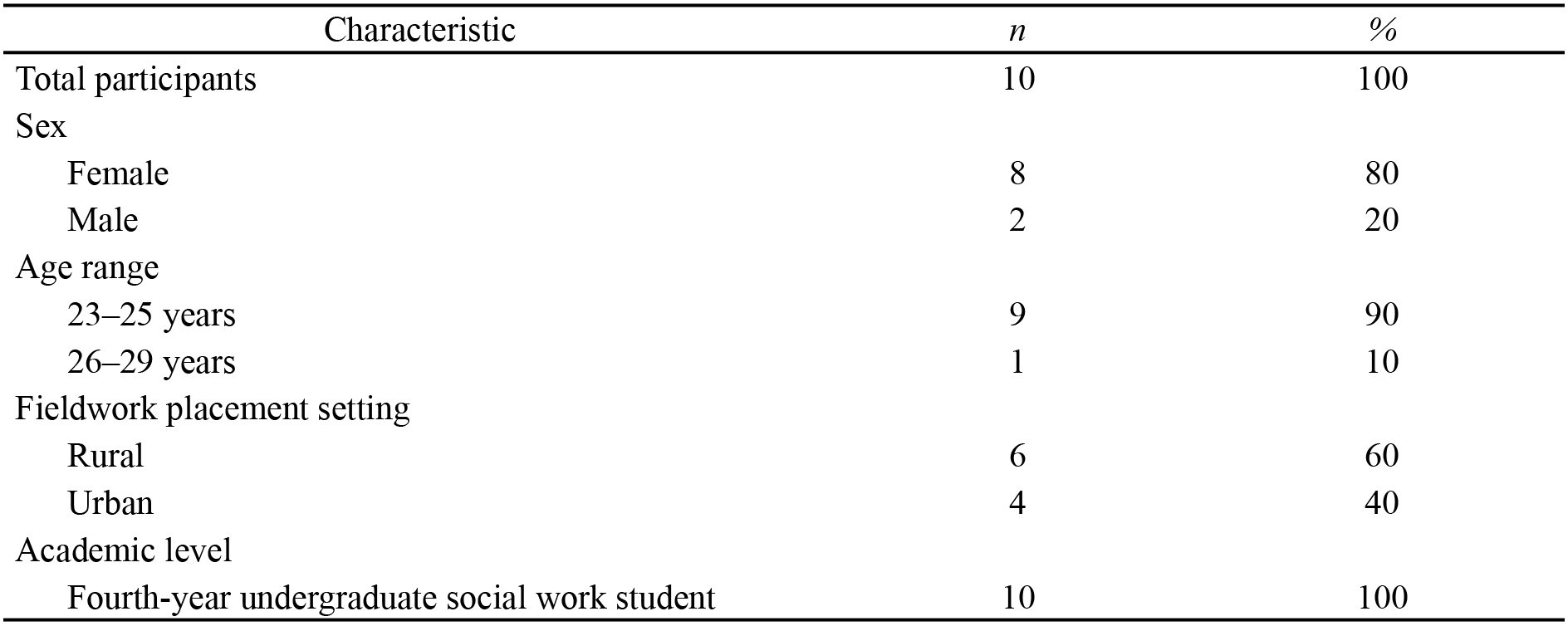
The study sample comprised ten fourth-year undergraduate social work students from Women’s University in Africa, Bulawayo campus. As shown in Table 1, the majority of participants were female and aged 23–25 years. Most students completed their fieldwork placement in rural settings.
Table 1
Sample Characteristics of Participants
Data Collection Methods
Data were collected using semistructured interviews. Kolb’s experiential learning theory was used to develop the interview guide (Kolb, 1984). Accordingly, interview questions were designed to elicit participants’ direct fieldwork experiences, their reflections on those experiences, the meanings they derived, and their thoughts on how these insights informed subsequent practice decisions. Interviews lasted 30 to 40 minutes and were audio recorded with informed consent. Ten participants were interviewed individually. Questions prompted participants to describe fieldwork benefits, reflect on them, articulate learning, and explain their application to social work practice. The interview guide ensured that the researcher covered all relevant topics and facilitated deeper insights into the benefits of fieldwork placements through probing. It also encouraged detailed information from students about the benefits of fieldwork placements in social work. The primary interview question was: “What did you benefit from your fieldwork placement?” This was followed by probes such as: “What skills did you gain?”; “What did you learn that you could not learn in class?”; and “Did fieldwork placement change how you see yourself as a social worker?”
Sampling Strategy
The study covered fourth-year social work undergraduate students who had completed fieldwork placements at the Bulawayo campus of the Women’s University in Africa. A total of ten social work students, representing about 17% of the population, participated in the study. The researcher strongly believes that the sample size of ten participants is adequate for this exploratory study. Vasileiou et al. (2018) argued that qualitative samples are typically small to allow for in-depth analysis.
Thematic saturation was achieved, as no new themes emerged from the interviews. Study participants were selected using purposeful sampling. Palinkas et al. (2016) indicated that purposive sampling is essential for the identification and selection of information-rich cases related to the phenomenon of interest. Purposeful sampling was most appropriate in this study because it enabled the researcher to select students who completed fieldwork practice under the supervision of an experienced and qualified social worker. Purposive sampling enabled the researcher to gather rich data on the benefits of fieldwork by selecting participants who are most relevant to this research.
Data Analysis
Data were analyzed using thematic analysis. Javadi and Zarea (2016) indicated that thematic analysis provides a flexible approach to identifying, analyzing, and reporting patterns within qualitative data. The researcher first familiarized himself with the data, then generated initial codes. The data were then grouped under each theme, and the themes were later reviewed and given names (Javadi & Zarea, 2016). This method allowed the researcher to gain students’ rich perspectives on the benefits of fieldwork in social work.
Ethical Considerations
Institutional permission to conduct this study was obtained from Women’s University in Africa, Bulawayo campus management. The researcher obtained informed consent from participants. Participation in this study was voluntary. The researcher ensured that the study did not harm participants, neither physically nor emotionally. Pseudonyms were used to maintain the anonymity of participants.
Findings
Based on the data, five themes were identified as benefits of fieldwork placements in social work education: skills development, bridging theory and practice, networking, professional identity formation, and exposure to diverse cultures. Each is discussed in the next sections.
Skills Development
The study participants described skills development as one major benefit of fieldwork placements in social work education. Participants indicated that they acquired critical assessment skills during their fieldwork practice. One student reported, “During my fieldwork placement, I learned how to conduct assessments using genograms, observations, and interviews” (Tshilidzi, female student, 25 years old). This reflects the fundamental role of fieldwork practice in developing practical competencies essential to social work practice.
Participants also indicated that they acquired report-writing skills during fieldwork placements. One student noted, “I benefited from many things during my social work attachment. In the attachment, we were thoroughly taught how to write a report. I am now very good in report writing” (Mulalo, male student, 24 years old). This shows that fieldwork placements are important in developing practical skills vital to social work practice.
Bridging Theory and Practice
The study participants identified bridging theory and practice as another benefit of fieldwork placements. The study revealed that students analyzed the root causes of gender-based violence cases using social work and development theories such as feminist theory. The following comment was shared by a student:
Sometimes we will analyze cases using social work theories. For instance, at some point we analyzed the root causes of gender-based violence cases using feminist theories and we realized that Sotho culture, which is patriarchal, contributes to violence against girls and women. In the Sotho culture, women are not supposed to question men’s authority, and they are supposed to be submissive to men. We addressed GBV through community conscientization(Shonisani, female student, 24 years old).
This study also revealed that social work students integrated social work theories when writing case reports. One student reported, “During fieldwork practice, I will interact with clients and discuss cases with my supervisor. In my report, my supervisor always encouraged me to include the theory that I applied”(Ndivhuwo, female student, 27 years old). This demonstrates that fieldwork placements are essential in integrating theory and practice.
Networking
The study participants also identified networking as a benefit of fieldwork placements in social work education. Participants revealed that fieldwork placements provided them with the opportunity to network with professionals from various government ministries, local authorities and nongovernmental organizations. A student shared the following assertion:
I was attached to the Department of Social Development, where I interacted with professionals from various ministries, including the Ministry of Youth, the Ministry of Women Affairs, the District Development Coordinator’s office, Rural District Council, the Ministry of Health, and NGOs such as the World Vision and DREAMS. This helped me to have broad exposure to developmental social work (Mpho, female student, 24 years old).
Participants also indicated that fieldwork placements provided the opportunity to share ideas with students from other tertiary institutions. One student reported, “I met students from other universities, and I was able to share ideas with them” (Mauna, female student, 22 years old). Therefore, fieldwork placements are crucial for networking with students from other institutions and staff from other agencies.
Professional Identity Formation
Participants identified professional identity formation as a benefit of fieldwork placements in social work education. The study participants reported that fieldwork placements helped them to observe social work principles and ethics. One student noted, “The attachment helped me to observe social work ethics and principles. My supervisor always encouraged me to adhere to social work ethics. In everything that I was doing, I made sure not to judge clients” (Shonisani, female student, 24 years old).
Participants also reported that fieldwork placements helped them develop a passion for the social work profession. One student reported, “The attachment made me end up in love with child protection social work because most cases that we were dealing with at [agency] were for child abuse neglect. I developed a strong passion for child protection social work” (Mulalo, male student, 24 years old). Thus, fieldwork placements play a pivotal role in shaping professional identity within social work practice.
Exposure to Diverse Cultures
Some participants identified exposure to diverse cultures as a benefit of fieldwork placements. Participants reported that fieldwork placements exposed them to different ethnic groups, which made them appreciate and respect other people’s cultures. One student noted, “I am from a Zezuru ethnic group, and I did my practical in Plumtree, which is mostly Ndebele and Kalanga ethnic groups. Working with clients from different cultures made me respect and appreciate other people’s cultures (Tendai, female student, 23 years old).
Participants also reported that interacting with clients from different cultures helped them understand other cultures, and they became more inclusive. One student reported, “I am Ndebele and I did my fieldwork practice at Gwanda District, which is predominantly Sotho, Venda, and Jawunda tribes. Interacting with clients from different cultures made me understand different cultures and be more inclusive” (Anna, female students, 26 years old). This demonstrates that fieldwork placements expose social work students to diverse cultural contexts, fostering cultural sensitivity and appreciation, leading to inclusive social work practice.
Discussion
This study provides fresh insights into the benefits of fieldwork placements in social work education, contributing to the existing body of knowledge. Five benefits of fieldwork placements are discussed in this section. In contrast, the challenges of fieldwork placements in social work education are also discussed here.
A key benefit of fieldwork placements in social work education is the formation of professional identity. Similarly, Dhemba (2012) asserted that fieldwork placements initiate social work students into the social work and development profession through assimilation of social work principles, ethics, and values. Keseke (1986) concurred that fieldwork placements are a tool that prepares social work students to become effective social work practitioners. Therefore, fieldwork placements are beneficial because they prepare social work students for future social work roles.
Another significant benefit of fieldwork placements is the opportunity to build professional networks. In the same vein, Regis College (n.d.) reported that contacts from the agency, school, or community that social work students make during fieldwork placements can support them as they prepare to be professional social workers. Thus, fieldwork placements are beneficial to social work students since they provide them with the opportunity to build a professional network that is essential in their social work career.
Skills development also emerged as a significant benefit of fieldwork placements. Similarly, Eltaiba and Ndoye (2018) asserted that during fieldwork placements, social work students develop skills that are not formally taught in lecture rooms. Dhemba (2012) concurred that fieldwork placements enable social work students to gain skills that empower them to be effective future social workers and development practitioners. Thus, fieldwork placements enable social work students to gain skills that are essential in social work practice.
Integrating theory and practice is another benefit of fieldwork placements in social work education. This aligns with Eltaiba and Ndoye’s (2018) assertion that fieldwork placements provide social work students with the opportunity to link theory and practice. Dhemba (2012) concurred that fieldwork placements are an opportunity to align theoretical knowledge with community needs. Therefore, fieldwork placements are valuable because they allow social work students to bridge theory and practice.
Exposure to diverse cultures and contexts is another significant benefit of fieldwork placements. Similarly, Eltaiba and Ndoye (2018) asserted that fieldwork placements provide social work students with opportunities to work with people from various cultural backgrounds. They further concurred that exposure to different cultures allowed them to be culturally competent and inclusive in social work practice. Budeli (2021) also found that fieldwork placements assist students to work with people from different cultures. Thus, fieldwork placements expose social work students to clients from various cultural backgrounds, hence improving their cultural competence in fieldwork practice.
On the other hand, fieldwork placement in Zimbabwe is challenging in numerous ways. Dhemba (2012) asserted that social work students often experience difficulties in securing agencies due to stiff competition from social work students from other universities, and noted as well that more than half of social work students are supervised by personnel from other social science disciplines such as sociology and psychology. Muchinako and Muridzo (2015) concurred that social work students often experience challenges in securing welfare and development agencies for fieldwork placement due to limited supply, and stated further that social work students often experience inadequate supervision, caused by delayed fieldwork placement visitation by university social work lecturers. Shokane et al. (2016) pointed out that social work students experience a lack of financial support during fieldwork placements, which hinders them from traveling to lead group sessions, make home visits, and facilitate community projects. It is essential to note that these challenges affect the quality of fieldwork placements, which compromises social work education.
Experiential learning is essential to fieldwork in social work education. It bridges a gap between social work theory and real-world social work practice. Experiential learning enables social work students to develop practical skills such as assessment and report writing, which are fundamental in social work practice. It also exposes students to diverse cultures and builds professional identity through interaction with diverse clients. Experiential learning also provides students with the opportunity to network with staff from other agencies and students from other universities. Therefore, experiential learning proves extremely beneficial for social work students, as it facilitates skills development and the integration of theory and practice, and fosters professional identity formation, networking. and culturally responsive social work practice.
The study findings closely align with Kolb’s (1984) experiential learning theory, which positions direct experience as the learning catalyst. Fieldwork placements provide an avenue for concrete experience, exposing fourth-year undergraduate social work students to real social work practice contexts. Participants demonstrated reflective observation by articulating how cultural exposure and professional networking shaped their understanding of social work. Social work students reconceptualized lecture-room knowledge in response to field realities. Finally, active experimentation emerged through skills development, as social work students applied newly formed insights and professional behaviors within professional settings. All in all, these results show that fieldwork placements are beneficial because they enable social work students to move through all four phases of Kolb’s theory.
Limitations of the Study
The study focused on one private university in Zimbabwe, which limits generalization of the results to other institutional contexts. The sole reliance on self-reported data from social work students may have introduced bias, as participants may have provided socially desirable responses. However, the researcher sought to enhance the credibility of the findings by triangulating them with recent literature.
Recommendations
The researcher recommends that social work training institutions should strengthen the capacity of social work students and agency fieldwork supervisors for cultural sensitivity in fieldwork placements. This is necessitated by the fact that social work students work with clients from varied cultural backgrounds. Cultural sensitivity in fieldwork placements will equip social work students with skills in dealing with clients from diverse cultures.
Stakeholders should ensure that social work students receive allowances during fieldwork placements to cover living expenses. The Council of Social Workers in Zimbabwe should lobby development and welfare agencies to hire qualified social workers who can effectively supervise social work students. Social work training institutions should supervise social work students in a timely manner.
The researcher also recommends that research be conducted on a large scale involving social work students, agency fieldwork supervisors, and university fieldwork coordinators, focusing on their experiences during fieldwork placements for students. The research should reach more participants from the populations of social work students, agency fieldwork supervisors, and university fieldwork coordinators. The researcher is of the opinion that various issues could be uncovered from these key stakeholders of fieldwork placements, and a detailed fieldwork plan could be developed.
Conclusion
The study reported several benefits of fieldwork placements in social work education, such as skills development, bridging theory and practice, networking, professional identity formation, and exposure to diverse cultures. The findings of this study provide valuable information on the benefits of fieldwork placements in social work and development. Results from this study can assist social work training institutions in better understanding the benefits of fieldwork placements. The theoretical implications of this study contribute to ongoing discussions about the role of fieldwork placements in social work and development, and their potential to promote positive, sustainable, and inclusive social work practice. Future studies with larger samples and more diverse participants should be conducted to examine fieldwork placements in detail.
References
Budeli, N. J. (2021). A comparative analysis of social work fieldwork supervision at the University of Venda and University of Limpopo: Implication for policy and practice guidelines [Unpublished doctoral dissertation]. University of Limpopo.
Dhemba, J. (2012). Fieldwork in social work education and training: Issues and challenges in the case of eastern and southern Africa. Social Work and Society International Online Journal, 10 (1), 1–16. https://d-nb.info/1024810879/34
Dias, L., & Yesudhas, R. (2021). Field practicum in social work education. Research and Publication Unit.
Drolet, J., Chilanga, E., Fischer, L. J., Kaushik, V., Khitiwada, K., McConnell, S. M., McKee, E., Nicholas, D., Salim, S., Sussman, T., & Walsh, C. (2023). The most significant challenges in social work field education: Perceptions of field educators and students in Canada. Field Educator, 13(2), 1–23. https://tinyurl.com/uya5n97m
Eltaiba, N., & Ndoye, A. (2018). The effectiveness of field education in social work education: A student perspective. Advances in Social Work & Welfare Education, 20(1), 170–184. https://tinyurl.com/4ya48444
Javadi, M., & Zarea, K. (2016). Understanding thematic analysis and its pitfall. Journal of Client Care, 1(1), 34–40. https://tinyurl.com/48ah6btb
Kaseke, E. (1986). The role of fieldwork in social work training. In J. Hampson & B. Willmore (Eds.), Social development and rural fieldwork: Edited proceedings of a workshop entitled Social Development, Rural Poverty, and Fieldwork Intervention. The Journal, Harare.
Ketner, M., Cooper-Bolinskey, D., & Van Cleave, D. (2017). The meaning and value of supervision in social work field education. Field Educator, 7(2), 1–18. https://tinyurl.com/y7k52vbu
Kolb, D. A. (1984). Experiential learning: Experience as the source of learning and development. Prentice-Hall.
Lim, W. M. (2024). What is qualitative research? An overview and guidelines. Australasian Marketing Journal, 33(2). https://doi.org/10.1177/14413582241264619
Muchinako, G. A., & Muridzo, N. (2015). Challenges faced by University of Zimbabwe social work students on fieldwork attachment. Researchjournali’s Journal of Sociology, 3(7), 1–12. https://researchjournali.com/view.php?id=1874
Nyathi, B. T. (2025). Enhancing social work fieldwork: Insights from the Women’s University in Africa. Social Work & Society International Online Journal, 23(2), 1–17. https://ejournals.bib.uni-wuppertal.de/sws/article/download/1667/3013
Nyathi, B. T. (2026). Beyond the classroom: Practitioner reflections on fieldwork placement models in Zimbabwe’s social work education. International Social Work. https://doi.org/10.1177/00208728261453254
Palinkas, L. A., Horwitz, S. M., Green, C. A., Wisdom, J. P., Duan, N., & Hoagwood, K. (2016). Purposeful sampling for qualitative data collection and analysis in mixed method implementation research. Administration and Policy in Mental Health, 42(5), 533–544. https://doi.org/10.1007/s10488-013-0528-y
Regis College. (n.d.). The benefits of social work field placements. Retrieved August 11, 2025, from https://online.regiscollege.edu/blog/social-work-field-placements.
Schmidt, K., & Rautenbach, J. V. (2015). Field instruction: Is the heart of social work education still beating in the Eastern Cape? Social Work/Maatskaplike Werk, 52(4), 589–610. https://doi.org/10.15270/52-4-532
Shokane, A. L., Nemutandani, V., & Budeli, J. (2016). Challenges faced by fourth year social work students during fieldwork practice at a rural-based university. AFFRIKA: Journal of Politics, Economics, and Society, 6(1), 133–163. https://tinyurl.com/d4ujvfaj
Tippa, N. G., & Mane, S. R. (2018). Problems and prospects of field work training in social work education: A review. Innovare Journal of Social Sciences, 6(1), 1–2. https://tinyurl.com/43623ad5
Vasileiou, K., Barnett, J., Thorpe, S., & Young, T. (2018). Characterising and justifying sample size sufficiency in interview-based studies: Systematic analysis of qualitative health research over a 15-year period. BMC Medical Research Methodology, 18(1), 148. https://doi.org/10.1186/s12874-018-0594-7
Woli, L. (2025). Barriers in fieldwork practice for social work students: Challenges and pathways for reform. International Research Journal of MMC, 6(5), 166–175. https://doi.org/10.3126/irjmmc.v6i5.89082